a) Ammonia gas
b) Filtration
c) $2NaHCO_3(s) \rightarrow Na_2CO_3(s) + CO_2(g) + H_2O(g)$
johnmulu answered the question on April 10, 2017 at 14:02
-
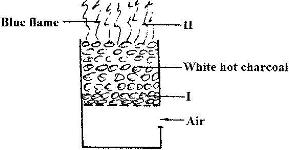
The diagram below represents a charcoal burner. Study it and answer the question that follows:
(Solved)
The diagram below represents a charcoal burner. Study it and answer the question that follows:
Date posted:
April 10, 2017
.
Answers (1)
-
A student investigated the effect of an electric current by passing it through some substances. The student used inert electrodes, and connected a bulb to the circuit. The table below shows the substances used and their states.
(Solved)
A student investigated the effect of an electric current by passing it through some substances. The student used inert electrodes, and connected a bulb to the circuit. The table below shows the substances used and their states.
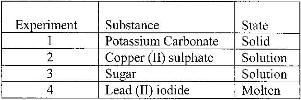
a) In which experiment did the bulb not light?
b) Explain your answer in (a) above.
Date posted:
April 10, 2017
.
Answers (1)
-
The table below gives information about elements A1, A2, A3 and A4
(Solved)
The table below gives information about elements A1, A2, A3 and A4
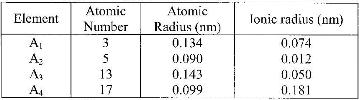
(i) In which period of the periodic table is element A2? Give a reason.
ii) Explain why the atomic radius of:
I. A1 is greater than that of A2;
II. A4 is smaller than its ionic radius.
iii) Select the element which is in the same group as A3.
Date posted:
April 10, 2017
.
Answers (1)
-
The diagram below illustrates a method of preparing salts by direct synthesis.
(Solved)
The diagram below illustrates a method of preparing salts by direct synthesis.
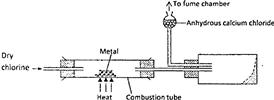
a) This method can be used to prepare either aluminium chloride or iron (III) chloride. Explain why it cannot be used to prepare sodium chloride.
b) Describe how a sample of sodium can be prepared in the laboratory by direct synthesis.
Date posted:
April 10, 2017
.
Answers (1)
-
The set-up below was used to prepare anhydrous chlorides of elements in laboratory where no fume cupboard was available. The chlorides were to be collected in flask 1.
(Solved)
The set-up below was used to prepare anhydrous chlorides of elements in laboratory where no fume cupboard was available. The chlorides were to be collected in flask 1.
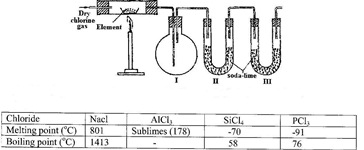
The following table shows the melting and boiling points of the chlorides that were prepared.
a) Explain why it is necessary to pass dry chlorine through the apparatus before heating each element.
b) Give two reasons why tubes II and III were filled with soda lime (solid mixture of sodium hydroxide and calcium hydroxide)
c) Explain why it would not be possible to collect any sodium chloride in flask 1
d) Name one other substance that can be used in tubes II and III
e) Write an equation for the reaction that forms phosphorous (III) chloride
f) Describe how you would separate a mixture of sodium chloride and aluminium chloride
Date posted:
April 10, 2017
.
Answers (1)
-
a) Other than their location in the atom, name two other differences between an electron and a proton.
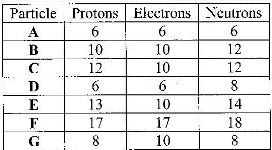
b) The table below gives the number of electrons, protons and neutrons in particles
A, B, C, D, E, F and G.
(Solved)
a) Other than their location in the atom, name two other differences between an electron and a proton.
b) The table below gives the number of electrons, protons and neutrons in particles
A, B, C, D, E, F and G.
i) Which particle is likely to be a halogen?
ii) What is the mass number of E?
iii) Write a formula of the compound formed when E combines with G.
iv) Name the type of bond formed in (iii) above.
v) How does the radii of C and E compare? Give a reason.
vi) Draw a dot (.) and cross (x) diagram for the compound formed between A and F
vii) Why would particle B not react with particle D?
Date posted:
April 10, 2017
.
Answers (1)
-
The diagram below shows the bonding between aluminium chloride and ammonia.
(Solved)
The diagram below shows the bonding between aluminium chloride and ammonia.
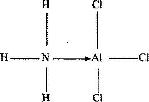
a) Name the types of bonds that exists in the molecule
b) How many electrons are used for bonding in the molecule?
Date posted:
April 10, 2017
.
Answers (1)
-
The table below gives atomic numbers of elements represented by the letters A, B, C and D.
(Solved)
The table below gives atomic numbers of elements represented by the letters A, B, C and D.

Use the information to answer the questions that follow.
a) Name the type of bonding that exists in the compound formed when A and D react.
b) Select the letter which represents the best oxidizing agent. Give a reason for your answer.
Date posted:
April 10, 2017
.
Answers (1)
-
The diagram below is a section of a model of the structure of element T.
(Solved)
The diagram below is a section of a model of the structure of element T.
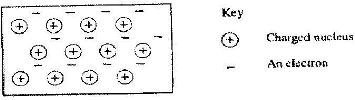
a) State the type of bonding that exists in T.
b) In which group of the periodic table does element T belong? Give a reason.
Date posted:
April 10, 2017
.
Answers (1)
-
Study the information given in the table below and answer the questions that follow.
The letters do not represent the actual symbols of the elements
(Solved)
Study the information given in the table below and answer the questions that follow.
The letters do not represent the actual symbols of the elements
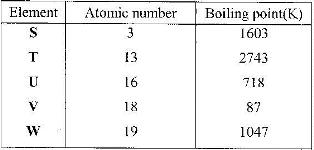
a) Select the elements which belong to the same:
i) Group
ii) Period
b) Which element
i) is in gaseous state at room temperature? Explain. (Take room temperature to be 298K)
ii) Does not form an oxide?
c) Write the
i) Formula of the nitrate of element T.
ii) Equation for the reaction between elements S and U
d) What type of bond would exists in the compound formed when U and T react? Give a reason for your answer
e) The aqueous sulphate of element W was electrolyzed using inert electrodes. Name products formed at the:
i) Cathode
ii) Anode
Date posted:
April 10, 2017
.
Answers (1)
-
The table below shows properties of some elements A, B, C and D which belong to the same periodic table. The letters are not the actual symbols of the elements.
(Solved)
The table below shows properties of some elements A, B, C and D which belong to the same periodic table. The letters are not the actual symbols of the elements.

a) Arrange the elements in order they would appear in the periodic. Give a reason
b) Select the metallic element which is the better conductor of electricity. Give a reason.
Date posted:
April 10, 2017
.
Answers (1)
-
Four metal F, G, H and J were each separately added to cold water, hot water and steam. The table below is a summary of the observations made and the formulae of the hydroxides formed.
(Solved)
Four metal F, G, H and J were each separately added to cold water, hot water and steam. The table below is a summary of the observations made and the formulae of the hydroxides formed.
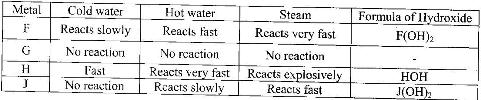
a) Which two elements are likely to be in the same group of the periodic table?
b) Arrange the metals in the order of their reactivity starting with the most reactive.
Date posted:
April 10, 2017
.
Answers (1)
-
The grid given below represents part of the periodic table. Study it and answer the questions that follow. (The letters do not represent the actual symbol of the elements)
(Solved)
The grid given below represents part of the periodic table. Study it and answer the questions that follow. (The letters do not represent the actual symbol of the elements)
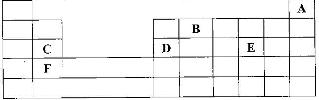
i) What name is given to the group of elements to which C and F belong?
ii) Which letter represents the element that is the least reactive?
iii) What type of bond is formed when B and E react? Explain
iv) Write the formula of the compound formed when element D and oxygen gas react
Date posted:
April 10, 2017
.
Answers (1)
-
The table below gives the atomic numbers of elements W, X, Y and Z. The letters do not represent the actual symbols of the elements.
(Solved)
The table below gives the atomic numbers of elements W, X, Y and Z. The letters do not represent the actual symbols of the elements.

a) Which one of the elements is least reactive? Explain.
b) (i) Which two elements would react most vigorously with each other?
(ii) Give the formula of the compound formed when the elements in b (i) react.
Date posted:
April 7, 2017
.
Answers (1)
-
The table below gives information on four elements represented by letters K, L, M and N. Study it and answer the questions that follow. The letters do not represent the actual symbols of the elements.
(Solved)
The table below gives information on four elements represented by letters K, L, M and N. Study it and answer the questions that follow. The letters do not represent the actual symbols of the elements.

a) Which two elements have two similar properties? Explain.
b) What is the most likely formula of oxide of L?
c) Which element is a non-metal? Explain
d) Which one of the elements is the strongest reducing agent? Explain.
e) Explain why ionic radius of N is less than that of M.
f) Explain why the ionic radius of L is bigger than its atomic radius.
Date posted:
April 7, 2017
.
Answers (1)
-
The table below gives the number of electrons, protons and neutrons in substances X, Y and Z. Study it and answer the questions that follow.
(Solved)
The table below gives the number of electrons, protons and neutrons in substances X, Y and Z. Study it and answer the questions that follow.

a) Which letter represents an ion?
b) Which of the substances are isotopes? Give reason.
Date posted:
April 7, 2017
.
Answers (1)
-
The table below shows the number of valence electrons of the element P, Q and R.
(Solved)
The table below shows the number of valence electrons of the element P, Q and R.

a) Explain why P and R would not be expected to form a compound.
b) Write an equation to show the effect of heat on the carbonate of R.
c) Write the formula for the most stable ion of Q
Date posted:
April 7, 2017
.
Answers (1)
-
The set up below was used to investigate the reaction between dry hydrogen gas and copper (II) oxide.
(Solved)
The set up below was used to investigate the reaction between dry hydrogen gas and copper (II) oxide.
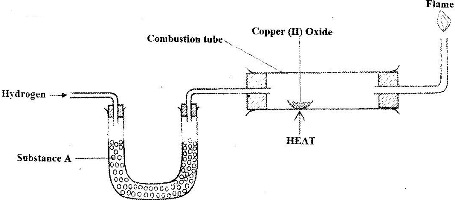
a) Name substance A.
b) State the observation made in the combustion tube.
c) Explain the observation stated in (b) above.
Date posted:
April 7, 2017
.
Answers (1)
-
The set up below was used to investigate the reaction between dry hydrogen gas and copper (II) oxide.
(Solved)
The set up below was used to investigate the reaction between dry hydrogen gas and copper (II) oxide.
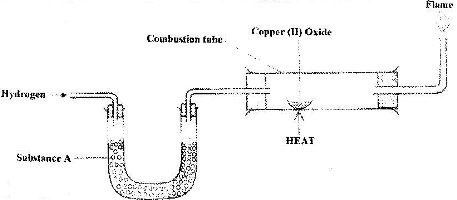
a) Name substance A.
b) State the observation made in the combustion tube.
c) Explain the observation stated in (b) above.
Date posted:
April 7, 2017
.
Answers (1)
-
The set-up below was used to investigate the products of burning biogas (methane). Study it and answer the questions that follow.
(Solved)
The set-up below was used to investigate the products of burning biogas (methane). Study it and answer the questions that follow.
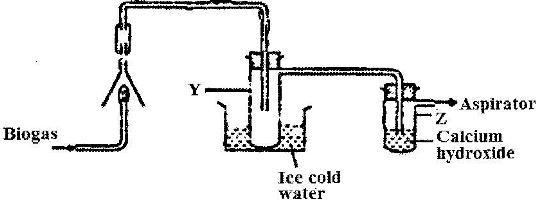
a) What product will be formed in test-tube Y?
b) State and explain the observations which will be made in Z.
Date posted:
April 7, 2017
.
Answers (1)