a) R - Sieve pore
S - Cytoplasmic strands, cytoplasmic filaments
Cell labeled T - Companion cells
b) Translocation - Its contractile is nature to push food/ organic products of photosynthesis from one sieve cell to the next
c) It is thickened or lignified to keep vessels strong and open.
johnmulu answered the question on May 2, 2017 at 09:14
-
Name two processes that bring about the translocation of manufactured food.
(Solved)
Name two processes that bring about the translocation of manufactured food.
Date posted:
May 2, 2017
.
Answers (1)
-
State two ways in which xylem vessels are adapted to their function.
(Solved)
State two ways in which xylem vessels are adapted to their function.
Date posted:
May 2, 2017
.
Answers (1)
-
The diagram below represents the pathways of water from the soil into the plant.
(Solved)
The diagram below represents the pathways of water from the soil into the plant.
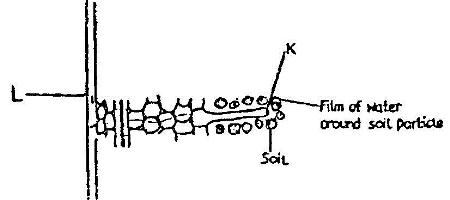
a) Name the structures labeled K and L.
b) Name the process by which minerals salts enter into the plant.
Date posted:
May 2, 2017
.
Answers (1)
-
The diagram below represents a transverse section of a young stem
(Solved)
The diagram below represents a transverse section of a young stem
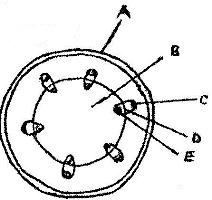
a) Name the parts labeled A and B.
b) State the function of the parts labeled C, D and E
Date posted:
May 2, 2017
.
Answers (1)
-
a)Name the appropriate food substance from substance for each of the following enzymes (i)Ptyalin (ii) Pepsin
(Solved)
a)Name the appropriate food substance from substance for each of the following enzymes (i)Ptyalin (ii) Pepsin(b) State the causes and two symptoms of Beri-beri.
Date posted:
May 2, 2017
.
Answers (1)
-
State two ways in which the human intestinal villus is adapted to its function.
(Solved)
State two ways in which the human intestinal villus is adapted to its function.
Date posted:
May 2, 2017
.
Answers (1)
-
What is the role of bile salts in digestion in humans?
(Solved)
What is the role of bile salts in digestion in humans?
Date posted:
May 1, 2017
.
Answers (1)
-
The diagram below represents the lower jaw of a mammal
(Solved)
The diagram below represents the lower jaw of a mammal
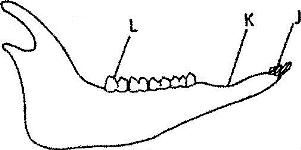
a) Name the mode of nutrition of the mammal whose jaw is shown.
b) i) Name the toothless gap labeled K.
ii) State the function of the gap.
c) Name the substance that is responsible for hardening of teeth.
Date posted:
May 1, 2017
.
Answers (1)
-
Explain how the following factors determine the daily energy requirement in human:(a)Age(b)Occupation(c) Sex
(Solved)
Explain how the following factors determine the daily energy requirement in human:
(a)Age
(b)Occupation
(c) Sex
Date posted:
May 1, 2017
.
Answers (1)
-
Explain how the carnassial teeth of a dog are adapted to their function.
(Solved)
Explain how the carnassial teeth of a dog are adapted to their function.
Date posted:
May 1, 2017
.
Answers (1)
-
a) The action of ptyalin stops at the stomach. Explain.(b) State a factor that denatures enzymes(c) Name the features that increase the surface area of small intestines
(Solved)
a) The action of ptyalin stops at the stomach. Explain.
b) State a factor that denatures enzymes
c) Name the features that increase the surface area of small intestines
Date posted:
May 1, 2017
.
Answers (1)
-
The diagram below represents a section though a human tooth
(Solved)
The diagram below represents a section though a human tooth
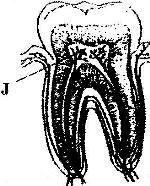
a) i) Name the type of tooth shown.
ii) Give a reason for your answer in (a)(i) above.
b) State the functions of potassium ions in the human body.
Date posted:
May 1, 2017
.
Answers (1)
-
a) Distinguish between the terms homodont and heterodont
b) What is the function of carnassial teeth?
(Solved)
a) Distinguish between the terms homodont and heterodont
b) What is the function of carnassial teeth?
Date posted:
May 1, 2017
.
Answers (1)
-
What happens to excess fatty acids and glycerol in the body
(Solved)
What happens to excess fatty acids and glycerol in the body
Date posted:
May 1, 2017
.
Answers (1)
-
The set up below illustrates a procedure that was carried out in the laboratory with a leaf plucked from a green plant that had been growing in sunlight.
(Solved)
The set up below illustrates a procedure that was carried out in the laboratory with a leaf plucked from a green plant that had been growing in sunlight.
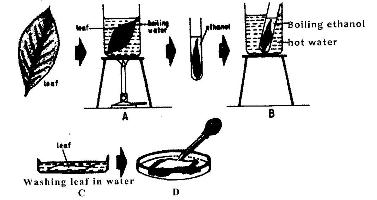
i) What was the purpose of the above procedure?
ii) Give reason for carrying out steps A, B and C in this procedure.
iii) Name the reagent that was used at the step labelled D.
iv) State the expected result on the leaf after adding the reagent named in (iii) above.
Date posted:
May 1, 2017
.
Answers (1)
-
A potted plant was kept in the dark for 48 hours. Two leaves X and Y were treated as shown in the diagram below.
(Solved)
A potted plant was kept in the dark for 48 hours. Two leaves X and Y were treated as shown in the diagram below.
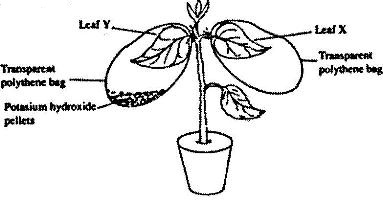
The experimental set-up was kept in sun light for six hours after which a starch test was carried out on the two leaves
a) What were the results of the starch test on leaves X and Y?
b) Give reasons for your answers in (a) above
Date posted:
May 1, 2017
.
Answers (1)
-
The diagram below represents a set - up that was used to investigate certain process in a plant.
(Solved)
The diagram below represents a set - up that was used to investigate certain process in a plant.
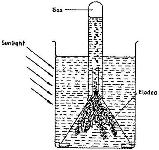
a) State the process that was being investigated
b) State a factor that would affect the process
Date posted:
May 1, 2017
.
Answers (1)
-
The diagram below represents a cell.
(Solved)
The diagram below represents a cell.
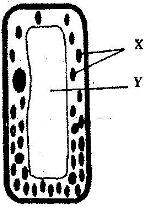
a) Name the parts labeled X and Y
b) Suggest why structures labelled X and would be more on one side than the other
Date posted:
May 1, 2017
.
Answers (1)
-
The graph below shows the effect of substrate concentration on the rate of enzyme reaction
(Solved)
The graph below shows the effect of substrate concentration on the rate of enzyme reaction
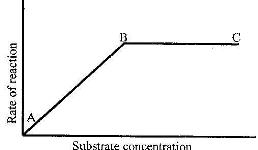
a) i) Account for the shape of the graph between A and B.
ii) B and C
b) How can the rate of reaction be increased after point B?
c) State two other factors that affect the rate of enzyme reaction
Date posted:
May 1, 2017
.
Answers (1)
-
In an experiment to investigate a factor affecting photosynthesis, a leaf of a potted plant which had been kept in the dark overnight was covered with aluminum foil as shown in the diagram below.
(Solved)
In an experiment to investigate a factor affecting photosynthesis, a leaf of a potted plant which had been kept in the dark overnight was covered with aluminum foil as shown in the diagram below.
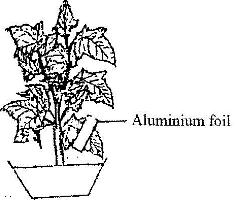
The set up was kept in sunlight for three hours after which a food test was carried out on the leaf.
a) Which factor was being investigated in the experiment?
b) What food test was carried out?
c) Why was it necessary to keep the plant in darkness before the experiment?
Date posted:
May 1, 2017
.
Answers (1)