(a) (i) To remove the large solid particles from water
(ii) Sedimentation
(iii) I. Cause the small suspended particles to settle down.
II. To kill germs/microorganisms/microbes
(b) (i) Permanent
(ii) Addition of Na2CO3 which precipitates
Mg2+ as MgCO3
OR
Use of ion exchange resin which will remove Mg2+ or distillation where MgSO4 is left behind as residue.
(c) (i) Add excess calcium oxide to dilute HCl/HNO3 filter to obtain the filtrate and add aqueous Na2CO3/K2CO3 to the filtrate to precipitate CaCO3; wash the precipitate with distilled water and dry it between filter
papers
(ii) Used as chalk
- Used in the extraction of iron.
sharon kalunda answered the question on March 19, 2019 at 14:02
-
a)The set up below was used during electrolysis of aqueous copper (II) sulphate using inert electrodes.
(Solved)
a)The set up below was used during electrolysis of aqueous copper (II) sulphate using inert electrodes.
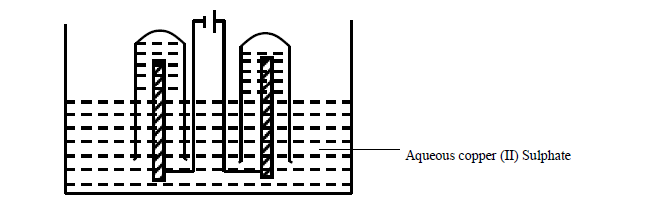
i) Name a suitable pair of electrodes for this experiment.
ii) Identify the ions and cations in the solution.
iii) On the diagram label the cathode.
iv) Write ionic equations for the reactions that took place at the anode
v) Explain the change that occurred to the Copper (II) Sulphate solution during the experiment.
vi) During the electrolysis a current of 2 amperes was passed through the solution for 4 hours. Calculate the volume of the gas produced at the anode. (1 Faraday = 96500 coulombs and volume of gas at room temperature is 24000cm3 )
b) i) Draw a diagram to show how an impure copper lump can be refined through electrolysis.
ii) State one other use of electrolysis other than the one shown in b (ii) above.
Date posted:
March 19, 2019
.
Answers (1)
-
(a) Below is a paper chromatogram of pure substances W, X and Y
(Solved)
(a) Below is a paper chromatogram of pure substances W, X and Y
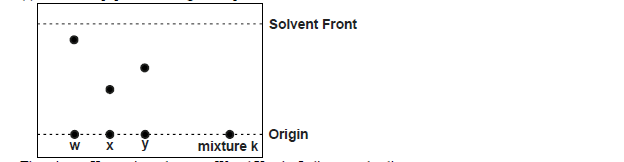
The mixture K contains substances W and X only. Indicate on the diagram the chromatogram of K.
(b) State one application of chromatography.
Date posted:
March 19, 2019
.
Answers (1)
-
Moist hydrogen sulphide gas was passed through a tube containing wet sulphur (IV) oxide gas as shown below.
(Solved)
Moist hydrogen sulphide gas was passed through a tube containing wet sulphur (IV) oxide gas as shown below.
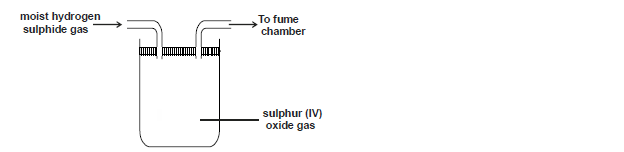
(a) State the observation (s) made.
(b) Write an equation for the reaction above.
(c) Giving a reason, which substance undergoes reduction above.
Date posted:
March 19, 2019
.
Answers (1)
-
Give two differences between chemical reactions and nuclear reactions.
(Solved)
Give two differences between chemical reactions and nuclear reactions.
Date posted:
March 19, 2019
.
Answers (1)
-
0.585g of sodium chloride were dissolved in 50cm³ of de-ionised water. The temperature of the water dropped from 29°C to 17°C. Find the molar heat...
(Solved)
0.585g of sodium chloride were dissolved in 50cm³ of de-ionised water. The temperature of the water dropped from 29°C to 17°C. Find the molar heat of solution of sodium chloride. Specific heat capacity of solution 4.2 kJk-2Kg-1, density of solution is 1g/cm³. (Na - 23.0, Cl = 35.5)
Date posted:
March 19, 2019
.
Answers (1)
-
The boiling points of some compounds of hydrogen with some elements in group 4 and 6 of the periodic table are given below.
(Solved)
The boiling points of some compounds of hydrogen with some elements in group 4 and 6 of the periodic table are given below.

a) Which of the compounds CH4 and SiH4 has the stronger inter molecular forces?Explain.
(b) Explain why the boiling points of H2O and H2S show different trends from that of CH4 and SiH4.
Date posted:
March 19, 2019
.
Answers (1)
-
In terms of structure and bonding explain why silicon (IV) oxide is a solid while sulphur (IV) oxide is a gas at room temperature.
(Solved)
In terms of structure and bonding explain why silicon (IV) oxide is a solid while sulphur (IV) oxide is a gas at room temperature.
Date posted:
March 19, 2019
.
Answers (1)
-
The data given below was recorded when metal M was completely burnt in air. M is not the actual symbol of the metal. (RAM M...
(Solved)
The data given below was recorded when metal M was completely burnt in air. M is not the actual symbol of the metal. (RAM M = 56.0, O=16)
Mass of empty crucible and lid = 5.240g
Mass of crucible, lid and metal m = 5.352g
Mass of crucible, lid, metal oxide = 5.400g
(a) Determine the mass of
(i) Metal m
(ii) Oxygen.
(b) Determine the empirical formula of the meat oxide.
Date posted:
March 19, 2019
.
Answers (1)
-
In an experiment air was passed through several reagents as shown in the flow chart below.
(Solved)
In an experiment air was passed through several reagents as shown in the flow chart below.

(a) Write an equation for the reaction which takes place in the chamber with magnesium powder.
(b) State the Role of concentrated potassium hydroxide solution.
(c) What observation is made in the chamber containing copper turnings.
Date posted:
March 19, 2019
.
Answers (1)
-
List the uses of chlorine gas and its compounds.
(Solved)
List the uses of chlorine gas and its compounds.
Date posted:
March 5, 2019
.
Answers (1)
-
Explain the effects of chlorine gas on a burning candle.
(Solved)
Explain the effects of chlorine gas on a burning candle.
Date posted:
March 5, 2019
.
Answers (1)
-
Using a table show the comparison between rhombic and monoclinic sulphur.
(Solved)
Using a table show the comparison between rhombic and monoclinic sulphur.
Date posted:
March 5, 2019
.
Answers (1)
-
Describe the Laboratory preparation of Nitric (V) acid.
(Solved)
Describe the Laboratory preparation of Nitric (V) acid.
Date posted:
March 5, 2019
.
Answers (1)
-
Draw a flowchart to show the Haber process.
(Solved)
Draw a flowchart to show the Haber process.
Date posted:
March 5, 2019
.
Answers (1)
-
Describe the action of aqueous ammonia on solution of metallic salts.
(Solved)
Describe the action of aqueous ammonia on solution of metallic salts.
Date posted:
March 5, 2019
.
Answers (1)
-
Describe the preparation of ammonium solution.
(Solved)
Describe the preparation of ammonium solution.
Date posted:
March 5, 2019
.
Answers (1)
-
Explain the action of heat on nitrates.
(Solved)
Explain the action of heat on nitrates.
Date posted:
March 5, 2019
.
Answers (1)
-
State the observation made in the combustion tube during preparation of ammonia
(Solved)
State the observation made in the combustion tube during preparation of ammonia
Date posted:
February 21, 2019
.
Answers (1)
-
Calculate the molar enthalpy of formation of carbon(II)oxide (CO) given : ?H?c of carbon-graphite = -393.5kJmole-1, ?H?c of carbon(II)oxide (CO)= -283 kJmole-1
(Solved)
Calculate the molar enthalpy of formation of carbon(II)oxide (CO) given : ΔHᶿc of carbon-graphite = -393.5kJmole-1, ΔHᶿc of carbon(II)oxide (CO)= -283 kJmole-1
Date posted:
February 20, 2019
.
Answers (1)
-
Calculate the molar enthalpy of formation of methane (CH4) given that ?H?c of carbon-graphite is -393.5kJmole-1,Hydrogen is -285.7 kJmole-1 and that of methane is 890...
(Solved)
Calculate the molar enthalpy of formation of methane (CH4) given that ΔHᶿc of carbon-graphite is -393.5kJmole-1,Hydrogen is -285.7 kJmole-1 and that of methane is 890 kJmole-1
Date posted:
February 20, 2019
.
Answers (1)