a). Forelimb / arm / front legs / humerus – upper arm / ulna and radius lower arm / scapula – shoulder / pectoral girdle
b). K – scapula
M – Humerus.
N – Ulna
P- Radius
c).
- has a ridge or coracoids process for increasing surface area for muscle attachment
- broad, wide or flattened for increasing surface are for muscle attachment
- has a socket, cavity or glenoid cavity or depression for articulation with next bone humerus or head of humerus
- has cartilage to make it smooth
- a smooth surface of the socket for reducing or minimizing friction.
d). Proximal end – ball and socket
Reason
- head shaped like a ball / ball like rounded head / round head , allow movement in more that one plane
Distal end – hinge joint
Reason:
Allow movement in only one plane / presence of a grove / olecranon process / presence of condl / trochlea which articulates with sigmoid notch
e). attachment of musles / tendons formation of hinge jpint, prevent overstretching of forearms backwards allow movement in only one plane
sharon kalunda answered the question on May 27, 2019 at 07:57
-
You are provided with photograph of specimens labelled A, B, C, D,E,F,GandH.Study them carefully then answer the questions that follow.
1. (a)Group of florets/inflorescence……………………….go to2
(b)simple flowers………………………………………..go...
(Solved)
You are provided with photograph of specimens labelled A, B, C, D,E,F,GandH.Study them carefully then answer the questions that follow.
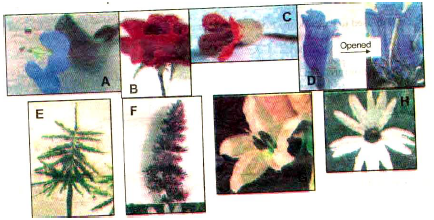
1. (a)Group of florets/inflorescence……………………….go to2
(b)simple flowers………………………………………..go to 4
2. (a)Florets compacted into compact heads………………compositae
(b)florets not compcted but arranged in spikes…………..go to3
3. (a)Florets conspicuous /purple in colour……………….Amaranthacea.
(b)Florets inconspicuous/green in colour……………….Graminae
4. (a)Flower polysepalous/many free sepals……………..Rosacea
(b)Flower gamesepalous……………………..go to 5
5. (a)Flowers with more than five anthers……..Umbelliferae
(b)Flowers with five or less anthers…………go to 6
6. (a)Petals form a corolla tube/gamepetalous…mimmosacea
(b)petals do not form corolla tube…………..go to 7
7. (a)Flowers with large anthers………………Solanacea
(b)Flowers with small anthers………………Ranunclulacea
Use the dichotomus key provided to Identify each specimen.In each case show in sequence the steps.In the key that you followed to arrive at the identity of each specimen.
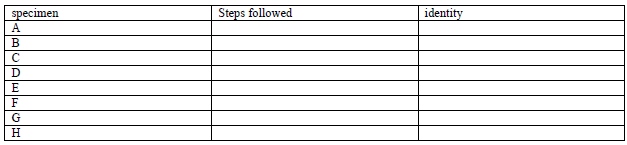
b) (i) What is the likely agent of pollination of specimen C and E?
C
E
(ii) Briefly explain an adaptive feature of specimen C to the mode of pollination you have named in b(i) above
c) Describe the ovary of specimen B and G using the most suitable biological terms.
d) Supply a term used to describe the flower of specimen E and F.
Date posted:
May 27, 2019
.
Answers (1)
-
Describe one method that can be used to measure the average growth rate of a single leaf.
(Solved)
Describe one method that can be used to measure the average growth rate of a single leaf.
Date posted:
May 27, 2019
.
Answers (1)
-
The diagram below represents a flower.
a) Name the parts labelled X and Y
X
Y
b) Describe the ovary position.
c) i) Suggest an agent of pollination...
(Solved)
The diagram below represents a flower.
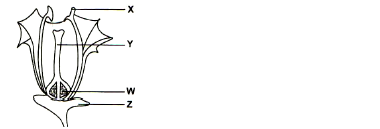
a) Name the parts labelled X and Y
X
Y
b) Describe the ovary position.
c) i) Suggest an agent of pollination of the flower above.
ii. Give a reason for your answer above.
d) In the flower above its sepals cell was found to have 20 chromosomes. What would be the number of chromosomes
found in the endosperm cell of the flower embryo sac after fertilization?.
Date posted:
May 27, 2019
.
Answers (1)
-
The diagram below shows a family tree. Squares represent males and circles representfemales. Normal individuals are indicated by unshaded squares and circles. Individuals who show...
(Solved)
The diagram below shows a family tree. Squares represent males and circles representfemales. Normal individuals are indicated by unshaded squares and circles. Individuals who show genetically controlled defects are indicated by shaded squares and circles.
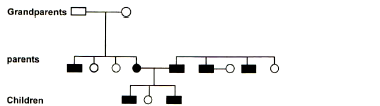
a) What is the name given to this type of a family tree?
b) In which of the grandparents is the genetically controlled defects likely to have developed and by what process.
c) Assume the genetically controlled defect was haemophilia,show the genotype of the following:
i. Grandparents
ii. The two couples
iii. The children of the couple that shoed the defect.
iv. What are the symptoms of the defect.
v. What is the remedy?
Date posted:
May 27, 2019
.
Answers (1)
-
What is meant by double fertilization in flowering plants.
(Solved)
What is meant by double fertilization in flowering plants.
Date posted:
May 27, 2019
.
Answers (1)
-
Name two kinds of nuclei found in a mature pollen grain.
(Solved)
Name two kinds of nuclei found in a mature pollen grain.
Date posted:
May 27, 2019
.
Answers (1)
-
Why is excretion of nitrogenous wastes more of a problem to animals than plants.
(Solved)
Why is excretion of nitrogenous wastes more of a problem to animals than plants.
Date posted:
May 27, 2019
.
Answers (1)
-
Give the genotype of a male who could be born haemophiliac.
(Solved)
Give the genotype of a male who could be born haemophiliac.
Date posted:
May 27, 2019
.
Answers (1)
-
Give two possible ways of establishing the genotype of an organism whose genotype is unknown.
(Solved)
Give two possible ways of establishing the genotype of an organism whose genotype is unknown.
Date posted:
May 27, 2019
.
Answers (1)
-
Identify two adaptations of vertebrae neurone that affects the speed of impulse transmission.
(Solved)
Identify two adaptations of vertebrae neurone that affects the speed of impulse transmission.
Date posted:
May 27, 2019
.
Answers (1)
-
Two potted plants A and B were placed in the dark for two days. Each was then placed in an air tight bell jar as...
(Solved)
Two potted plants A and B were placed in the dark for two days. Each was then placed in an air tight bell jar as follows then transferred to light for four hours. Each plant was then tested for starch.
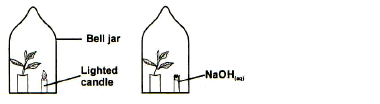
a) why were the plants put in the dark place for two days.
b) what was the result of the starch test in plant B.Expain your answer.
Date posted:
May 27, 2019
.
Answers (1)
-
Name the polysaccharides found in the following structures.
a) Exoskeleton
b) Xylem vessels
(Solved)
Name the polysaccharides found in the following structures.
a) Exoskeleton
b) Xylem vessels
Date posted:
May 27, 2019
.
Answers (1)
-
Name two enzymes and one ion metal that are needed in the blood clotting process.
(Solved)
Name two enzymes and one ion metal that are needed in the blood clotting process.
Date posted:
May 27, 2019
.
Answers (1)
-
What is the role of Cotyledons in a germinating seed.
(Solved)
What is the role of Cotyledons in a germinating seed.
Date posted:
May 27, 2019
.
Answers (1)
-
A certain animal has no incisor, no canines, 6 premolars and 6 molar in its upper jaw. In the lower jaw there are 6 incisors,...
(Solved)
A certain animal has no incisor, no canines, 6 premolars and 6 molar in its upper jaw. In the lower jaw there are 6 incisors, 2 canines, 6 premolars and 6 molars. Write its dental formula
Date posted:
May 27, 2019
.
Answers (1)
-
Explain what leads to struggle for existence in organisms.
(Solved)
Explain what leads to struggle for existence in organisms.
Date posted:
May 27, 2019
.
Answers (1)
-
A group of students set up an experiment to demonstrate a certain process as shown below.
After 10 minutes the students carried out iodine test inside...
(Solved)
A group of students set up an experiment to demonstrate a certain process as shown below.
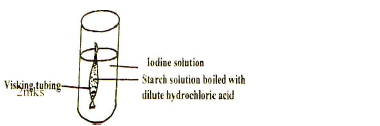
After 10 minutes the students carried out iodine test inside and outside the visiking tubing.
a) state two roles of the process being investigated in animals.
b) account for the results expected in the experiment above.
c)i) What is the importance of plasma membrane in active transport.
ii) Give one similarity between osmosis and active transport.
Date posted:
May 27, 2019
.
Answers (1)
-
Name the parts of a mammalian ear which carry out the following function (i) balance and posture (ii) hearing
(Solved)
Name the parts of a mammalian ear which carry out the following function
i) balance and posture
ii) hearing
Date posted:
May 24, 2019
.
Answers (1)
-
The number and distribution of stomata of three different leaves are shown in the table below
Suggest the possible habitat of the plant from which the...
(Solved)
The number and distribution of stomata of three different leaves are shown in the table below

Suggest the possible habitat of the plant from which the leaves were obtained
A
B
Date posted:
May 24, 2019
.
Answers (1)
-
Name the blood vessel that connects arteries to veins
(Solved)
Name the blood vessel that connects arteries to veins
Date posted:
May 24, 2019
.
Answers (1)