-
Explain the effect of hydrogen chloride on blue and red litmus papers when it is dissolved in water and in methylbenzene.
(Solved)
Explain the effect of hydrogen chloride on blue and red litmus papers when it is dissolved in water and in methylbenzene.
Date posted:
August 16, 2019
.
Answers (1)
-
The diagram below represents a mercury cell chlor-alkali process that can be used in the industrial manufacture of sodium hydroxide. Study it and answer the...
(Solved)
The diagram below represents a mercury cell chlor-alkali process that can be used in the industrial manufacture of sodium hydroxide. Study it and answer the questions that follow.
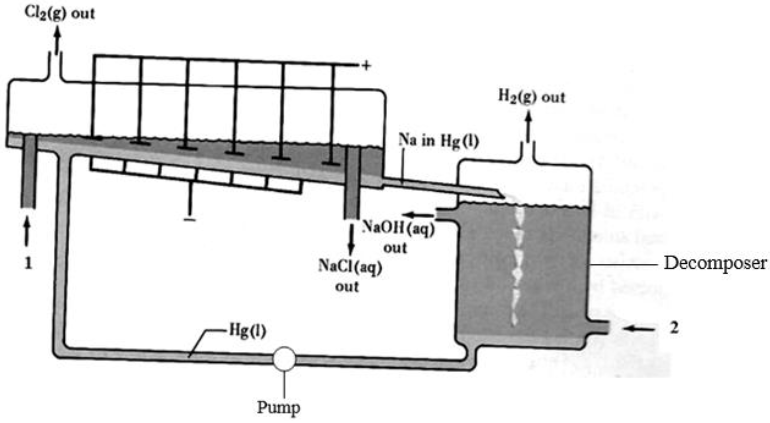
(a) (i) Name the raw materials introduced at 1 and 2.
(ii) Identify a substance that can be used as anode.
(iii) Write equations for the reactions taking place at:
Cathode
Decomposer
(iv) How is the aqueous sodium hydroxide purified?
Date posted:
August 16, 2019
.
Answers (1)
-
The scheme below shows several reactions starting with propanol. Study the scheme and answer the questions which follow.
(Solved)
The scheme below shows several reactions starting with propanol. Study the scheme and answer the questions which follow.
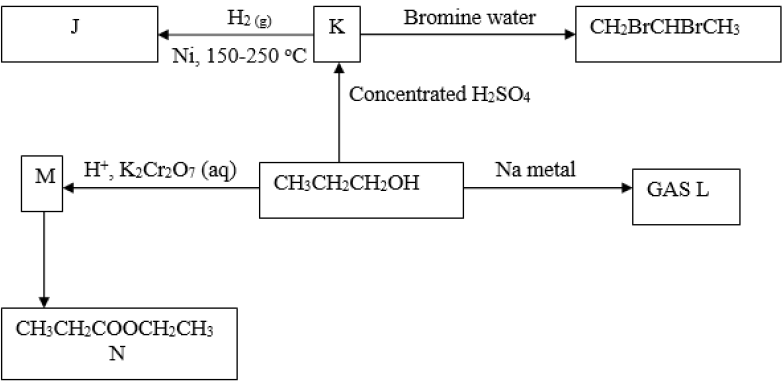
(a) (i) Name gas L.
(ii) Name and draw the structural formula of compound K.
(iii) What conditions and reagents are necessary to convert M and N?
Reagents
Conditions
(iv) Write chemical equation for the conversion of K to J.
Date posted:
August 16, 2019
.
Answers (1)
-
Given that:
Enthalpy of combustion of Carbon (graphite) = -393kJmol-1
Enthalpy of combustion of carbon (II) oxide = -283 kJmol-1
(Solved)
Given that:
Enthalpy of combustion of Carbon (graphite) = -393kJmol-1
Enthalpy of combustion of carbon (II) oxide = -283 kJmol-1
(a) Write down the thermo-chemical equations for the combustion of:
(i) Carbon (graphite)
(ii) Carbon (II) oxide
(b) Determine the enthalpy of formation of carbon (II) oxide.
(c) Draw an energy level diagram for the processes in (a) and (b) above.
(d) State two properties of Carbon (IV) Oxide that make it suitable for use in fire extinguishers.
(e) When 8.0 g of sulphur is completely burned in oxygen in a calorimeter, the heat evolved raises the temperature of 500 cm3 of water by 35 0C. Calculate the heat of combustion of sulphur.
(The specific heat capacity of water = 
Date posted:
August 16, 2019
.
Answers (1)
-
The table below shows the radioactive decay for a sample of iodine -131.Study it and answer the questions that follow.
(Solved)
The table below shows the radioactive decay for a sample of iodine -131.Study it and answer the questions that follow.
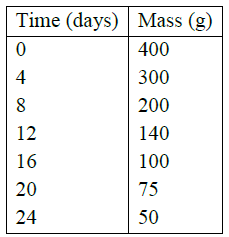
(i) Plot the decay curve of iodine -131 using the data given in the table above.
(ii) Use the graph to determine the half-life of the sample.
(iii) What fraction of the original sample remains after 18 days?
Date posted:
August 16, 2019
.
Answers (1)
-
Study the diagram below and answer the questions that follow.
(Solved)
Study the diagram below and answer the questions that follow.
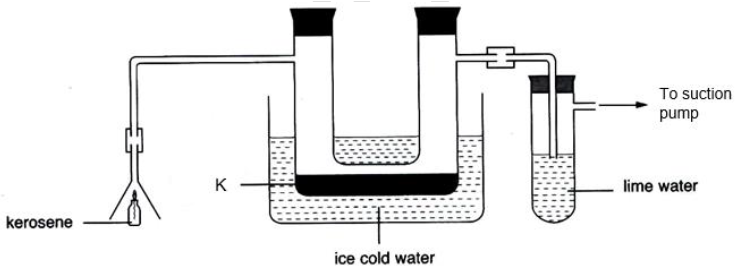
(i) State the observation made in the lime water. Explain.
(ii) How can the identity of substance K be demonstrated?
Date posted:
August 16, 2019
.
Answers (1)
-
In an experiment to determine the proportion of oxygen in air, Copper turning were packed in excess in a combustion tube connected to two syringes...
(Solved)
In an experiment to determine the proportion of oxygen in air, Copper turning were packed in excess in a combustion tube connected to two syringes of 80 cm3 each in a volume . Syringe R contained 80 cm3 of air while syringe S was closed and empty as shown.
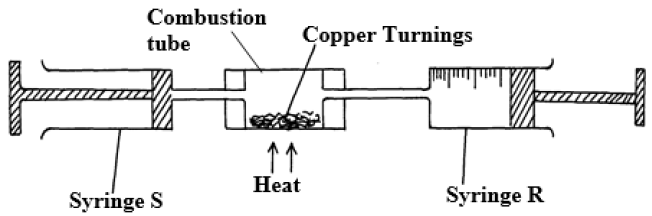
Air was passed over heated turnings slowly and repeatedly until there was no further change in volume. After cooling, 63.2 cm3 of air remained in syringe R.
(i) Why was copper packed in excess?
(ii) State one observation made in the combustion tube during experiment.
(iii) Give an equation for the reaction that took place in combustion tube.
(iv) Determine the percentage of oxygen used up during the experiment.
Date posted:
August 16, 2019
.
Answers (1)
-
In an experiment to separate a mixture of water (100oC) and ethanol (78.4oC), a student set up the apparatus shown below.
(Solved)
In an experiment to separate a mixture of water (100oC) and ethanol (78.4oC), a student set up the apparatus shown below.
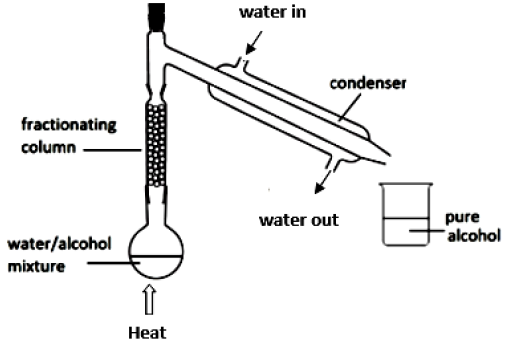
(a) Identify the mistakes in the set up.
(b) What method would the student use to test the purity of ethanol obtained?
Date posted:
August 16, 2019
.
Answers (1)
-
Use the bond energy values given below to determine the enthalpy change for the conversion of propene to propane by hydrogenation.
(Solved)
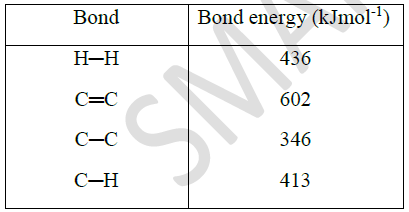
Use the bond energy values given below to determine the enthalpy change for the conversion of propene to propane by hydrogenation.
Date posted:
August 14, 2019
.
Answers (1)
-
Using reagents provided, explain how you could prepare dry zinc carbonate solid.
Zinc powder, dilute nitric (V) acid, Water and Solid sodium carbonate
(Solved)
Using reagents provided, explain how you could prepare dry zinc carbonate solid.
Zinc powder, dilute nitric (V) acid, Water and Solid sodium carbonate
Date posted:
August 14, 2019
.
Answers (1)
-
Below is a list of oxides.
(Solved)
Below is a list of oxides.

Select:
(a) A neutral oxide
(b) A highly water soluble basic oxide.
(c) An oxide which can react with sodium hydroxide and dilute hydrochloric acid.
Date posted:
August 14, 2019
.
Answers (1)
-
Calculate the percentage of nitrogen in calcium nitrate
(Solved)
Calculate the percentage of nitrogen in calcium nitrate
Date posted:
August 5, 2019
.
Answers (1)
-
Dry carbon (II) oxide gas reacts with hot lead (II) oxide as shown in the equation below.
(Solved)
Dry carbon (II) oxide gas reacts with hot lead (II) oxide as shown in the equation below.

a) Name another gas that can be used to function as carbon (II) oxide in this experiment.
b) With an appropriate reason, identify the oxidizing agent in the equation above.
Date posted:
August 5, 2019
.
Answers (1)
-
Explain why there is effervescence when lemon juice is added to sodium hydrogen carbonate. ...
(Solved)
Explain why there is effervescence when lemon juice is added to sodium hydrogen carbonate.
Date posted:
August 5, 2019
.
Answers (1)
-
The diagram below represents the Haber process for the manufacture of ammonia. Study it and answer the questions that follow.
(Solved)
The diagram below represents the Haber process for the manufacture of ammonia. Study it and answer the questions that follow.
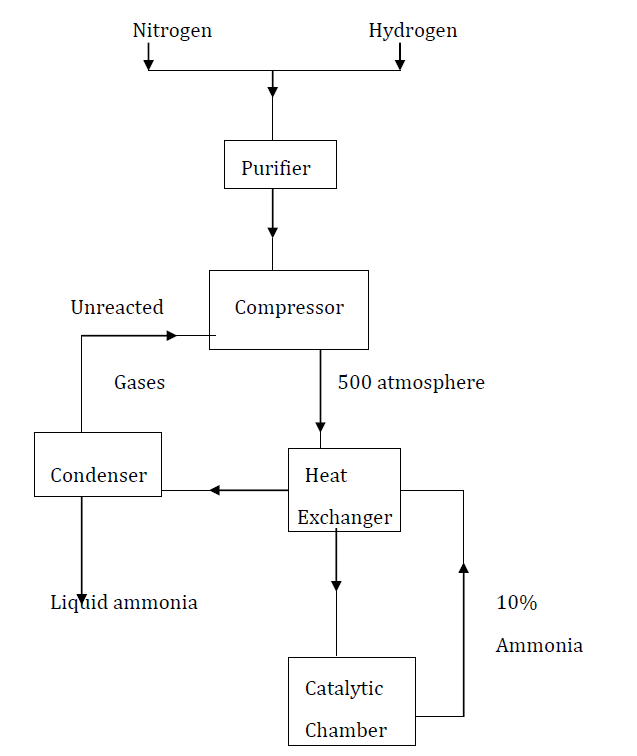
a) Name any two impurities removed by the purifier.
b) The catalyst used in the process is finely divided iron. Why iron is finely divided?
c) In the Haber process the conversion of nitrogen and hydrogen into ammonia is only 10%.
The remaining unreacted gases are recycled. What is the advantage of this.
d) A part from iron catalyst and pressure of 500 atmospheres, name any other condition required for this process.
Date posted:
August 5, 2019
.
Answers (1)
-
The table below gives some elements of the periodic table and their atomic masses, atomic numbers and melting points. The letters are not the actual...
(Solved)
The table below gives some elements of the periodic table and their atomic masses, atomic numbers and melting points. The letters are not the actual symbols of the elements.
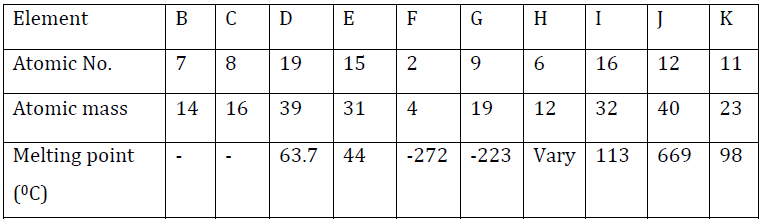
(a) Select two elements with oxidation states of -3.
(b) Which elements represent the most powerful reducing agent? Explain.
(c) Which element has the highest ionization energy?
(d) Select two elements which when reacted form a compound that conducts electricity both in molten and aqueous state.
(e) Select any two elements which when reacted form a compound that dissolves in water to form an acidic solution.
(f) Using dots (●) and crosses (X) to represent electrons; draw diagrams to show bonding between B and J.
(g) Explain why for some elements the atomic mass is not twice the atomic number.
(h) Explain why the melting point of element K is higher than that of element D.
(i) Describe how a solid mixture of the Sulphate of element K and lead (II) Sulphate can be separated.
Date posted:
August 5, 2019
.
Answers (1)
-
Explain why the boiling and melting point of alkali metals decrease down the group as the halogens increase down the group
(Solved)
Explain why the boiling and melting point of alkali metals decrease down the group as the halogens increase down the group
Date posted:
June 28, 2019
.
Answers (1)
-
In an experiment to determine the percentage purity of the sample of
sodium carbonate produced in the Solvay process, 2.15 g of the
sample reacted completely with...
(Solved)
In an experiment to determine the percentage purity of the sample of
sodium carbonate produced in the Solvay process, 2.15 g of the
sample reacted completely with 40.0cm3 of 0.5 M sulphuric acid.
I calculate the number of moles of sodium carbonate that
reacted.
II Determine the percentage of sodium carbonate in the
sample. (Na= 23.0, C= 12.0, O = 16.0)
Date posted:
June 24, 2019
.
Answers (1)
-
0.84 g of aluminium reacted completely with chlorine gas.
Calculate the volume of chlorine gas used (Molar gas volume is 24dm3, al = 27).
(Solved)
0.84 g of aluminium reacted completely with chlorine gas.
Calculate the volume of chlorine gas used (Molar gas volume is 24dm3, al = 27).
Date posted:
June 24, 2019
.
Answers (1)
-
A sample of biogas contains 35.2% by mass of methane. A biogas cylinder
contains 5.0 kg of the gas.
Calculate the;
(i) Number of moles of methane in...
(Solved)
A sample of biogas contains 35.2% by mass of methane. A biogas cylinder
contains 5.0 kg of the gas.
Calculate the;
(i) Number of moles of methane in the cylinder. (Molar mass of methane=16)
(ii) Total volume of carbon (IV) oxide produced by the combustion of methane in the
cylinder (Molar gas Volume=24.0 dm-3+ at room temperature and pressure).
Date posted:
June 24, 2019
.
Answers (1)