(a) A – mitochondrion reject mitochondria
C – Ribosome – rejects ribosomes/rough endoplasmic reticulum.
(b) - small intestine
- kidney
sharon kalunda answered the question on September 16, 2019 at 05:40
-
During an ecological study of a lake, a group of students recorded the following observations.
(Solved)
During an ecological study of a lake, a group of students recorded the following observations.
(i) Planktonic crustaceans feed on planktonic algae;
(ii) Small fish feed on planktonic crustaceans, worms and insect larvae;
(iii) Worms feed on insect larvae;
(iv) A bird species feeds on small fish, planktonic crustaceans, worms and large fish;
(v) Insect larvae feed on planktonic algae;
(vi) Large fish feed on small fish.
(a) From this record of observations, construct a food web.
(b) From the food web, isolate and write down a food chain that ends with:-
(i) Bird species as a secondary consumer.
(ii) Large fish as a tertiary consumer.
(c) The biomass of the producers in the lake was found to be greater than that of primary consumers. Explain this observation.
(d) Using the food web, identify three pairs of organisms that compete for food in the lake and for each case, name the food being competed for.
(e) (i) State three ways by which human beings may interfere with this lake ecosystem.
(i) Explain how each of the ways stated in (e) (i) above may affect life in the lake.
Date posted:
September 16, 2019
.
Answers (1)
-
You are provided with photographs of animals. Study the photographs and the dichotomous key below to enable you identify the taxonomic group to which each...
(Solved)
You are provided with photographs of animals. Study the photographs and the dichotomous key below to enable you identify the taxonomic group to which each animal belongs.
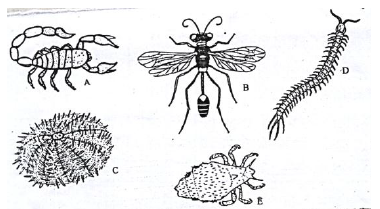
KEY
1. a) Jointed legs present ………………………………………………………………go to 2
b) Jointed legs absent………………………………………………………………..go to 7
2. a) Three pairs of legs ………………………………………………………………..go to 3
b) More than 3 pairs of legs………………………………………………………….go to 5
3. a) Wings present …………………………………………………………………….go to 4
b) Wings absent………………………………………………………………………Anoplura
4. a) One pair of wings…………………………………………………………………Diptera
b) Two pairs of wings……………………………………………………………Hymenoptera
5. a) Four pairs of legs ………………………………………………………………… Arachnida
b) More than ten pairs of legs ………………………………………………………. go to 6
6. a) One pair of legs in each body segment…………………………………………… Chilopoda
b) Two pairs of legs in each body segment ………………………………………… Diplopoda
7. a) Body partially enclosed in a shell………………………………………………… Mollusca
b) Body surface has spiny projection…………………………………………….Echinodermata
a) Using the key, identify the following organisms to their taxonomic groups. In each case, give the sequence of steps which you followed in identifying them.

b) i) Using observable features only, state the class to which the animal labeled A and B on the photographs above belong.State two observable features on B, that enabled you to arrive at that answer in (b) (i) above.
Date posted:
September 13, 2019
.
Answers (1)
-
A student divided a small air tight box into two chambers with wire mesh. In one chamber he kept a number of rats and in...
(Solved)
A student divided a small air tight box into two chambers with wire mesh. In one chamber he kept a number of rats and in the other a number of potted plants. What was likely to happen if the box was placed in the dark for two hours? Explain your answer.
Date posted:
September 13, 2019
.
Answers (1)
-
When transplanting a seedling, it is advisable to remove some of the leaves. Explain
(Solved)
When transplanting a seedling, it is advisable to remove some of the leaves .Explain
Date posted:
September 13, 2019
.
Answers (1)
-
The figure below shows the embryo-sac before fertilization.
(Solved)
The figure below shows the embryo-sac before fertilization.
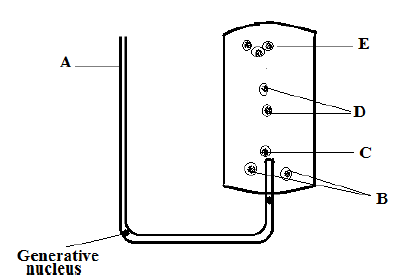
(a) Identify the structures labeled A and B.
(b) Identify the structures labelled in the diagram that will develop into the following after fertilization.
(i) Embryo
(ii) Endosperm
(c) State the ploidy of each the following nucleic after fertilization
(i) C
(ii) D
Date posted:
September 13, 2019
.
Answers (1)
-
In maize the gene for the purple colour is dorminant for the gene for white colour. A purple colour was crossed with heterozygous plant. Using...
(Solved)
In maize the gene for the purple colour is dorminant for the gene for white colour. A purple colour was crossed with heterozygous plant. Using letter G to represent the gene for purple colour, work out the genotypic ratio of the offspring. Show your working.
Date posted:
September 13, 2019
.
Answers (1)
-
(a) Given a sample of urine, name one test you would carry out to determine if it was obtained from a person suffering from diabetes...
(Solved)
(a) Given a sample of urine, name one test you would carry out to determine if it was obtained from a person suffering from diabetes mellitus.
(b) What results are expected if one is diabetic?
Date posted:
September 13, 2019
.
Answers (1)
-
A goat weighing 20kg requires 216KJ while a mouse weighing 54gms requires 2830KJ per day. Explain.
(Solved)
A goat weighing 20kg requires 216KJ while a mouse weighing 54gms requires 2830KJ per day. Explain.
Date posted:
September 13, 2019
.
Answers (1)
-
Mr. Juma has sued Serenity Hospital on grounds that their child was wrongly identified such that they got the wrong one.The child is blood group...
(Solved)
Mr. Juma has sued Serenity Hospital on grounds that their child was wrongly identified such that they got the wrong one.The child is blood group O. Mr. Juma is blood group AB while Mrs. Juma is heterozygous blood group A.
(a) Work out the possible blood group of their offsprings.
(b) Is Mr. Juma justified in his claims?
Date posted:
September 13, 2019
.
Answers (1)
-
The diagram below show single circulation of a fish.
(Solved)
The diagram below show single circulation of a fish.
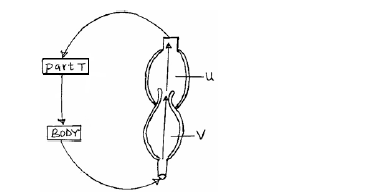
(a) Write down the names of the parts labelled T,U and V.
(b) Explain the main disadvantage of this type of circulation.
(c) How is this type of circulation different from that found in man?
Date posted:
September 13, 2019
.
Answers (1)
-
A student collected a plant with the following features:
-Vascular bundles in the stem were scattered with no cambium.
-Fibrous root system.
Name the sub-division and the class...
(Solved)
A student collected a plant with the following features:
-Vascular bundles in the stem were scattered with no cambium.
-Fibrous root system.
Name the sub-division and the class to which the above plant belonged.
Sub-division
Class
Date posted:
September 13, 2019
.
Answers (1)
-
Name one waste product that is transported in the blood but not removed by the kidneys.
(Solved)
Name one waste product that is transported in the blood but not removed by the kidneys.
Date posted:
September 13, 2019
.
Answers (1)
-
Potato cylinders were weighed and kept in distilled water overnight. They were then reweighed.
(Solved)
Potato cylinders were weighed and kept in distilled water overnight. They were then reweighed.
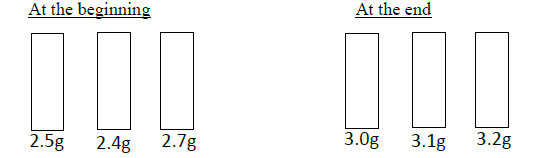
(a) Calculate the average mass of the potato cylinders at the end of the experiments.(Show your working).
(b) Explain why the mass of the cylinders had increased.
Date posted:
September 13, 2019
.
Answers (1)
-
What is the importance of fixation in preparation of temporary slide?
(Solved)
What is the importance of fixation in preparation of temporary slide?
Date posted:
September 13, 2019
.
Answers (1)
-
Explain why athletes practicing at high altitude zones have a higher number red blood cells than those at sea level.
(Solved)
Explain why athletes practicing at high altitude zones have a higher number red blood cells than those at sea level.
Date posted:
September 13, 2019
.
Answers (1)
-
Explain why emulsification is not a chemical digestion.
(Solved)
Explain why emulsification is not a chemical digestion.
Date posted:
September 13, 2019
.
Answers (1)
-
The diagram below shows a transverse section of a spinal cord.
(Solved)
The diagram below shows a transverse section of a spinal cord.
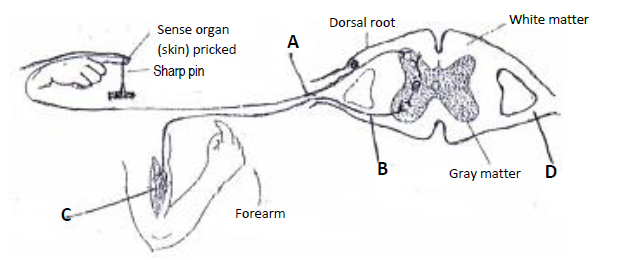
Name the parts labelled A – D.
Date posted:
September 13, 2019
.
Answers (1)
-
Study the diagram below and answer the questions that follow:
(a) Identify the above apparatus.
(b) State the function of the above apparatus.
(c) Name an apparatus...
(Solved)
Study the diagram below and answer the questions that follow:
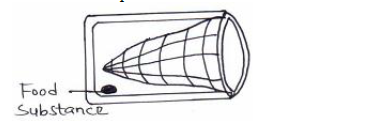
(a) Identify the above apparatus.
(b) State the function of the above apparatus.
(c) Name an apparatus that can be used for catching insects on barks of trees or rock surfaces.
(d) Name the branch of Biology that deals with the study of birds.
Date posted:
September 13, 2019
.
Answers (1)
-
The diagram below indicates an organism that grows under shaded places with damp conditions. Study it and answer the questions that follow.
(Solved)
The diagram below indicates an organism that grows under shaded places with damp conditions. Study it and answer the questions that follow.
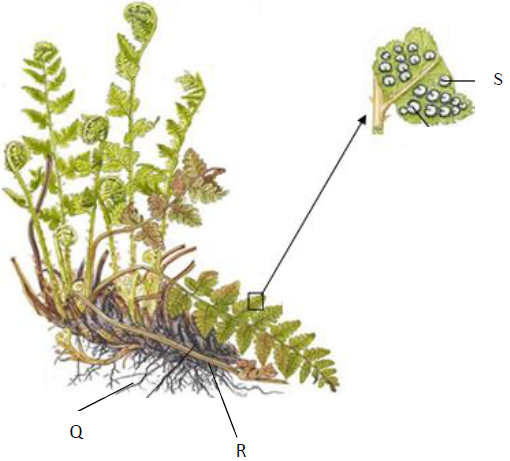
a) Name the division to which the specimen belongs.
b) Name the parts labeled Q, R and S.
c) State the functions of the parts labeled Q and S
d) Name the two body forms of the organism in its alteration of generations.
Date posted:
September 13, 2019
.
Answers (1)
-
The figure below shows blood of a person that was obtained after a test.
a) What condition is the person suffering from?
b) Why would such...
(Solved)
The figure below shows blood of a person that was obtained after a test.
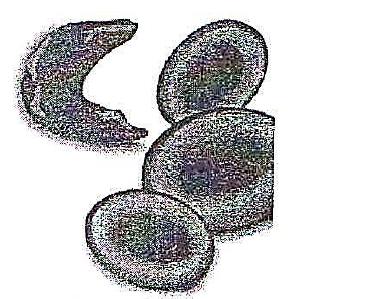
a) What condition is the person suffering from?
b) Why would such a person survive better in malaria prone areas than a normal person?
c) What is the disadvantage of acquiring such a condition?
Date posted:
September 13, 2019
.
Answers (1)