This is the amount of money that households, firms and the government hold, for future exchange of goods and services. These agencies hold money because income (money receipts) and expenditure flows are not synchronized in time. Expenditure tends to be continuous while receipts are discrete. Money is therefore required to bridge the gap between receipts and disbursements. The amount of money held for transaction purposes depend on:
• Level of income
• Spending habits
• Time interval in-between income receipts
Money is held at an opportunity cost of the interest it would earn if it were invested.
Holding spending habits and interval between income receipts constant, the higher the income, the higher the amount of money held for transaction motive.
Transactions demand for money is given by
M
t = L
t (Y)
Where; Y = Level of income, M
t = Total amount of money demanded for transaction motive and L
t = Liquidity function corresponding to the money income
OR
M
t = kY
Where k = Lt and 0 < k < 1
Mt is also a function of frequency of money receipts. The shorter the pay period, the less the money required for transaction purpose, holding other factors constant. As payment period becomes longer, people will need to hold more money for transaction purpose.
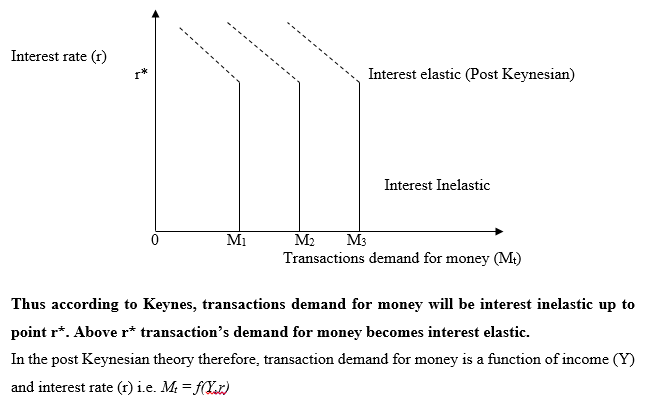
According to Keynes, transactions demand for money is interest inelastic. But at very high interest rates and with increased income, people convert some of their idle balances into interest bearing securities, such as treasury bills, etc, provided that the cost of buying and selling those securities is less than the expected interest.
Kavungya answered the question on
August 10, 2021 at 08:17