-
Define standard heat of combustion of a substance.
(Solved)
Define standard heat of combustion of a substance.
Date posted:
May 17, 2019
.
Answers (1)
-
Study the diagram below. State and explain the observation made after sometime
(Solved)
Study the diagram below.
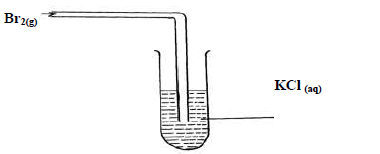
State and explain the observation made after sometime.
Date posted:
May 17, 2019
.
Answers (1)
-
Give an equation to show how chlorine forms bleaching powder.
(Solved)
Give an equation to show how chlorine forms bleaching powder.
Date posted:
May 17, 2019
.
Answers (1)
-
Chlorine reacts with cold dilute sodium hydroxide to form a bleaching agent.
Name the bleaching agent.
(Solved)
Chlorine reacts with cold dilute sodium hydroxide to form a bleaching agent.
Name the bleaching agent.
Date posted:
May 17, 2019
.
Answers (1)
-
The set up below was used to prepare chlorine gas. (i) Identify solid M (ii) What is the role of water in the experiment?.....
(Solved)
The set up below was used to prepare chlorine gas.
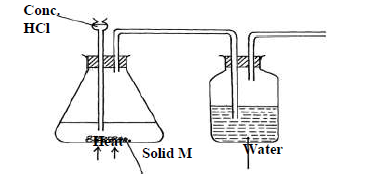
(i) Identify solid M
(ii) What is the role of water in the experiment?
(iii) Complete the set up to show how dry chlorine gas can be collected
(iv) Write a chemical equation to show how chlorine gas is formed.
Date posted:
May 17, 2019
.
Answers (1)
-
State one use of lead.
(Solved)
State one use of lead.
Date posted:
May 17, 2019
.
Answers (1)
-
Pure lead can be obtained by electrolysis. Identify the anode and cathode for the
process.
(Solved)
Pure lead can be obtained by electrolysis. Identify the anode and cathode for the
process.
Date posted:
May 17, 2019
.
Answers (1)
-
The flow chart below summarizes the process of extraction of lead from a chief ore.
(Solved)
The flow chart below summarizes the process of extraction of lead from a chief ore.
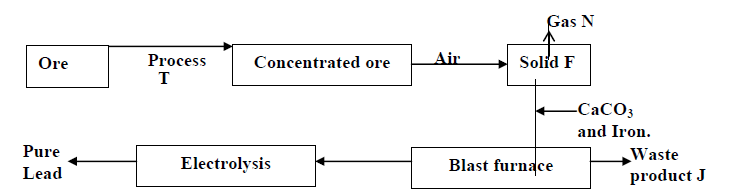
(i) Identify process T
(ii) Give the name of:
Gas N
Solid F
(iii) Give two functions of CaCO3 in the extraction process.
(iv) Write an equation to show how waste product J is formed.
Date posted:
May 17, 2019
.
Answers (1)
-
Name any two ores of lead.
(Solved)
Name any two ores of lead.
Date posted:
May 17, 2019
.
Answers (1)
-
A sealed glass tube containing 250 cm3 of nitrogen gas at r.t.p was immersed in boiling water. Calculate the pressure inside the tube if the...
(Solved)
A sealed glass tube containing 250 cm3 of nitrogen gas at r.t.p was immersed in boiling water. Calculate the pressure inside the tube if the volume of the gas does not change due to expansion of glass. (Room pressure=760mmHg, room temperature=298K).
Date posted:
May 17, 2019
.
Answers (1)
-
Explain this observation:
When hydrogen chloride gas is dissolved in water, the solution conducts electricity while a
solution of hydrogen chloride gas in propanone does not conduct...
(Solved)
Explain this observation:
When hydrogen chloride gas is dissolved in water, the solution conducts electricity while a
solution of hydrogen chloride gas in propanone does not conduct electricity
Date posted:
May 17, 2019
.
Answers (1)
-
A solution of bromine in methyl benzene turns colourless when butane gas is passed through it.
(Solved)
A solution of bromine in methyl benzene turns colourless when butane gas is passed through it.
(a) What type of reaction takes place?
(b) Write equation of the reaction which takes place.
Date posted:
May 17, 2019
.
Answers (1)
-
60 cm3 of ozone (O3) diffused through a semi permeable membrane in 80 seconds. Calculate the time taken for 90 cm3 of nitrogen (IV) oxide...
(Solved)
60 cm3 of ozone (O3) diffused through a semi permeable membrane in 80 seconds. Calculate the time taken for 90 cm3 of nitrogen (IV) oxide (NO2) to diffuse under the same conditions. (O=16,N=14).
Date posted:
May 17, 2019
.
Answers (1)
-
The set up below was used by a student. Filter paper soaked in purple litmus solution was
placed in the middle of the combustion tube.
(Solved)
The set up below was used by a student. Filter paper soaked in purple litmus solution was
placed in the middle of the combustion tube.
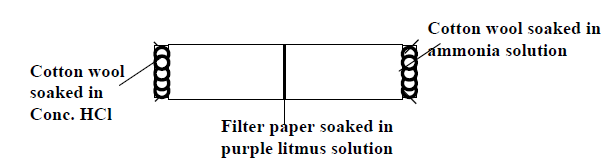
(i) What is the main aim of the experiment.
(ii) State the first observation likely to have been made in the tube. Explain the observation.
Date posted:
May 17, 2019
.
Answers (1)
-
0.5g of Manganese (IV) oxide were added to 50 cm3 of 3.5M hydrogen peroxide. The
temperature of the solution rose from 21oC to 64oC. The information...
(Solved)
0.5g of Manganese (IV) oxide were added to 50 cm3 of 3.5M hydrogen peroxide. The
temperature of the solution rose from 21oC to 64oC. The information was represented on an energy level diagram as shown.
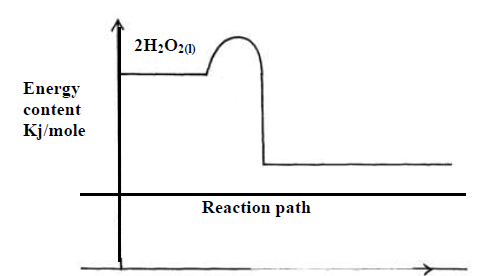
(a) Determine the number of moles of hydrogen peroxide that decomposed.
(b) Calculate the molar enthalpy of decomposition of hydrogen peroxide.
(c) On the same set of axes above sketch the curve that would be obtained if manganese (IV)
oxide was not used and other conditions remained constant.
Date posted:
May 17, 2019
.
Answers (1)
-
In a reaction, an alkanol B was converted to pent-2-ene
(Solved)
In a reaction, an alkanol B was converted to pent-2-ene
(a) Give the structural formula of alkanol B.
(b) Name (i) the type of reaction that converts alkanol B to pent-2-ene.
(ii) The reagent used.
Date posted:
May 17, 2019
.
Answers (1)
-
The diagram below is a set up used to investigate the effect of heat on hydrated copper(II)
sulphate. Study the diagram and answer the questions that...
(Solved)
The diagram below is a set up used to investigate the effect of heat on hydrated copper(II)
sulphate. Study the diagram and answer the questions that follow.
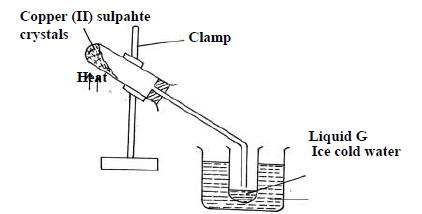
(a) Why is boiling tube slanted as shown?
(b) What is observed in the boiling tube.
(c) Identify liquid G.
Date posted:
May 17, 2019
.
Answers (1)
-
Explain why the following combination of reagents is unsuitable for the laboratory
preparation of hydrogen.
(Solved)
Explain why the following combination of reagents is unsuitable for the laboratory
preparation of hydrogen.
(i) Zinc + dilute nitric acid.
(ii) Lead + dilute hydrochloric acid.
(iii) Potassium + dilute sulphuric acid.
Date posted:
May 17, 2019
.
Answers (1)
-
Give names of the following processes used to:
(Solved)
Give names of the following processes used to:
(a) Obtain a solvent from a saturated solution.
(b) Remove steam from air
(c) Separate zinc carbonate from water
(d) Separate a mixture of nitrogen and helium.
Date posted:
May 17, 2019
.
Answers (1)
-
Describe a simple test that can be carried out in the laboratory to distinguish between manganese (IV) oxide and copper (II) oxide.
(Solved)
Describe a simple test that can be carried out in the laboratory to distinguish between manganese (IV) oxide and copper (II) oxide.
Date posted:
May 17, 2019
.
Answers (1)