-
Re-arrange the following sentences to make a short story.
(Solved)
Re-arrange the following sentences to make a short story.
a) The bird, highly flattered, opened her mouth to sing.
b) One day a crow spied a piece of cheese on a window sill.
c) The cheese fell and was soon eaten by the crafty animal.
d) She picked it up and flew to a neighboring tree.
e) A cunning fox approached and praised her voice.
Date posted:
October 14, 2019
.
Answers (1)
-
Read the passage below and then answer the questions that follow.
(Solved)
Read the passage below and then answer the questions that follow.
Moving to a new country can be exciting, even exhilarating experience. In a new environment, you somehow feel more alive: seeing new sights, eating new food, hearing the foreign sounds of a new language, and feeling a different climate against your skin stimulate your senses as never before. Soon, however, this sensory bombardment becomes sensory overload. Suddenly, new experiences seem stressful rather than stimulating, and delight turns into discomfort. This is the phenomenon known as culture shock. Culture shock is more than jet lag or homesickness, and it affects nearly everyone who enters a new culture – tourists, business travelers, diplomats and students alike. Although not everyone experiences culture shock in exactly the same way, many experts agree that it has roughly five stages.
In the first stage, you are excited by your new environment. You experience some simple difficulties such as trying to use the telephone or public transportation, but you consider these small challenges that you can
quickly overcome. Your feelings about the new culture are positive, so you are eager to make contact with people and to try new foods.
Sooner or later, differences in behavior and customs become more noticeable to you. This is the second stage of culture shock. Because you do not know the social customs of the new culture, you may find it difficult to make friends. For instance, you do not understand how to make “small talk,” so they overhear a conversation. You understand all the words, but you do not understand the meaning. Why is everyone laughing? Are they laughing at you or at some joke that you did not understand?
Also, you aren’t always sure how to act while shopping. Is this store self-service or should you wait for a clerk to assist you? If you buy a sweater the wrong size, can you exchange it? These are not minor challenges; they are major frustrations.
In the third stage you no longer have positive feelings about the new culture. You feel that you have made a mistake in coming here. Making friends hasn’t been easy, so you begin to feel lonely and isolated. Now you want to be with familiar people and eat similar food. You begin to spend most your free time with students from your home country, and you eat in restaurants that serve your native food. In fact, food becomes an obsession, and you spend a lot of time planning, shopping for, and cooking food from home.
You know that you are in the fourth stage of culture shock when you have negative feelings about almost everything. In this stage you actively reject the new culture. You become critical, suspicious, and irritable. You believe that people are unfriendly, that your landlord is trying to cheat you, that your teachers do not like you, and that the food is making you sick. In fact, you may actually develop stomachaches, headaches, sleeplessness, lethargy, or other physical symptoms.
Finally, you reach the fifth stage. As your language skills improve, you begin to have some success in meeting people and in negotiating situations. You are able to exchange the sweater that was too small, and you can successfully chat about the weather with a stranger on the bus. Your self-confidence grows. After realizing that you cannot change your surroundings, you begin to accept the differences and tolerate them. For instance the food will never be as tasty as the food in your home country, but you are now able to eat and sometimes even enjoy many dishes. You may not like the way some people in your host country dress or behave in public, but you do not regard their clothes and behavior as wrong – just different. In conclusion, nearly everyone moving to a new country feels some decree of culture shock.
Symptoms may vary, and not all people experience all five stages. Newcomers with a strong support group may feel at home immediately in the new culture, while others take months to feel comfortable. Staying in touch with friends and family, keeping a positive attitude, and above all, learning the language as soon as possible is ways to overcome the difficulties and frustrations of adapting to life in a new land.
From: Writing Academic English, Alice Oshima and Ann Hogue, Pearson Education, Longman (2006)
(a) According to the passage, what is the meaning of culture shock?
(b) Identify any three factors that can cause culture shock?
(c) What evidence does the author give to show "you understand all the words, but you do not understand the meaning"?
(d) Give any three features that characterize a person in the worst state of culture shock.
(e) In note form, give the difficulties experienced in the second stage of culture shock
(f) Why is making friends helpful in overcoming culture shock?
(g) Explain the meaning of the following words as used in the passage.
i. Alive –
ii. Obsession –
iii. Negotiation –
(h) Staying in touch with friends and family, keeping a positive attitude, and, above all, learning the language as soon as possible are ways to overcome the difficulties and frustrations of adapting to life in a new land.
(Rewrite the sentence above without changing the meaning. Begin: You.....)
Date posted:
October 14, 2019
.
Answers (1)
-
Read the following narrative and answer the questions that follow.
(Solved)
Read the following narrative and answer the questions that follow.
The Ndebele tell their children that long ago, there were three friends: the beautiful leopard, the jackal and the hyena. They went everywhere together. Whenever Leopard killed an animal, he would always leave part of it for his friends so that they could have a good feed too.
One day it happened that leopard was ill, and so he could not hunt. "Jackal," he said, "please catch some food for us, for I am not well."
But lazy Jackal said, "No, I am too weary. Ask Hyena."
So Leopard said, "Hyena, please hunt for us today, for I am not well enough to do so.”
But Hyena, too, made an excuse: "No, I have a sore foot."
So leopard roared in anger. "I thought you were my friends, but you are a no-good, lazy pair. Never again will I leave you meat when I make my kill. From this day on, I will make sure of it. I shall take what is left and hang it in a tree, when I have eaten all I want. Then neither of you will be able to get at it."
Leopard was true to his word – for since that day he has never left any meat for his selfish friends. Up into a tree it goes, high out of reach of jackals and hyenas. They have become scavengers now instead, and they eat the scraps that other animals leave behind. It was a sad day for them when they lost Leopard’s friendship.
(when Hippo was Hairy and Other Tales from Africa, Letterworth Press, 1990)
a) Giving a reason for your answer, say what kind of narrative this is.
b) What character can you give the leopard?
c) Identify the features of oral narratives that have been used in this story.
d) What lessons do we learn from this story?
e) What function is played by an opening formula and a closing formula in an oral narrative?
Date posted:
October 14, 2019
.
Answers (1)
-
Read the comprehension below and answer the questions that follow.
(Solved)
Read the comprehension below and answer the questions that follow.
Prof Atieno Ndede-Amadi the head of the university’s school of Business at Technical University of Kenya (TUK) and associate professor of information systems and accounting, has embarked on a crusade to convince her peers of the need to introduce information systems (IS) analysis as a complete academic programme. She believes that the course would benefit young people interested in IT, as well as local enterprises that have had to rely on expatriates with the skill.
Prof Atieno’s concern arises from her own study. She established that despite a high demand for information system analysts there weren’t many Kenyans specially trained for the job.
As such, companies were hiring outsiders as local universities continued to concentrate on broad range computer science and programming courses, and failing to give much thought to IS analysis.
Information system analysts are trained to evaluate and develop technology systems to help business to run optimally. They identify user and consumer needs and translate them into technology solutions. Despite this critical function, there aren’t many people called IS analysts in the local market, and that’s because the universities here have not been keen to train in this specialization.
“A wide systems analysis skills gap exists in the country due to the absence of strong information system academic programs in local universities.” Prof Atieno states in her study report which is titled,” Information Systems Education in Kenya: Students Specialization Choice trends.” The work has been published in the International Journal of Education and Development using Information and communication Technology (IJEDICT). The study found that of all the 32 public universities and university colleges studied, none offered an information systems or management information systems degree. Only two degrees came close with four institutions offering a Bachelor of Technology (Business Information Technology) degree in varying combinations, and one university offering a Bachelor in Business Information and Management.
Prof Atieno says that if both students and university heads fully appreciated the value of information systems analysis, they would be more focused on it as an area of study. She actually established in her study that the supply gap of people with the skill is largely a result of ignorance. Globally, a majority of IS programs within universities are located in business schools, and they have names such an information systems, management information systems, computer information systems, business information systems, or business information technology. An IS degree programme combines business and computing topics, with the emphasis on technical and organizational issues varying from one programme to another, and also from one academic institution to the next. Generally, it bridges business and computer science, using the theoretical foundations of information and computation to study various business models and related algorithmic process within the computer science discipline.
According to Prof Atieno, organizations cannot effectively and efficiently do business without solid IS setups for connecting systems within as well as with its supply chain stake holders, such as vendors and distributors. Yet, many students aren’t aware of the possibility of a career in this field. In fact, the study found that only 11% of those interviewed knew about IS analysis as a possible area of specialization. “An Information system as an academic discipline seems to be largely unknown to high school students in Kenya, making it impossible for them to select it as an area of specialization in their university education,” it states. The net effect is that the level of IS education in the country has suffered, resulting in a deficiency in systems analysis and related skills.
1. What campaigns has Prof Atieno Amadi involved herself in according to paragraph one.
2. Mention the consequence Kenyans face as a result of lack of personnel in Information Systems Analysis.
3. Explain the irony evident in the passage.
4. Enumerate the functions of an Information System analyst.
5. In your own words write the message in this passage.
6. What do you think is shocking about the findings of this study.
7. What is the tone of the passage?
8. i) A wide system analysis skills gap exists in the country due to the absence of strong information systems.
Begin: As a result
ii) There weren’t many Kenyans specially trained for the job (add a question tag)
9. Explain the meaning of the following words and phrases as used in the passage
i. Globally
ii. Specialization.
iii. Supply chain stake holders
iv. Algorithmic processes
Date posted:
October 14, 2019
.
Answers (1)
-
Read the passage below and answer the questions that follow.
WASTE DISPOSAL
Population in most cities increasing at a very high rate. The high population...
(Solved)
Read the passage below and answer the questions that follow.
WASTE DISPOSAL
Population in most cities increasing at a very high rate. The high population results in high levels of activities and consumption. People in cities consume a lot of food and they buy groceries from shops, which are wrapped in polythene bags. As a result, a lot of garbage is generated and disposed off within and outside the urban areas. The higher the population, the higher the amount of garbage generated. This means that there should be an efficient system of collecting and disposing off the garbage.
The effectiveness of waste management by city councils varies from country to country. In most African cities, a large amount of waste is not deposited in rubbish pits. Instead, it is dumped in the open. According to United Nations Environmental Program (UNEP) statistics, sixty five percent of garbage in Tripoli, for example, is dumped in the open while eighty percent of garbage in Ismailia (Egypt is also dumped in the open.
With extreme warm temperatures such garbage tends to decompose rapidly causing serious health risks besides being a nuisance. One common method of deposing off waste is open burning. This contributes to the problem of urban air pollution.
In Nairobi, for example, it is common to find informal open burning sites. Most residents of city estates say that they are forced to burn waste in the open because the city council is incapable of dealing with the increasing amount of garbage. When waste is not disposed off effectively, it affects human health and damages the environment. For example, it has led to problems such as pollution of water sources, offensive odour, and increase in disease vectors, pests and scavengers.
However, there are examples of domestic waste being disposed off hygienically or being recycled. For example, in rural Egypt, there are organizations that promote environmental awareness among women by providing them with plastic bags so that they can collect their garbage. On the other hand, the youth are given the task of taking the garbage to a designated collection point. This scheme can be imported to the urban areas with a lot of success.
Another possible solution could be the introduction of reusable shopping bags in place of the usual polythene bags. Supermarkets and other businesses can pack customers’ goods in bags that are reusable. This would drastically reduce the amount of domestic waste generated everyday.
Questions
a) What is the result of high population in most cities?
b)In most African cities, where are large amounts of waste deposited?
c)How much waste does Egypt dump in the open?
d)What two problems result from dumping waste in the open?
e)Why is open burning of waste common?
f)In what two ways can waste be successfully managed according to the passage?
g)In note form, briefly state the various forms of waste disposal discussed in the passage.
h)Why is Egypt mentioned in the passage?
i)What is the writer’s attitude towards the city council?
j)The high population results in high levels of activities and consumption.
(Rewrite beginning So…..)
k)Explain the meaning of the following words and phrases as used in the passage.
i) Offensive odour
ii)Disposed off
iii)Decompose
Date posted:
October 10, 2019
.
Answers (1)
-
An experiment was set to investigate the effect of unilateral light on the growth of oat coleoptiles. The diagram in the table represents the experimental...
(Solved)
An experiment was set to investigate the effect of unilateral light on the growth of oat coleoptiles. The diagram in the table represents the experimental set ups the start and the result at the end of experiment.
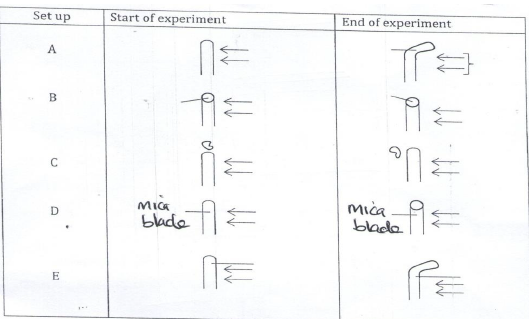
(a) Account for the reaction in experiment set up A
(b) Explain the purpose of experiment set up B and C
c) Explain the results in the experiment set D and E
D
E
Date posted:
October 9, 2019
.
Answers (1)
-
The table below shows the concentration of sodium and iodine ions in pond water and in the cell sap
(Solved)
The table below shows the concentration of sodium and iodine ions in pond water and in the cell sap.
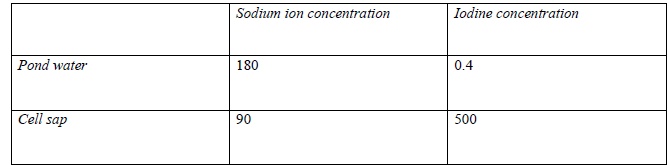
Giving reasons name the process through which each of the ions is taken up by the plants
a)
(i) Sodium ion
(ii) Iodine ion
(b) The lettuce plant was then treated with a chemical substance that inhibits the synthesis of ATP Giving a reason, state which ion was affected by the treatment.
(c) Explain why fresh water fish cannot survive is marine habitat.
Date posted:
October 9, 2019
.
Answers (1)
-
Arrange the adjective in the sentences below in their correct order.
(Solved)
Arrange the adjective in the sentences below in their correct order.
i) My friends and I attended a (political, boring, huge) rally.
ii) Why do you still keep this (shapeless, torn, Brazilian) mat?
iii) We found the tourist looking at the (collapsed, ugly, ancient) building.
iv) My uncle operates a (medical, new, successful) store.
Date posted:
October 9, 2019
.
Answers (1)
-
For each of the words in capital letters below, place the stress marker to show where stress falls in the word.
(Solved)
For each of the words in capital letters below, place the stress marker to show where stress falls in the word.
i) My COLLEAGUE and I will visit you.
ii) She keeps her car in PERFECT condition.
Date posted:
October 9, 2019
.
Answers (1)
-
You have been invited to a neighboring school to participate in a debating session. List four things you would do before and during the debate...
(Solved)
You have been invited to a neighboring school to participate in a debating session. List four things you would do before and during the debate in order to be effective.
Date posted:
October 9, 2019
.
Answers (1)
-
The underlining indicates which word is stressed in the sentences below. Briefly explain what each sentence means.
(Solved)
The underlining indicates which word is stressed in the sentences below. Briefly explain what each sentence means.
i) We borrowed this book.
ii) We borrowed this book.
iii) We borrowed this book.
iv) We borrowed this book.
Date posted:
October 9, 2019
.
Answers (1)
-
Fill in each blank space in the passage below with the most appropriate word.
(Solved)
Fill in each blank space in the passage below with the most appropriate word.
Girls and their families may find little 1 .... to the attend school if they are 2 ....that girls are of 3 ...value than boys on if they are tracked 4 .... fields of study on how low paid occupations considered 5 ...... for women. Studies shows that in Africa, Asia and the middle East, women are 6 .... portrayed as subordinate and passive 7 .... men are shown as displaying intelligence leadership and dominance. Many developing countries 8 .....practice gender streaming in secondary schools directing girl 9 ....from Maths and Science. Teaching 10 .....such as giving boys more opportunities to ask and answer questions may further discourage girls.
Date posted:
October 9, 2019
.
Answers (1)
-
Choose the correct form of adjectives in brackets to fill in blank spaces.
(Solved)
Choose the correct form of adjectives in brackets to fill in blank spaces.
i) The weather today is ...........than yesterday’s. (forbidding)
ii) This is the........... student in this class. (timid)
iii) I could do with a ........... brush; this one is worn out. (fine)
iv) Which is the cake with the ........... sugar? (little)
v) Is this one really as ........... as that one? (bad)
Date posted:
October 9, 2019
.
Answers (1)
-
The following is a riddling session. In each space, indicate the name of the stage.
(Solved)
The following is a riddling session. In each space, indicate the name of the stage.
Abby: Riddle, Riddle
Bob: Riddle come
Abby: My house has no door
Bob: A stone
Abby: Not correct.
Bob: An orange
Abby: No Give me a prize.
Bob: I give you London city.
Abby: Thank you. And the correct answer is an egg.
Date posted:
October 9, 2019
.
Answers (1)
-
Underline the odd one out according to the pronunciation of letters ‘S’
(Solved)
Underline the odd one out according to the pronunciation of letters ‘S’
i) Set one (helps, cooks, lanes, pigs )
ii) Set two ( consul, unsure, censure, insult)
Date posted:
October 9, 2019
.
Answers (1)
-
Write the silent letter.
(Solved)
Write the silent letter.
i) Guilt
ii) Asthma
iii) Drastically
iv) Buffet
v) Condemn
Date posted:
October 9, 2019
.
Answers (1)
-
Fill in the blank spaces with the most appropriate words.
(Solved)
Fill in the blank spaces with the most appropriate words.
Praise songs are songs....1...describe the ....2....qualities that some individuals or possessions such as cattle....3..., and which put them above others....4... praise songs use ....5... to describe qualities that ....6.... those praised above those who are just ....7.... Those praised in the song are usually ....8... to animals that are revered for their positive qualities ....9..... bravely, gracefulness and wisdom. Kings, chiefs, warriors and famous medicine men/women are the....10.... of most praise songs.
Date posted:
October 9, 2019
.
Answers (1)
-
Read the following poem then answer the questions that follow.
(Solved)
Read the following poem then answer the questions that follow.
MADE FOR PURE PLEASURE
Like buds too wonderful to name,
Each miracle unfolds,
And Catherine-wheels begin to flame
Like a whirling marigolds
Rockets and Roman candles make
An orchard of the sky,
Whence magic trees their petals shake
Upon each gazing eye
Questions
i) What is the rhyme scheme of this poem?
ii) Using a vivid example, explain how rhythm has been achieved in this poem.
Date posted:
October 9, 2019
.
Answers (1)
-
Rewrite according to the instruction without changing the meaning of the sentence.
(Solved)
Rewrite according to the instruction without changing the meaning of the sentence.
i. I will talk to Joseph. I will talk to Kennedy.
Combine using ‘both’
ii. My father is a watchman. My mother is a watchwoman.
Combine by removing gender-insensitive words
iii. The musician wore a new shirt. The musician moved to the stage.
Begin: Wearing.......
iv. Be mindfull of the people sitting there.
Correct the error
Date posted:
October 8, 2019
.
Answers (1)
-
Read the excerpt below and then answer the questions that follow.
(Solved)
Read the excerpt below and then answer the questions that follow.
Helmer. You can’t deny it, my dear little Nora. (Puts his arm round her waist.) It’s a sweet little spendthrift, but she uses up a deal of money. One would hardly believe how expensive such little persons are!
Nora. It’s a shame to say that. I do really save all I can.
Helmer (laughing). That’s very true,–all you can. But you can’t save anything!
Nora (smiling quietly and happily). You haven’t any idea how many expenses we skylarks and squirrels have, Torvald.
Helmer. You are an odd little soul. Very likeyour father. You always find some new way of wheedling money out of me, and, as soon as you have got it, it seems to melt in your hands. You never know where it has gone. Still, one must take you as you are. It is in the blood; for indeed it is true that you can inherit these things, Nora.
Nora. Ah, I wish I had inherited many of papa’s qualities.
Helmer. And I would not wish you to be anything but just what you are, my sweet little skylark. But, do you know, it strikes me that you are looking rather–what shall I say–rather uneasy today?
Nora. Do I?
Helmer. You do, really. Look straight at me.
Nora (looks at him). Well?
Helmer (wagging his finger at her). Hasn’t Miss Sweet Tooth been breaking rules in town today?
Nora. No; what makes you think that?
Helmer. Hasn’t she paid a visit to the confectioner’s?
Helmer. Not been nibbling sweets?
Nora. No, certainly not.
Helmer. Not even taken a bite at a macaroon ortwo?
Nora. No, Torvald, I assure you really–
Helmer. There, there, of course I was only joking.
Nora (going to the table on the right). I should notthink of going against your wishes.
Helmer. No, I am sure of that; besides, yougave me your word– (Going up to her.) Keepyour little Christmas secrets to yourself, mydarling. They will all be revealed tonight whenthe Christmas Tree is lit, no doubt.
Nora. Did you remember to invite Doctor Rank?
(a) 'You can’t deny it, my dear little Nora?' What is Nora denying?
(b) 'Helmer refers to Nora as a sweet little spendthrift who is expensive.' Agree with him by drawing your three supportive illustrations from what happens earlier and later in the play.
(a) '.......it strikes me that you are looking rather–what shall I say–rather uneasy today?' Why in Nora uneasy referring to what happens earlier in the play?
(b) 'Hasn’t Miss Sweet Tooth been breaking rules in town today?' What is Helmer’s attitude towards Nora when he says the words in boldface?
(c) Discuss two themes presented in the excerpt
(d) Describe two traits of Nora as portrayed in the excerpt
(e) 'Did you remember to invite Doctor Rank?' Paraphrase the statements made by Helmer on the topic of Doctor Rank and the event immediately after this excerpt.
f) Give an alternative word with the same meaning as each of the following words as used in the excerpt.
i. Wheedling
ii. Nibbling
Date posted:
October 8, 2019
.
Answers (1)