
(a) Fixed Interest loans, which is usually a medium term loan of up to 5 years. The borrower
knows in advance what his interest payments will be.
(b) Roll over (variable interest rates) loans. These are loans whereby the bank agrees to
provide finance to the borrower for a given period but the interest rate on the loan is subject to
renegotiation at pre-arranged intervals of every 3 or 6 months.
(c) Stand by credit: This is an overdraft facility offered by a bank to its customers in a
eurocurrency. The bank charges an agreed interest rate together with a commitment fee of
about 1% for funds made available to the customer under the credit, but which he then fails to
draw.
(d) Syndicated credit, which are large Eurocurrency loans put together for a single customer by a
syndicate of banks, usually for a longer term than the Eurocurrency loans. The customer
approaches a bank for a loan and if the bank is unable or unwilling to provide all the loan itself,
it can arrange, by means of a placement memorandum, for a number of other banks to
contribute to the loan as a member of a syndicate. The bank which sets up the syndicate is
known as the managing bank.
(e) Euro commercial paper (or euro notes): This is a short-term financial instrument:
i. Issued in the form of unsecured promissory notes with a fixed maturity of up to one year
ii. Issued in bearer form
iii. Issued on a discount basis (so the rate of interest) on the commercial paper is implicit in
its sales value)
The eurocommercial paper is denominated in any currency - usually a hand currency.
Kavungya answered the question on April 15, 2021 at 07:25
-
XYZ Ltd, a UK firm has bought goods from a US supplier and must pay USD 4 million in 3 months time.
The company finance...
(Solved)
XYZ Ltd, a UK firm has bought goods from a US supplier and must pay USD 4 million in 3 months time.
The company finance director wishes to hedge against the foreign exchange risk and is considering 3
methods:
- Using the forward exchange contract
- Using the money market hedge
- Using a lead payments
Annual interest rate and foreign exchange rate are given below:
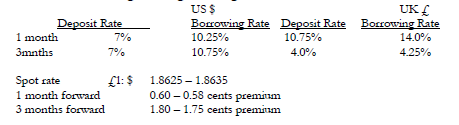
Required
Advise the company on the best method to use.
Date posted:
April 15, 2021
.
Answers (1)
-
Assume that the foreign currency (F) has been quoted against the £ as follows :
Spot rate ...
(Solved)
Assume that the foreign currency (F) has been quoted against the £ as follows :
Spot rate £1: F2156 – 2166
3 months forward rate £1: F2207 – 2222
Required:
1. Determine the amount required in sterling pound to buy 2 million foreign currencies
• At the spot
• In 3 months time under the forward exchange contract.
2. Compute the amount a customer would get if he were to sell 2 million foreign currency.
• At the spot rate
• In 3 months time under forward exchange contract
Date posted:
April 15, 2021
.
Answers (1)
-
Assume that the direct quote is deuchemark is DM 1 - USD 0.5 while the general interest rate in US is
6% and general interest rate...
(Solved)
Assume that the direct quote is deuchemark is DM 1 - USD 0.5 while the general interest rate in US is
6% and general interest rate in Germany is 3%.
Required:
Compute the percentage change in direct quote and the new exchange rate.
Date posted:
April 15, 2021
.
Answers (1)
-
XYZ Ltd has an issued share capital of 10 million ordinary shares with a par value of £1, on which it pays a
constant dividend of...
(Solved)
XYZ Ltd has an issued share capital of 10 million ordinary shares with a par value of £1, on which it pays a
constant dividend of £0.4 per share. The market value per share was £2 ex-dividend.
The company then proposed a 1 for 4 rights issue with an issue price of £1.50. The money raised would be
used to finance a major new project, which was expected to increase annual profits after taxation by
£950,000. This information is released together with the announcement of rights issue.
Required:
(a) Compute the cum-right price at the eve-of the rights issue
(b) Compute the theoretical ex-rights price
(c) Calculate the market price per share at the time of the rights issue if the money raised was to be used
to redeem £3,750,000 of 8% debentures. The tax rate is 50%.
Date posted:
April 15, 2021
.
Answers (1)
-
Assume that the following information has been obtained:
P = Sh 20
X = Sh 20
t = 3 months (0.25 years)
KRF = 12%
d² = 0.16
Determine the value...
(Solved)
Assume that the following information has been obtained:
P = Sh 20
X = Sh 20
t = 3 months (0.25 years)
KRF = 12%
δ² = 0.16
Determine the value of the option.
Date posted:
April 14, 2021
.
Answers (1)
-
ABC Ltd has decided to acquire a piece of equipment costing Shs 240 000 of five years. The
equipment is expected to have no salvage value...
(Solved)
ABC Ltd has decided to acquire a piece of equipment costing Shs 240 000 of five years. The
equipment is expected to have no salvage value ate the end and the company uses straight-line
depreciation method on all it Fixed Assets. The company has two financing alternative methods
available, leasing or borrowing.
The loan has an interest rate of 15% requiring equal-year-end installments to be paid. The lease
would be set at a level that would amortize the cost of equipment over the lease period and would
provide the lessor with a 14% return on capital. The company’s tax rate is 40%.
Required:
a. Compute the annual lease payments.
b. Compute the PV of the cash out flow under lease financing
c. Calculate the annual loan installment payment
d. For each of the 5 years, calculate the interest and the principal component of the loan
repayment.
e. Calculate the PV of after tax cash flow under the loan alternative
f. Which alternative is better and why?
Date posted:
April 14, 2021
.
Answers (1)
-
A company negotiates a Sh 30 million loan for eight years from a financial institution. The interest rate is 14% per annum on the outstanding...
(Solved)
A company negotiates a Sh 30 million loan for eight years from a financial institution. The interest rate is 14% per annum on the outstanding balance of the loan. The principal and interest will be repaid in eight equal year-end instalments.
Required
Prepare a loan repayment schedule
Date posted:
April 14, 2021
.
Answers (1)
-
A company currently has Shs 20 000 000, 12% debenture issue outstanding which has 20 years remaining to maturity. The company can now sell a...
(Solved)
A company currently has Shs 20 000 000, 12% debenture issue outstanding which has 20 years remaining to maturity. The company can now sell a Shs 20 million 20 year bond or debenture with a normal or coupon rate of 20% that will net Shs 19.6 million, after the underwriting expenses of the old bond. The core premium and the unamortized discount of the old bond
are deductible as expenses in the year of refunding. The old issue has Shs 200 000 unamortized
discounts outstanding and unamortized legal fee of Shs 100 000. The core right of old bond is
Shs 109 and the issuing expenses on the new bond are Shs 150, 000 and there is a 30 day period
of interest overlap. Assume that the effective income tax is 50%.
Required:
Advice the company on whether to replace the old issue with the new bonds.
Date posted:
April 14, 2021
.
Answers (1)
-
XYZ Ltd has 900,000 shares outstanding at current market price of Sh 130 per share. The company
needs Sh 22,500,000 to finance its proposed expansion. The...
(Solved)
XYZ Ltd has 900,000 shares outstanding at current market price of Sh 130 per share. The company
needs Sh 22,500,000 to finance its proposed expansion. The board of directors has decided to issue
rights for raising the required funds. The subscription price has been fixed at Sh 75 per share.
Required:
(a) How many rights are required to purchase one new share?
(b) What is the price of one share after the rights issue (Ex-right price)?
(c) Compute the theoretical value of each right
(d) Consider the effect of the rights issue on the shareholders' wealth under the three options
available to the shareholders (Assume he owns 3 shares and has Sh 75 cash on hand).
Date posted:
April 14, 2021
.
Answers (1)
-
Companies U and L are identical in every respect except that U is unlevered while L has Sh 10 million of 5% bonds outstanding. Assume
(a)...
(Solved)
Companies U and L are identical in every respect except that U is unlevered while L has Sh 10 million of 5% bonds outstanding. Assume
(a) That all of the MM assumptions are met
(b) That there are no corporate or personal taxes
(c) That EBIT is Sh 2 million
(d) That the cost of equity to company U is 10%
Required:
i. Determine the value MM would estimate for each firm
ii. Determine the cost of equity for both firms
iii. What is the overall cost of capital for both firms
iv. Suppose the value of U is Sh 20 million and that of L is Sh 22 million. Explain the arbitrage process for a shareholder who owns 10% of company L's shares.
Date posted:
April 14, 2021
.
Answers (1)
-
Company A and B are in the same risk class and are identical in every respect except that Company A is
geared while B is not....
(Solved)
Company A and B are in the same risk class and are identical in every respect except that Company A is
geared while B is not. Company A has Sh 6 million in 5% bonds outstanding. Both companies earn 10%
before interest and taxes on their Sh 10 million total assets. Assume perfect capital markets, rational
investors, a tax rate of 60% and a capitalization rate of 10% for an all equity company.
Required:
(a) Compute the value of firms A and B using the net income (NI) approach and Net operating income
(NOI) approach.
(b) Using the NOI approach, calculate the after tax weighted average cost of capital for firms A and B.
Which of these firms has the optimal capital structure according to NOI approach? Why?
(c) According to the NOI approach, the values of firms A and B computed in (a) are not in equilibrium.
Assuming that you own 10% of A's shares, show the process which will give you the same amount of
income but at less cost. At what point would this process stop?
Date posted:
April 14, 2021
.
Answers (1)
-
X Ltd intends to take-over Y Ltd by offering two of its share for every five shares in Y Company Ltd.
Relevant financial data is as...
(Solved)
X Ltd intends to take-over Y Ltd by offering two of its share for every five shares in Y Company Ltd.
Relevant financial data is as follows:
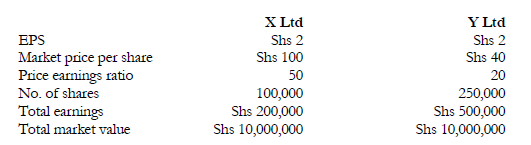
Required.
a. Compute the combined EPS & MPS
b. Has wealth been created for shareholders?
Date posted:
April 14, 2021
.
Answers (1)
-
The following data are pertinent for companies A and B.
a. If the two companies were to merge and the exchange ratio were one share of...
(Solved)
The following data are pertinent for companies A and B.

a. If the two companies were to merge and the exchange ratio were one share of Company A for each share of Company B, what would be the initial impact on earnings per share of the two companies? what is the market value exchange ratio? Is the merger likely to take place?
b. If the exchange ratio were two shares of Company A for each share of Company B what would happen with respect to the above?
c. If the exchange ratio were 1.5 shares of Company A for each share of Company B, what would happen?
d. What exchange ratio would you recommend?
Date posted:
April 14, 2021
.
Answers (1)
-
XYZ Ltd. is considered acquiring ABC Ltd. The following information relates to ABC Ltd. for the next five years. The projected financial data are for...
(Solved)
XYZ Ltd. is considered acquiring ABC Ltd. The following information relates to ABC Ltd. for the next five years. The projected financial data are for the post-merger period. The corporate tax rate is 40% for both companies.

Other information
a. After the fifth year the cashflows available to XYZ from ABC is expected to grow by 10% per
annum in perpetuity.
b. ABC will retain Shs 40,000 for internal expansion every year.
c. The cost of capital can be assumed to be 18%.
REQUIRED:
i. Estimate the annual cash flows.
ii. Determine the maximum amount XYZ would be willing to acquire ABC at.
Date posted:
April 14, 2021
.
Answers (1)
-
Company A is considering the acquisition by shares of Company B. The following information is also available.
Company B has agreed to an offer of Shs...
(Solved)
Company A is considering the acquisition by shares of Company B. The following information is also available.
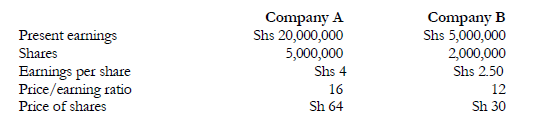
Company B has agreed to an offer of Shs 35 a share to be paid in Company A shares.
Consider the effect of the acquisition to the earnings per share.
Date posted:
April 14, 2021
.
Answers (1)
-
XYZ ltd. is considering three possible capital projects for next year. Each project has a 1 year life, and
project returns depend on next years state...
(Solved)
XYZ ltd. is considering three possible capital projects for next year. Each project has a 1 year life, and
project returns depend on next years state of the economy. The estimated rates of return are shown below.
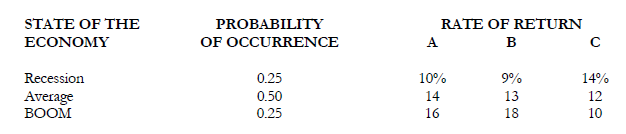
a. Find each project expected rate of return, variance, standard deviation and coefficient of
variation.
b. Compute the correlation coefficient between
i. A and B
ii. A and C
iii. B and C
c. Compute the expected return on a portfolio if the firm invests equal wealth on each asset.
d. Compute the standard deviation of the portfolio.
Date posted:
April 13, 2021
.
Answers (1)
-
The risk free rate is 10% and the expected return on the market portfolio is 15%. The expected returns for 4
securities are listed below together...
(Solved)
The risk free rate is 10% and the expected return on the market portfolio is 15%. The expected returns for 4
securities are listed below together with their expected betas.
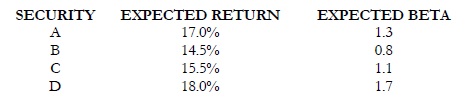
a. On the basis of these expectations, which securities are overvalued? Which are undervalued?
b. If the risk-free rate were to rise to 12% and the expected return on the market portfolio rose to 16%,
which securities would be overvalued? which would be under-valued? (Assume the expected returns
and the betas remain the same).
Date posted:
April 13, 2021
.
Answers (1)
-
Security returns depend on only three risk factors-inflation, industrial production and the aggregate degree of
risk aversion. The risk free rate is 8%, the required rate...
(Solved)
Security returns depend on only three risk factors-inflation, industrial production and the aggregate degree of
risk aversion. The risk free rate is 8%, the required rate of return on a portfolio with unit sensitivity to
inflation and zero-sensitivity to other factors is 13.0%, the required rate of return on a portfolio with unit
sensitivity to industrial production and zero sensitivity to inflation and other factors is 10% and the required
return on a portfolio with unit sensitivity to the degree of risk aversion and zero sensitivity to other factors is
6%. Security i has betas of 0.9 with the inflation portfolio, 1.2 with the industrial production and-0.7 with
risk bearing portfolio—(risk aversion)
Assume also that required rate of return on the market is 15% and stock i has CAPM beta of 1.1
Required:
Compute security i's required rate of return using
a. CAPM
b. APT
Date posted:
April 13, 2021
.
Answers (1)
-
Assume that the risk free rate of return is 8%, the market expected rate of return is 12%. The standard deviation of the market return...
(Solved)
Assume that the risk free rate of return is 8%, the market expected rate of return is 12%. The standard deviation of the market return is 2% while the covariance of return for security A and the market is 2%.
What is the required rate of return on Security A?
Date posted:
April 13, 2021
.
Answers (1)
-
Four assets have the following distribution of returns.a. Compute the expected return and standard deviation of each asset.b. Compute the covariance of asseti. A and...
(Solved)
Four assets have the following distribution of returns.
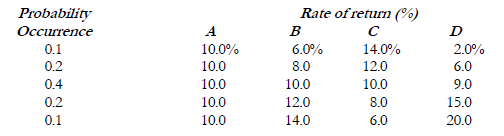
Required.
a. Compute the expected return and standard deviation of each asset.
b. Compute the covariance of asset
i. A and B
ii. B and C
iii. B and D
c. Compute the correlation coefficient of the combination of assets in b above.
Date posted:
April 13, 2021
.
Answers (1)