
• Reduction in Trade Barriers
SAP’s require the removal of barriers to imports, including tariffs, to facilitate integration into
the international market. In practice, these measures allow cheaper imports to flood the
country, depressing local industry and agriculture and leading to massive unemployment.
• Currency Devaluation
By making imports more expensive and exports cheaper, neo-liberal economist (such as
McKinnon (1973) and Shaw (1973)) asserts that devaluation will reduce trade imbalances,
freeing more resources for debt repayment. In practice however, devaluation makes essential
imports like medicines and oil far more costly, placing a strain on the poor countries.
• Price Liberalisation
Price controls and subsidies are removed to eliminate artificial disincentives for production.
In theory, this encourages food production. What is certain is that these measures increase
the price of food and basic services, making life difficult for the poor.
• Export promotion
Priority is given to production for export since this earns the country hard currency needed
for debt repayment. As a result, more and more land is used for cash crops and food
production falls. Pesticide use and deforestation increase, leading to ecological destruction.
Labour laws are weakened to drive down wages and increase foreign investment in assembly
plants for export products.
• Cutting government budgets
National budgets are slashed to free up resources for debt repayment. In particular,
expenditures to social services, health, and education are normally reduced drastically. As a
result, the future prospects for the poor are severely diminished. Governments must also sell
state corporations to raise money and increase efficiency. Layoffs in the civil service and
privatized enterprises however, cause more unemployment.
• Raising interest rates
Interest rates rise to depress excess demand and decrease inflation. As a result, internal
investment is restricted and farm credit disappears. Local production falls and unemployment
rises (which does, in fact, depress demand by ensuring that people can no longer buy
essentials like food, housing, and medicine).
Kavungya answered the question on April 15, 2021 at 07:30
-
State and explain the types of euro-currency loans.
(Solved)
State and explain the types of euro-currency loans.
Date posted:
April 15, 2021
.
Answers (1)
-
ABC Ltd a UK firm has been invited to tender for a contract in Blueland with the local currency of Blues
(B). The company thinks that...
(Solved)
ABC Ltd a UK firm has been invited to tender for a contract in Blueland with the local currency of Blues
(B). The company thinks that the contract should cost £1 850, 000 and is prepared to price the contract
at £2 million. The current exchange rate for Blues and £ is £1: B2.80. The company therefore bids for
B5.6 million. The contract will not be awarded until after six months. A 6 month currency option to sell
B5.6 million at an exchange rate of £1: B2.8 is currently costing £40 000.
ABC Ltd can either buy the option or enter into forward Exchange contract at a rate of £1: B 2.80,
Assume that the company fails to win the contract and the spot rate in 6 months time is £1:B2.50.
Required:
Advice the company on which alternative is better.
Date posted:
April 15, 2021
.
Answers (1)
-
XYZ Ltd, a UK firm has bought goods from a US supplier and must pay USD 4 million in 3 months time.
The company finance...
(Solved)
XYZ Ltd, a UK firm has bought goods from a US supplier and must pay USD 4 million in 3 months time.
The company finance director wishes to hedge against the foreign exchange risk and is considering 3
methods:
- Using the forward exchange contract
- Using the money market hedge
- Using a lead payments
Annual interest rate and foreign exchange rate are given below:
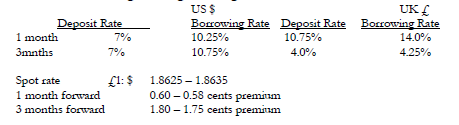
Required
Advise the company on the best method to use.
Date posted:
April 15, 2021
.
Answers (1)
-
Assume that the following quotation is given:
Spot rate £1: USD1.635 - USD 1.6385
One month forward...
(Solved)
Assume that the following quotation is given:
Spot rate £1: USD1.635 - USD 1.6385
One month forward 0.5 – 0.47 cents premium
Required:
Compute the cost of the forward cover for a customer
Buying dollars 1 month forward.
Selling dollars one month forward.
Date posted:
April 15, 2021
.
Answers (1)
-
Assume that the foreign currency (F) has been quoted against the £ as follows :
Spot rate ...
(Solved)
Assume that the foreign currency (F) has been quoted against the £ as follows :
Spot rate £1: F2156 – 2166
3 months forward rate £1: F2207 – 2222
Required:
1. Determine the amount required in sterling pound to buy 2 million foreign currencies
• At the spot
• In 3 months time under the forward exchange contract.
2. Compute the amount a customer would get if he were to sell 2 million foreign currency.
• At the spot rate
• In 3 months time under forward exchange contract
Date posted:
April 15, 2021
.
Answers (1)
-
State and explain the ways in which the exchange rate exposure can be perceived.
(Solved)
State and explain the ways in which the exchange rate exposure can be perceived.
Date posted:
April 15, 2021
.
Answers (1)
-
Outline the advantages of using fixed exchange rates.
(Solved)
Outline the advantages of using fixed exchange rates.
Date posted:
April 15, 2021
.
Answers (1)
-
Define the term fixed exchange rate.
(Solved)
Define the term fixed exchange rate.
Date posted:
April 15, 2021
.
Answers (1)
-
Assume that the direct quote is deuchemark is DM 1 - USD 0.5 while the general interest rate in US is
6% and general interest rate...
(Solved)
Assume that the direct quote is deuchemark is DM 1 - USD 0.5 while the general interest rate in US is
6% and general interest rate in Germany is 3%.
Required:
Compute the percentage change in direct quote and the new exchange rate.
Date posted:
April 15, 2021
.
Answers (1)
-
Assume that the direct quote between the USD and £ is £1 = USD 1.5 and that the inflation rate in UK is
10% and the...
(Solved)
Assume that the direct quote between the USD and £ is £1 = USD 1.5 and that the inflation rate in UK is
10% and the inflation rate in the US is 6%
Required
Compute the % change in the direct quote and determine the new exchange rate.
Date posted:
April 15, 2021
.
Answers (1)
-
Dimango Company is considering whether it would be financially advisable to retire its existing long term
debt with a cheaper loan. The current loan of Sh...
(Solved)
Dimango Company is considering whether it would be financially advisable to retire its existing long term
debt with a cheaper loan. The current loan of Sh 10 million has an annual interest charge of 15% and has 10
years to maturity. The company has Sh 125,000 of unamortized loan expenses still in the books.
If the company decides to redeem the loan, there is an early payment penalty amounting to 10% of the loan.
A new Sh 10 million loan can be raised at 13% per annum for a ten year period. It is expected that
underwriting costs will amount to Sh 600,000. In addition to these costs, the company will be further
required to pay interest for the two months which would allow the normal interest payment due to be
reached for the old loan.
Dimango Company is in the 40% income tax bracket.
Required:
(a) Calculate the net amount of cash investment required for the refunding of the loan.
(b) Compute the annual cash savings which result from refunding
(c) Determine whether refunding is advantageous to the company
(PVIFA 8% = 6.71)
Date posted:
April 15, 2021
.
Answers (1)
-
XYZ Ltd has an issued share capital of 10 million ordinary shares with a par value of £1, on which it pays a
constant dividend of...
(Solved)
XYZ Ltd has an issued share capital of 10 million ordinary shares with a par value of £1, on which it pays a
constant dividend of £0.4 per share. The market value per share was £2 ex-dividend.
The company then proposed a 1 for 4 rights issue with an issue price of £1.50. The money raised would be
used to finance a major new project, which was expected to increase annual profits after taxation by
£950,000. This information is released together with the announcement of rights issue.
Required:
(a) Compute the cum-right price at the eve-of the rights issue
(b) Compute the theoretical ex-rights price
(c) Calculate the market price per share at the time of the rights issue if the money raised was to be used
to redeem £3,750,000 of 8% debentures. The tax rate is 50%.
Date posted:
April 15, 2021
.
Answers (1)
-
Assume that the following information has been obtained:
P = Sh 20
X = Sh 20
t = 3 months (0.25 years)
KRF = 12%
d² = 0.16
Determine the value...
(Solved)
Assume that the following information has been obtained:
P = Sh 20
X = Sh 20
t = 3 months (0.25 years)
KRF = 12%
δ² = 0.16
Determine the value of the option.
Date posted:
April 14, 2021
.
Answers (1)
-
ABC Ltd has decided to acquire a piece of equipment costing Shs 240 000 of five years. The
equipment is expected to have no salvage value...
(Solved)
ABC Ltd has decided to acquire a piece of equipment costing Shs 240 000 of five years. The
equipment is expected to have no salvage value ate the end and the company uses straight-line
depreciation method on all it Fixed Assets. The company has two financing alternative methods
available, leasing or borrowing.
The loan has an interest rate of 15% requiring equal-year-end installments to be paid. The lease
would be set at a level that would amortize the cost of equipment over the lease period and would
provide the lessor with a 14% return on capital. The company’s tax rate is 40%.
Required:
a. Compute the annual lease payments.
b. Compute the PV of the cash out flow under lease financing
c. Calculate the annual loan installment payment
d. For each of the 5 years, calculate the interest and the principal component of the loan
repayment.
e. Calculate the PV of after tax cash flow under the loan alternative
f. Which alternative is better and why?
Date posted:
April 14, 2021
.
Answers (1)
-
What is a venture capital?
(Solved)
What is a venture capital?
Date posted:
April 14, 2021
.
Answers (1)
-
State and explain the features of warrants.
(Solved)
State and explain the features of warrants.
Date posted:
April 14, 2021
.
Answers (1)
-
A company negotiates a Sh 30 million loan for eight years from a financial institution. The interest rate is 14% per annum on the outstanding...
(Solved)
A company negotiates a Sh 30 million loan for eight years from a financial institution. The interest rate is 14% per annum on the outstanding balance of the loan. The principal and interest will be repaid in eight equal year-end instalments.
Required
Prepare a loan repayment schedule
Date posted:
April 14, 2021
.
Answers (1)
-
A company currently has Shs 20 000 000, 12% debenture issue outstanding which has 20 years remaining to maturity. The company can now sell a...
(Solved)
A company currently has Shs 20 000 000, 12% debenture issue outstanding which has 20 years remaining to maturity. The company can now sell a Shs 20 million 20 year bond or debenture with a normal or coupon rate of 20% that will net Shs 19.6 million, after the underwriting expenses of the old bond. The core premium and the unamortized discount of the old bond
are deductible as expenses in the year of refunding. The old issue has Shs 200 000 unamortized
discounts outstanding and unamortized legal fee of Shs 100 000. The core right of old bond is
Shs 109 and the issuing expenses on the new bond are Shs 150, 000 and there is a 30 day period
of interest overlap. Assume that the effective income tax is 50%.
Required:
Advice the company on whether to replace the old issue with the new bonds.
Date posted:
April 14, 2021
.
Answers (1)
-
State and explain the advantages of dividend reinvestment scheme.
(Solved)
State and explain the advantages of dividend reinvestment scheme.
Date posted:
April 14, 2021
.
Answers (1)
-
XYZ Ltd has 900,000 shares outstanding at current market price of Sh 130 per share. The company
needs Sh 22,500,000 to finance its proposed expansion. The...
(Solved)
XYZ Ltd has 900,000 shares outstanding at current market price of Sh 130 per share. The company
needs Sh 22,500,000 to finance its proposed expansion. The board of directors has decided to issue
rights for raising the required funds. The subscription price has been fixed at Sh 75 per share.
Required:
(a) How many rights are required to purchase one new share?
(b) What is the price of one share after the rights issue (Ex-right price)?
(c) Compute the theoretical value of each right
(d) Consider the effect of the rights issue on the shareholders' wealth under the three options
available to the shareholders (Assume he owns 3 shares and has Sh 75 cash on hand).
Date posted:
April 14, 2021
.
Answers (1)