
Dividends as residual
- In a small world with no external finance, dividend policy should be residual. This means that the
only source of finance for additional investment is earnings and consequently dividends should only
be paid when the firm has financed all its positive NPV projects
- In a world with transaction costs, associated with dividends and obtaining investment finance
through the sale of new shares, dividend policy will be influenced by, but not exclusively determined
by the dividend as a residual approach policy.
Clientele preferences
- The clientele preferences or effect is the concept that shareholders are attracted to firms that follow dividend policy (i.e.) consistent with their objectives. In other words some shareholders prefer a dividend pattern which matches their desired consumption patterns.
- For example, retired people, listing off their private investments, may prefer a stable and steady
income and so they would tend to be attracted to firms with a high and stable dividend yield.
Likewise, pension funds need regular cash receipts to meet payments to pensioners.
Kavungya answered the question on April 19, 2021 at 20:03
-
Mr. Charles Kabazi has a capital of Sh.1,000,000 which he wishes to invest in three sectors of
the economy; agriculture, service and manufacturing. The funds will...
(Solved)
Mr. Charles Kabazi has a capital of Sh.1,000,000 which he wishes to invest in three sectors of
the economy; agriculture, service and manufacturing. The funds will be allocated as follows:
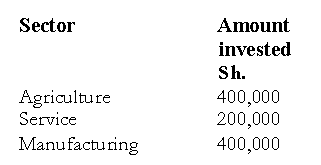
Details on the possible future economic states, their probabilities of occurrence and the expected return
for each of the sectors are presented below:

Required:
i) Determine the risk associated with the investment in each of the three sectors above.
ii) Determine the expected portfolio return
Date posted:
April 19, 2021
.
Answers (1)
-
A company is considering whether it is necessary to purchase equipment to increase its production and
sales volumes. The equipment costs Sh.500,000 and has a useful...
(Solved)
A company is considering whether it is necessary to purchase equipment to increase its production and
sales volumes. The equipment costs Sh.500,000 and has a useful life of three years after which it can be
sold as scrap for Sh.80,000. For each of the three years of usage, the equipment is expected to increase
both sales revenue and operating costs by Sh.600,000 and Sh.390,000 respectively. The company's cost
of capital is 10%
Required:
i) Calculate the project's net present value (NPV)
ii) Compute the percentage changes required in the cost of the equipment, the scrap value and the sales
revenue for the project to be rejected.
Date posted:
April 19, 2021
.
Answers (1)
-
The following details relating to Bidii Limited show how the level of gearing affects the
company's cost of debt.
Required:
Determine the company's optimal capital structure.
(Solved)
The following details relating to Bidii Limited show how the level of gearing affects the
company's cost of debt.

Required:
Determine the company's optimal capital structure.
Date posted:
April 19, 2021
.
Answers (1)
-
Distinguish between a currency option and a currency swap.
(Solved)
Distinguish between a currency option and a currency swap.
Date posted:
April 19, 2021
.
Answers (1)
-
Highspeed Electronics Limited has taken delivery of 50,000 electronic devices from an American
company. The seller is in a strong bargaining position and has priced the...
(Solved)
Highspeed Electronics Limited has taken delivery of 50,000 electronic devices from an American
company. The seller is in a strong bargaining position and has priced the devices in American dollars
at USD12.00 each.
Highspeed Electronics Limited has been granted three months credit. Assume that interest rates in
America are 3% per quarter (three months). Highspeed electronics Limited has all its money tied up
in its operations but it could borrow in dollars at 3% per quarter if necessary.
Foreign exchange rates
USD = Sh. 1
Spot 0.013
Three month forward 0.0154
A three month dollar call option for USD 600,000 is available at a premium of USD15,000.
Required:
Using suitable computations, illustrate two hedging strategies available to Highspeed
Electronics Limited.
Date posted:
April 19, 2021
.
Answers (1)
-
Kasuku Limited has set aside Sh. 40 million for investments as on 1 January 2004. Five proposals are presented to the company's board of directors...
(Solved)
Kasuku Limited has set aside Sh. 40 million for investments as on 1 January 2004. Five proposals are presented to the company's board of directors by the finance manager as shown below:
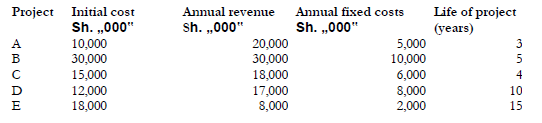
Additional information:
1. Projects D and E are mutually exclusive.
2. Each project is divisible and can only be undertaken once.
3. Variable costs are 40% of annual revenue.
4. All cash flows will occur at the end of the year commencing 31 December 2004.
5. Cost of capital is 10% (ignore tax).
Required:
i. Determine the optimal allocation of the Sh. 40 million amongst the five projects.
ii. What is the net present value resulting from this allocation?
Date posted:
April 19, 2021
.
Answers (1)
-
Savanna Limited has a cost of equity of 10%. Currently it has 250,000 ordinary shares which are quoted
at the Stock Exchange of Sh. 120 per...
(Solved)
Savanna Limited has a cost of equity of 10%. Currently it has 250,000 ordinary shares which are quoted
at the Stock Exchange of Sh. 120 per share. The company's earnings per share is Sh. 10
and it intends to maintain a dividend payout ratio of 50% at the end of the current financial year.
The expected net income for the current year is Sh. 3 million and the available investment
proposals are estimated to cost Sh. 6 million.
Required:
(i) Using the Modigliani and Miller (MM) model, show that the payment of dividends does not affect the value of the firm.
(ii) What are the assumptions inherent in the MM model?
Date posted:
April 19, 2021
.
Answers (1)
-
The managing director of Bicdo Ltd., a company quoted on the Nairobi Stock Exchange (NSE)
has asked you to assist in estimating the firm's equity beta...
(Solved)
The managing director of Bicdo Ltd., a company quoted on the Nairobi Stock Exchange (NSE)
has asked you to assist in estimating the firm's equity beta co-efficient. The firm is all equity
financed and listed in the NSE five years ago. You have gathered the following information from
the NSE for the last four years:
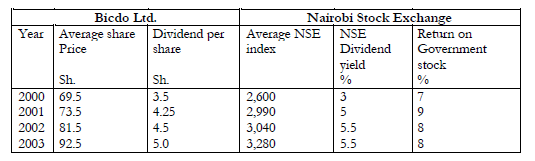
Required:
Use the capital asset pricing model (CAPM) to estimate the beta of Bicdo Ltd.
Date posted:
April 19, 2021
.
Answers (1)
-
Many of the underlying assumptions of CAPM are violated in the real world. Does that fact invalidate the model's conclusions? Explain.
(Solved)
Many of the underlying assumptions of CAPM are violated in the real world. Does that fact invalidate the model's conclusions? Explain.
Date posted:
April 19, 2021
.
Answers (1)
-
Bara Ltd. is contemplating a bid for the share capital of Pwani Ltd. with an intention of buying the whole company. The following data for...
(Solved)
Bara Ltd. is contemplating a bid for the share capital of Pwani Ltd. with an intention of buying the whole company. The following data for the two companies have been provided.

After acquisition, Bara Ltd. intends to sell a division of Pwani Ltd. which accounts for Sh.20 million
annually in equity earnings. The division does not form part of the core business of the intended group. The
division has a current market price of Sh. 50 million.
Bara Ltd.'s management believes that by introducing better management, earnings of Pwani Ltd. could
be permanently increased by 25% although the price/earnings multiple will remain the same. To avoid duplication,
some of Bara Ltd.'s own property could be disposed of at an estimated price of Sh. 130 million.
Rationalization costs are estimated at Sh. 100 million, these comprise retrenchment and legal costs
among others.
Required:
(a) Highlight the advantages of growth by acquisition.
(b) Calculate the effect on the current share price of each company, all other things being equal, of a two for
ten share offer by Bara Ltd., assuming that Bara Ltd.'s estimates are in line with those of the market.
(c) Assume that Bara Ltd. is proposing to offer Pwani Ltd.'s shareholders the choice of a two for ten
share exchange or a cash alternative. Giving reasons, advise Bara Ltd. whether the cash alternative
should be more or less that the current value of the share exchange.
Date posted:
April 19, 2021
.
Answers (1)
-
As a senior financial analyst of an investment bank, you are charged with the responsibility of
estimating the expected returns of various securities. One o the...
(Solved)
As a senior financial analyst of an investment bank, you are charged with the responsibility of
estimating the expected returns of various securities. One o the securities you want to estimate is
expected return in Alpha Steel works Ltd.
You have decided to use arbitrage pricing model and you have derived the following estimates
for the factor betas and risk premiums.
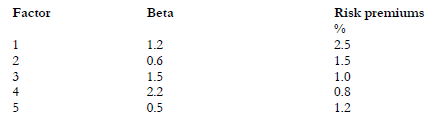
Required:
(i) Identify the risk factor for Alpha Steel Works Ltd.
(ii) If the risk free rate is 5%, estimate the expected return on Alpha Steel Works Ltd.
Date posted:
April 19, 2021
.
Answers (1)
-
Goldstar Manufacturing Limited is evaluating an investment opportunity that would require an
outlay of sh.100 million. The annual net cash inflows are estimated to vary according...
(Solved)
Goldstar Manufacturing Limited is evaluating an investment opportunity that would require an
outlay of sh.100 million. The annual net cash inflows are estimated to vary according to economic
conditions.
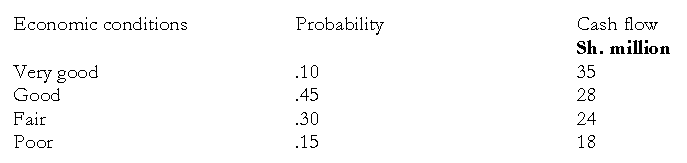
The firm's required rate of return is 14 percent. The project has an expected life of six years.
Required:
Compute the expected net present value (NPV) of the proposed investment.
Date posted:
April 18, 2021
.
Answers (1)
-
Juma Company Ltd. Which is effectively controlled by the Juma family although they own only a minority of shares, is to undertake a substantial new...
(Solved)
Juma Company Ltd. Which is effectively controlled by the Juma family although they own only a minority of shares, is to undertake a substantial new project which requires external finance of about Sh.400 million, leading to a 40% increase in gross assets. The project is to develop and market a new product and is fairly risky. About 70% of the funds required will be spent on land and buildings. The resale value of the land and buildings is expected to remain equal to or greater than, the initial purchase price. Expenditure during the development period of the first 4 to 7 years will be financed from other revenue of Juma Company Ltd. This
will have a consequent strain on the company's overall liquidity.
If, after the development stage, the project proves unsuccessful, then the project will be terminated and its assets sold. If, as is likely, the development is successful, the project's assets will be utilized in production and the company's profits will rise considerably. However, if the project proves to be very successful, then additional finance may be required to further expand the production facilities.
At present, Juma Company Ltd. Is all equity financed.
The financial manager is uncertain whether he should seek funds from a financial institution in the form of an equity interest, a loan (long or short term) r convertible debentures.
Required:
(a) Describe the major factors to be considered by Juma Company Ltd. In deciding on the method of
financing the proposed expansion project.
(b) Briefly discuss the suitability of equity, loans and convertible debentures for the purpose of
financing the project from the point of view of:
(i) Juma Company Ltd.
(ii) The provider of finance.
Clearly state and justify the type of finance recommended for Juma Company Ltd.
Date posted:
April 17, 2021
.
Answers (1)
-
Discuss the importance and limitations of Executive Share Option Plans (ESOPs) in mitigating
management/shareholder agency conflicts.
(Solved)
Discuss the importance and limitations of Executive Share Option Plans (ESOPs) in mitigating
management/shareholder agency conflicts.
Date posted:
April 17, 2021
.
Answers (1)
-
Tom Donji an investment specialist has been entrusted with Sh.10 million by a unit trust and instructed to invest the money optimally over a two-year...
(Solved)
Tom Donji an investment specialist has been entrusted with Sh.10 million by a unit trust and instructed to invest the money optimally over a two-year period. Part of the instructions are that:
The funds be invested in one or more of four specified projects and in the money market
The four projects are not divisible and cannot be postponed.
The unit requires a return of 24% over the two years.
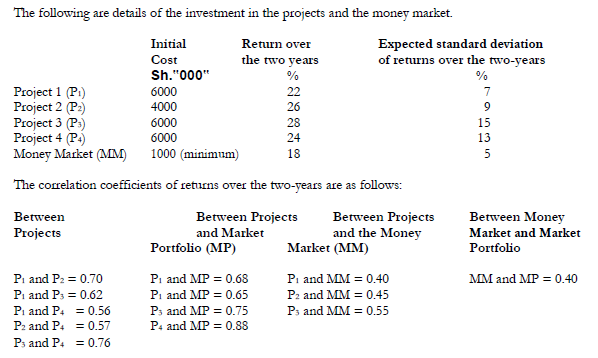
Over the two-year period, the risk free rate is estimated to be 16%, the market portfolio return, 27% and
the variance of the return on the market, 100%.
Required:
By analyzing the two-asset portfolios:
i ) Use the mean-variance dominance rule to evaluate how Tom Donji should invest the Sh.10 million.
ii) Determine the betas and required rates of return for the portfolios and then use the Capital Asset
Pricing Model (CAPM) to evaluate how Tom Donji should invest the Sh.10 million.
Date posted:
April 17, 2021
.
Answers (1)
-
What are the limitations of the Capital Asset Pricing Model (CAPM) as an investment appraisal technique?
(Solved)
What are the limitations of the Capital Asset Pricing Model (CAPM) as an investment appraisal technique?
Date posted:
April 17, 2021
.
Answers (1)
-
The following data relate to call options on two shares, A and B
Required:
Using the Black-Scholes Option Pricing Model (OPM).
Calculate the price of call option A....
(Solved)
The following data relate to call options on two shares, A and B
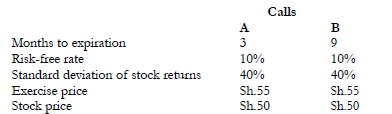
Required:
Using the Black-Scholes Option Pricing Model (OPM).
Calculate the price of call option A. Of the two call options, which would you expect to have the higher price? Why? (Do not compute).
Date posted:
April 17, 2021
.
Answers (1)
-
Given below is the Option Pricing Model (OPM) derived by Black and Scholes in 1973 for predicting the market price of call options.
Required:
State and briefly...
(Solved)
Given below is the Option Pricing Model (OPM) derived by Black and Scholes in 1973 for predicting the market price of call options.
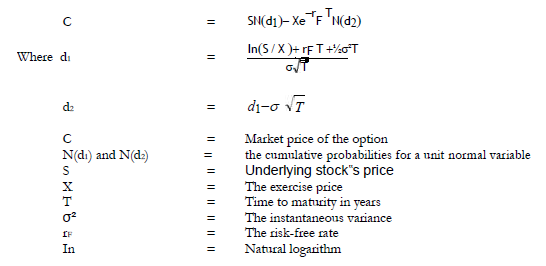
Required:
State and briefly explain the relationship between a call option‟s price and the following determinants:
1) the underlying stock‟s price.
2) the exercise price
3) the time to maturity
4) the risk-free rate.
Date posted:
April 17, 2021
.
Answers (1)
-
City Graphics Limited is evaluating a new technology for its reproduction equipment. The technology will have a
three-year life and would cost Sh.800,000. Its impact on...
(Solved)
City Graphics Limited is evaluating a new technology for its reproduction equipment. The technology will have a
three-year life and would cost Sh.800,000. Its impact on the company‟s cash flows is subject to risk.
In the first year, management estimates that there is an equal chance that the technology will either
succeed and save the company Sh.800,000 or fail saving it nothing at all.
If the technology fails in the first year, savings in the last two years will be zero. Even worse, there is a 40%
chance that additional Sh.240,000 may be required in the second year to convert back to the original process.
If the technology succeeds in the first year, the second year cash flows may be Sh.1,440,000, Sh.1,120,000 or
Sh.800,000 with probabilities of 0.20, 0.60 or 0.20 respectively. Third year cash flows are then expected to be
Sh.160,000 greater or Sh.160,000 less than cash flows in the second year, with equal chance of either
occurring.
All the cash flows above are after taxes.
Required:
a) A probability tree depicting the above cash flow possibilities.
b) Net present values for each possibility using a risk-free rate of 5%.
c) The expected net present value of the technology using a risk-free rate of 5%
Date posted:
April 17, 2021
.
Answers (1)
-
Explain with the aid of a diagram a protective put buying strategy.
(Solved)
Explain with the aid of a diagram a protective put buying strategy.
Date posted:
April 16, 2021
.
Answers (1)