-
The CMA (Capital Markets Authority) has put in place several tax incentives to encourage investments in capital markets.
Highlight some of the tax incentives by the Capital Markets Authority.
Date posted:
December 14, 2021
-
Millennium Investments Ltd. wishes to raise funds amounting to Sh.10 million to finance a project in the following manner:
Sh.6 million from debt; and Sh.4 million from floating new ordinary shares.
The present capital structure of the company is made up as follows:
1. 600,000 fully paid ordinary shares of Sh.10 each
2. Retained earnings of Sh.4 million
3. 200,000, 10% preference shares of Sh.20 each.
4. 40,000 6% long term debentures of Sh.150 each.
The current market value of the company's ordinary shares is Sh.60 per share.
The expected ordinary share dividends in a year's time is Sh.2.40 per share.
The average growth rate in both dividends and earnings has been 10% over the past ten
years and this growth rate is expected to be maintained in the foreseeable future.
The company's long term debentures currently change hands for Sh.100
each. The debentures will mature in 100 years. The preference shares were issued four
years ago and still change hands at face value.
Required:
(i) Compute the component cost of:
- Ordinary share capital;
- Debt capital
- Preference share capital.
(ii) Compute the company's current weighted average cost of capital. (5 marks)
(iii) Compute the company's marginal cost of capital if it raised the additional Sh.10
million as envisaged. (Assume a tax rate of 30%).
Date posted:
December 14, 2021
-
The Apollo Credit Collection Company Ltd. employs agents who collect hire purchase instalments and other outstanding amounts on a door to door basis from Monday to Friday. The agents bank their collections at the close of business everyday from
Monday to Thursday. At the close of business on Friday the week's bankings are withdrawn and, together with Friday's collections, are remitted to the head office. The takings are evenly spread daily and weekly. The budget for the next year
shows that total collections will amount to Sh.26 million. The bankings are used to reduce an overdraft whose interest rate is 19%.
The collection manager has suggested that instead of banking collections, they be remitted daily to the head office by the collectors.
Required:
Determine the increase in annual interest if the collection manager's suggestion was adopted.
Date posted:
December 14, 2021
-
The financial data given below shows the capital structure of Akabebi Company Limited.
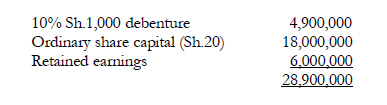 The structure is considered optimum and the management would wish to maintain this level.
Akabebi Company Limited intends to invest in a new project which is estimated to cost
Sh.16,800,000 with an expected net cash flow of Sh.3,000,000 per annum for 10 years. The
management has proposed to raise the required funds through the following means:
1. Issue 100 10% debentures at the current market value of Sh.5,000 per debenture.
2. Utilize 60% of the existing retained earnings.
3. Issue 10% Sh.20 preference shares at the current market price of Sh.25 per share
4. Issue ordinary shares at the current market price of Sh.45 per share. Floatation cost per
share is estimated to be 12% of the share value.
The company's current dividend yield is 5% which is expected to continue in
the near future. Corporation tax rate is 30%.
Required:
(a) Determine the current dividend per share.
(b) Determine the number of ordinary shares to be issued.
(c) Determine the marginal cost of capital for Akabebi Company Ltd based on the above
information.
(d) Evaluate whether it is viable to invest in the proposed project (Round off your answer
for cost of capital to the nearest 1)
(e) Explain clearly the sense in which depreciation is said to be a source of funds to
business firms.
The structure is considered optimum and the management would wish to maintain this level.
Akabebi Company Limited intends to invest in a new project which is estimated to cost
Sh.16,800,000 with an expected net cash flow of Sh.3,000,000 per annum for 10 years. The
management has proposed to raise the required funds through the following means:
1. Issue 100 10% debentures at the current market value of Sh.5,000 per debenture.
2. Utilize 60% of the existing retained earnings.
3. Issue 10% Sh.20 preference shares at the current market price of Sh.25 per share
4. Issue ordinary shares at the current market price of Sh.45 per share. Floatation cost per
share is estimated to be 12% of the share value.
The company's current dividend yield is 5% which is expected to continue in
the near future. Corporation tax rate is 30%.
Required:
(a) Determine the current dividend per share.
(b) Determine the number of ordinary shares to be issued.
(c) Determine the marginal cost of capital for Akabebi Company Ltd based on the above
information.
(d) Evaluate whether it is viable to invest in the proposed project (Round off your answer
for cost of capital to the nearest 1)
(e) Explain clearly the sense in which depreciation is said to be a source of funds to
business firms.
Date posted:
December 14, 2021
-
Andreas Company Ltd. currently pays a dividend of Sh.2 per share and this dividend is expected to grow at an annual rate of 15% for the first 3 years then at a rate of 10% for the next 3 years after which it is expected to grow at a rate of 5% thereafter.
(i) What value would you place on the stock if an 18% rate of return were required?
(ii) Would your valuation change if you expected to hold the stock for only 3 years?
Explain.
Date posted:
December 14, 2021
-
Mwomboko Company Ltd currently operates with terms of net 30 days. The company has sales of Sh.12 million and its average collection period is 45 days. To stimulate demand, the company is considering the possibility of offering terms of net 60 days. If
it offers these terms sales will increase by 20%. After the change the average collection period is expected to increase to 75 days with no difference in payments habits between old and new customers.
The company has variable costs of Sh.70 for every Sh.100 of sales. The required rate of return on receivables is 20%.
Required:
Should the company extend its credit period? (Assume a year has 360 days).
Date posted:
December 14, 2021
-
PQR Ltd. operates a chain of supermarkets. Its strategy has been to adjust product prices to accommodate differences in customers, products, locations and other variables. The market has become increasingly competitive and PQR Ltd. has decided to change its strategy. In future, it will provide a high quality service by introducing Total Quality Management (TQM) techniques in every supermarket.
Explain the relevance of a programme of TQM for PQR Ltd. in the implementation of its new strategy.
Date posted:
April 24, 2021
-
With reference to the measurement of portfolio risk, distinguish between Portfolio theory and the Capital Asset Pricing Model (CAPM).
Date posted:
April 23, 2021
-
Karim plc and Roshan plc are quoted companies. The following figures are from their current balance sheets:
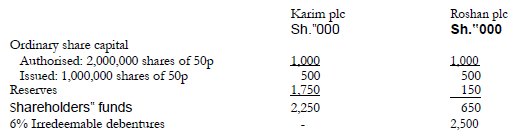 Both companies earn an annual profit, before charging debenture interest of Sh.500,000 which is expected to
remain constant for the indefinite future. The profits of both companies, before charging debenture interest,
are generally regarded as being subject to identical levels of risk. It is the policy of both companies to
distribute all available profits as dividends at the end of each year.
The current market value of Karim Ltd.‟s ordinary shares is Sh.3.00 per share cum div. An
annual dividend is due to be paid in the very near future.
Roshan Ltd. has just made annual dividend and interest payments both on its ordinary shares and on its
debentures. The current market value of the ordinary shares is Sh.1.40 per share and of the debentures,
Sh.50.00 percent.
Mr. Hashim owns 50,000 ordinary shares in Roshan Ltd. He is wondering whether he could increase his
annual income, without incurring any extra risk, by selling his shares in Roshan Ltd and buying some of the
ordinary shares of Karim Ltd. Mr. Hashim is able to borrow money at an annual compound rate of interest
of 12%.
You are required:
(a) to estimate the cost of ordinary share capital and the weighted average cost of capital of Karim Ltd
and Roshan Ltd;
(b) to explain briefly why both the cost of ordinary share capital and weighted average cost of capital of
Karim Ltd differ from those of Roshan Ltd;
(d) to prepare calculations to demonstrate to Mr. Hashim how he might improve his position in the way
he has suggested, stating clearly any reservations you have about the scheme; and
(d) to discuss the implications of your answers to (a), (b) and (c) above for the determination of a
company‟s optimal financial structure in practice.
Both companies earn an annual profit, before charging debenture interest of Sh.500,000 which is expected to
remain constant for the indefinite future. The profits of both companies, before charging debenture interest,
are generally regarded as being subject to identical levels of risk. It is the policy of both companies to
distribute all available profits as dividends at the end of each year.
The current market value of Karim Ltd.‟s ordinary shares is Sh.3.00 per share cum div. An
annual dividend is due to be paid in the very near future.
Roshan Ltd. has just made annual dividend and interest payments both on its ordinary shares and on its
debentures. The current market value of the ordinary shares is Sh.1.40 per share and of the debentures,
Sh.50.00 percent.
Mr. Hashim owns 50,000 ordinary shares in Roshan Ltd. He is wondering whether he could increase his
annual income, without incurring any extra risk, by selling his shares in Roshan Ltd and buying some of the
ordinary shares of Karim Ltd. Mr. Hashim is able to borrow money at an annual compound rate of interest
of 12%.
You are required:
(a) to estimate the cost of ordinary share capital and the weighted average cost of capital of Karim Ltd
and Roshan Ltd;
(b) to explain briefly why both the cost of ordinary share capital and weighted average cost of capital of
Karim Ltd differ from those of Roshan Ltd;
(d) to prepare calculations to demonstrate to Mr. Hashim how he might improve his position in the way
he has suggested, stating clearly any reservations you have about the scheme; and
(d) to discuss the implications of your answers to (a), (b) and (c) above for the determination of a
company‟s optimal financial structure in practice.
Date posted:
April 23, 2021
-
The following data have been developed for the Ujasiri Company Limited:
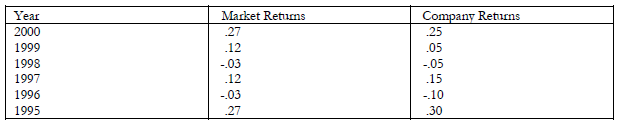 The yield to maturity on Treasury Bills is 0.066 and is expected to remain at this point for the
foreseeable future.
Required:
(a) The equation of the Security Market Line.
(b) The required return for the Ujasiri Company Limited.
(c) Is the Company correctly priced, underpriced or overpriced in the market? Explain.
The yield to maturity on Treasury Bills is 0.066 and is expected to remain at this point for the
foreseeable future.
Required:
(a) The equation of the Security Market Line.
(b) The required return for the Ujasiri Company Limited.
(c) Is the Company correctly priced, underpriced or overpriced in the market? Explain.
Date posted:
April 23, 2021
-
Rodfin plc is considering investing in one of two short-term portfolios of four short-term financial
investments in diverse industries. The correlation between the returns of the individual components of these
investments is believed to be negligible.
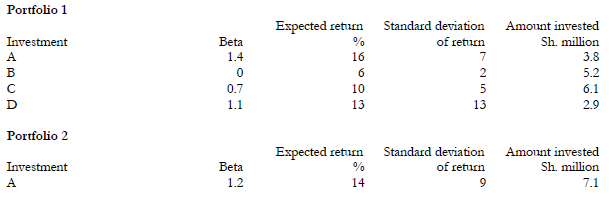
 The managers of Rodfin are not sure of how to estimate the risk of these portfolios, as it has been
suggested to them that either portfolio theory or the capital asset pricing model (CAPM) will give the same
measure of risk. The market return is estimated to be 12.5% and the risk free rate 5.5%.
Required:
(a) Discuss whether or not portfolio theory and CAPM give the same portfolio risk measure.
(b) Using the above data estimate the risk and return of the two portfolios and recommend which one
should be selected.
The managers of Rodfin are not sure of how to estimate the risk of these portfolios, as it has been
suggested to them that either portfolio theory or the capital asset pricing model (CAPM) will give the same
measure of risk. The market return is estimated to be 12.5% and the risk free rate 5.5%.
Required:
(a) Discuss whether or not portfolio theory and CAPM give the same portfolio risk measure.
(b) Using the above data estimate the risk and return of the two portfolios and recommend which one
should be selected.
Date posted:
April 23, 2021
-
XYZ company Limited is considering a major investment in a new productive process. The total
cost of the investment has been estimated at Sh.2,000,000 but if this were increased to Sh.3,000,000,
productive capacity would be substantially increased. Because of the nature of the process, once the
basic plant has been established, to increase capacity at some future date is exceptionally costly. One
of the problem facing management is that the demand for process output is very uncertain.
However, the market research and finance departments have been able to produce the following
estimate:
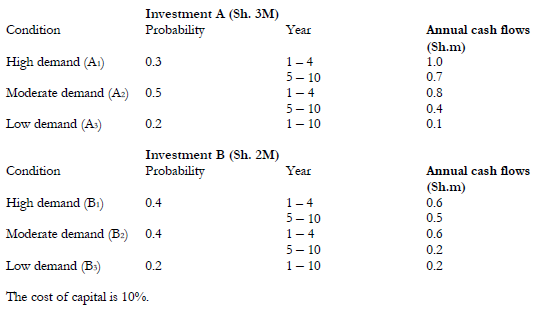 Required:
Compute the expected NPV of each of the project and state the one to be chosen.
Required:
Compute the expected NPV of each of the project and state the one to be chosen.
Date posted:
April 23, 2021
-
Outline the major causes of public projects failure.
Date posted:
April 23, 2021
-
The following data have been provided with respect to three shares traded on the Nairobi
Stock Exchange (NSE).
Share A Share B Share C
Risk free rate of return 0.120 0.120 0.120
Beta coefficient 1.340 1.000 0.750
Return on the NSE index 0.185 0.185 0.185
Required:
(i) What is the beta coefficient?
(ii) Interpret the beta coefficient of shares A, B and C.
(iii) Using the Capital Asset Pricing Model, compute the expected return
on shares A, B and C.
(iv) Can the beta coefficient be less than zero? Explain
Date posted:
April 23, 2021
-
You have been provided with the following information about a project, which XYZ Ltd. is planning to undertake soon.
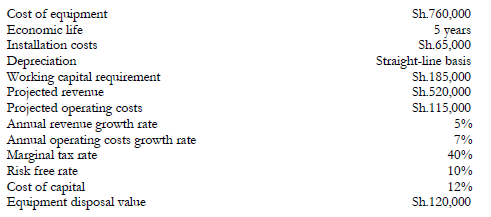 Required:
(a) Calculate the project‟s net investment.
(b) Using the net present value method, show whether or not the project should be undertaken by the company.
(c) Suppose in addition to the information given above you are provided with the following cash
flows certainty equivalents:
Year 0: 1.00
Year 1: 0.90
Year 2: 0.80
Year 3: 0.60
Year 4: 0.50
Year 5: 0.40
Does your conclusion about the acceptability of the project in part (c) above change? Explain.
Required:
(a) Calculate the project‟s net investment.
(b) Using the net present value method, show whether or not the project should be undertaken by the company.
(c) Suppose in addition to the information given above you are provided with the following cash
flows certainty equivalents:
Year 0: 1.00
Year 1: 0.90
Year 2: 0.80
Year 3: 0.60
Year 4: 0.50
Year 5: 0.40
Does your conclusion about the acceptability of the project in part (c) above change? Explain.
Date posted:
April 22, 2021
-
Explain briefly what is meant by foreign currency options and give examples of the advantages and disadvantages of exchange traded foreign currency options to the financial manager.
Date posted:
April 22, 2021
-
You are required to discuss whether a multinational company should hedge translation exposure by incurring transaction exposure.
Date posted:
April 22, 2021
-
A company operating in a country having the dollar as its unit of currency has today invoiced sales to the
United Kingdom in sterling, payment being due three months from the date of invoice. The invoice
amount is £3,000,000 which, at today's spot rate of 1.5985 is equivalent to USD4,795,500.
It is expected that the exchange rate will decline by about 5% over the three month period and in
order to protect the dollar proceeds from the sale, the company proposes taking appropriate
action through either the foreign exchange market or the money market.
The USD/£ three-months forward exchange rate is quoted as 1.5858-1.5873. the three-months
borrowing rate for Eurosterling is 15.0% and the deposit rate quoted by the company's own
bankers is currently 9.5%.
You are required to
Explain the alternative courses of action available to the company, with relevant calculations to four
decimal places, and to advise which course of action should be adopted.
Date posted:
April 22, 2021
-
Fidden is a medium-sized UK company with export and import trade with the USA. The following transactions are due with the next six months. Transactions are in the currency specified.
Purchases of components, cash payment due in three months: £116,000
Sales of finished goods, cash receipt due in three months: USD 197,000
Purchase of finished goods for resale, cash payment due in six months: USD 447,000
Sale of finished goods, cash receipt due in six months: USD 154,000
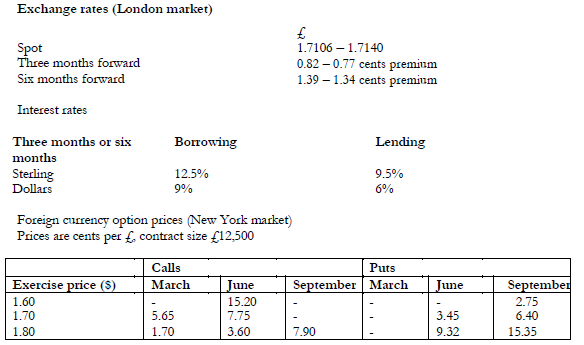 Assume that it is now December with three months to expiry of the March contract and that the option
price is not payable until the end of the option period, or when the option is exercised.
You are required:
(i) to calculate the net sterling receipts/payments that Fidden might expect for both its three and
six month transactions if the company hedges foreign exchange risk on:
the forward foreign exchange market; the money market.
(ii) If the actual spot rate in six months time was with hindsight exactly the present six months forward
rate, calculate whether Fidden would have been better to hedge through foreign currency
options rather than the forward market or money market.
(iii) to explain briefly what you consider to be the main advantage of foreign currency options.
Assume that it is now December with three months to expiry of the March contract and that the option
price is not payable until the end of the option period, or when the option is exercised.
You are required:
(i) to calculate the net sterling receipts/payments that Fidden might expect for both its three and
six month transactions if the company hedges foreign exchange risk on:
the forward foreign exchange market; the money market.
(ii) If the actual spot rate in six months time was with hindsight exactly the present six months forward
rate, calculate whether Fidden would have been better to hedge through foreign currency
options rather than the forward market or money market.
(iii) to explain briefly what you consider to be the main advantage of foreign currency options.
Date posted:
April 22, 2021
-
Ceder Ltd has details of two machines which could fulfill the company's future production
plans. Only one of these machines will be purchased.
The standard model costs Sh.50,000, and the deluxe Sh.88,000, payable immediately. Both
machines would require the input of Sh.10,000 working capital throughout their working lives, and both
machines have no expected scrap value at the end of their expected working lives of four years for the
standard machine and six years for the deluxe machine.
The forecast pre-tax operating net cash flows associated with the two machines are:
 The de-luxe machine has only recently been introduced to the market and has not been fully tested in
operating conditions. Because of the higher risk involved, the appropriate discount rate for the de-luxe
machine is believed to be 14% per year, 2% higher than the discount rate for the standard machine.
The company is proposing to finance the purchase of either machine with a term loan at a fixed interest
rate of 11% per year.
Taxation at 35% is payable on operating cash flows one year in arrears, and capital allowances are available
at 25% per year on a reducing balance basis.
You are required:
(a) to calculate for both the standard and the de-luxe machine:
(i) pay-back period;
(ii) net present value
Recommend, with reasons, which of the two machines Ceder Ltd should purchase.
(Relevant calculations must be shown)
(b) If Ceder Ltd were offered the opportunity to lease the standard model machine over a four year
period at a rental of Sh.15,000 per year, not including maintenance costs, evaluate whether the
company should lease or purchase the machine.
The de-luxe machine has only recently been introduced to the market and has not been fully tested in
operating conditions. Because of the higher risk involved, the appropriate discount rate for the de-luxe
machine is believed to be 14% per year, 2% higher than the discount rate for the standard machine.
The company is proposing to finance the purchase of either machine with a term loan at a fixed interest
rate of 11% per year.
Taxation at 35% is payable on operating cash flows one year in arrears, and capital allowances are available
at 25% per year on a reducing balance basis.
You are required:
(a) to calculate for both the standard and the de-luxe machine:
(i) pay-back period;
(ii) net present value
Recommend, with reasons, which of the two machines Ceder Ltd should purchase.
(Relevant calculations must be shown)
(b) If Ceder Ltd were offered the opportunity to lease the standard model machine over a four year
period at a rental of Sh.15,000 per year, not including maintenance costs, evaluate whether the
company should lease or purchase the machine.
Date posted:
April 22, 2021
-
Justify and criticize the usual assumption made in financial management literature that the objective of a
company is to maximize the wealth of its shareholders. (Do not consider how this wealth is to be measured).
Date posted:
April 21, 2021
-
Discuss how government actions can influence the tasks of the financial manager and explain how these actions can affect the attainment of financial objectives.
Date posted:
April 21, 2021
-
Maltec plc is a company that has diversified into five different industries in five different countries. The investments are each approximately equal in value. The company's objective is to reduce risk
through diversification, and it believes that the return on any investment is not correlated with the return on any other investment. The estimated risk and return (in present value terms) of the five investments are shown below:
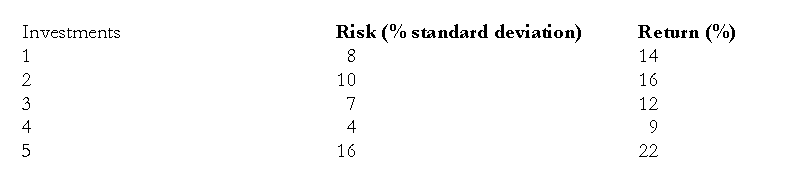 Required:
(a) Estimate the risk and return of the portfolio of five investments, and briefly explain the significance of your results.
(b) Discuss the validity to investors of Maltec's objective of risk reduction through international
diversification.
Required:
(a) Estimate the risk and return of the portfolio of five investments, and briefly explain the significance of your results.
(b) Discuss the validity to investors of Maltec's objective of risk reduction through international
diversification.
Date posted:
April 21, 2021
-
Outline the potential problems in the achievement of synergies.
Date posted:
April 20, 2021
-
Explain the possible synergies that might occur in mergers and acquisitions.
Date posted:
April 20, 2021
-
Briefly discuss the meaning and importance of the terms 'delta', 'theta' and 'vega' (also known as
kappa or lamba) in option pricing.
Date posted:
April 20, 2021
-
The managers of Strayer plc are investigating a potential Sh.25 million investment. The investment would be a diversification away from existing mainstream activities and into the printing industry. Sh.6 million of the investment would be financed by internal funds, Sh.10 million by a rights issue and Sh.9 million by long term loans. The investment is expected to generate pre-tax net cash flows of approximately Sh.5 million per year, for a period of ten years. The residual value at the end of year ten is forecast to be Sh.5 million after tax. As the investment is in an area that the government wishes to develop, a subsidized loan of Sh.4 million out of the total Sh.9 million is available. This will cost 2% below the company's normal cost of long-term debt finance, which is 8%.
Strayer's equity beta is 0.85, and its financial gearing is 60% equity, 40% debt by value. The average
equity beta in the printing industry is 1.2, and average gearing 50% equity, 50% debt by market value.
The risk free rate is 5.5% per annum and the market return 12% per annum.
Issue costs are estimated to be 1% for debt financing (excluding the subsidized loan), and 4% for
equity financing. These costs are not tax allowable.
The corporate tax rate is 30%.
Required:
(a) Estimate the Adjusted Present Value (APV) of the proposed investment.
(b) Comment upon the circumstances under which APV might be a better method of evaluating a
capital investment than Net Present Value (NPV).
Date posted:
April 20, 2021
-
Components Manufacturing Corporation (CMC) has an all-common-equity capital structure. It has 200,000 shares of Sh.2 par value common stock outstanding. When CMC‟s founder, who has also its research director and most successful inventor; retired unexpectedly to the South Pacific in late 2000, CMC was left suddenly and permanently with materially lower growth expectations and relatively few attractive new investment opportunities. Unfortunately, there was no way to replace the founder's contributions to the firm.
Previously, CMC found it necessary to plow back most of its earnings to finance growth, which averaged 12 percent per year. Future growth at a five percent rate is considered realistic, but that level would call for an increase in the dividend payout. Further, it now appears that new investment projects with at least the 14 percent rate of return required by CMC's stockholders (ks= 14%) would amount to only Sh.800,000 for 2001in comparison to a projected Sh.2,000,000 of net income. If the existing 20 percent dividend payout were continued, retained earnings would be Sh.1.6 million in 2001, but as noted, investments that yield the 14 percent cost of capital would amount to only Sh.800,000.
The one encouraging thing is that the high earnings from existing assets are expected to continue, and
net income of Sh.2 million is still expected for 2001. Given the dramatically changed
circumstances, CMC's management is reviewing the firm's dividend policy.
(a) Assuming that the acceptable 2001 investment projects would be financed entirely by earnings
retained during the year, calculate DPS in 2001 if CMC follows the residual divided policy.
(b) What payout ratio does your answer to part a imply for 2001?
(c) If a 60 percent payout ratio is maintained for the foreseeable future, what is your estimate of
the present market price of the common stock? How does this compare with the market price
that should have prevailed under the assumptions existing just before the news
about the founder's retirement? If the two values of P0 are different, comment on why.
(d) What would happen to the price of the stock if the old 20 percent payout were continued? Assume
that if this payout is maintained, the average rate of return on the retained earnings will fall to 7.5
percent and the new growth rate will be
g = (1.0 – Payout ratio)(ROE)
= (1.0 – 0.2)(7.5%) = (0.8)(7.5%) = 6.0%
Date posted:
April 20, 2021
-
Lancaster Engineering Inc. (LEI) has the following structure, which it considers to be optimal:
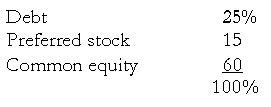 LEI's expected net income this year is Sh.34,285.72; its established dividend payout ratio is 30
percent; its marginal tax rate is 40 percent; and investors expect earnings and dividends to grow at a
constant rate of nine percent in the future. LEI paid a dividend of Sh.3.60 per share last hear, and its stock currently sells at a price of Sh.60 per share.
LEI can obtain new capital in the following ways:
Common: New common stock has a flotation cost of ten percent for up to Sh.12,000 of new stock and
20percent for all common stock over Sh.12,000.
Preferred: New preferred stock with a dividend of Sh.11 can be sold to the public at a price of Sh.100
per share. However, flotation costs of Sh.5 per share will be incurred for up to Sh.7,500 of preferred stock, and flotation costs will rise to Sh.10 per share, or ten percent, on all preferred stock over Sh.7,500.
Debt: Up to Sh.5,000 of debt can be sold at an interest rate of 12 percent; debt in the range of Sh.5,001 to Sh.10,000 must carry an interest rate of 14 percent; and all debt over Sh.10,000 will have an interest rate of 16 percent.
LEI has the following independent opportunities:
LEI's expected net income this year is Sh.34,285.72; its established dividend payout ratio is 30
percent; its marginal tax rate is 40 percent; and investors expect earnings and dividends to grow at a
constant rate of nine percent in the future. LEI paid a dividend of Sh.3.60 per share last hear, and its stock currently sells at a price of Sh.60 per share.
LEI can obtain new capital in the following ways:
Common: New common stock has a flotation cost of ten percent for up to Sh.12,000 of new stock and
20percent for all common stock over Sh.12,000.
Preferred: New preferred stock with a dividend of Sh.11 can be sold to the public at a price of Sh.100
per share. However, flotation costs of Sh.5 per share will be incurred for up to Sh.7,500 of preferred stock, and flotation costs will rise to Sh.10 per share, or ten percent, on all preferred stock over Sh.7,500.
Debt: Up to Sh.5,000 of debt can be sold at an interest rate of 12 percent; debt in the range of Sh.5,001 to Sh.10,000 must carry an interest rate of 14 percent; and all debt over Sh.10,000 will have an interest rate of 16 percent.
LEI has the following independent opportunities:
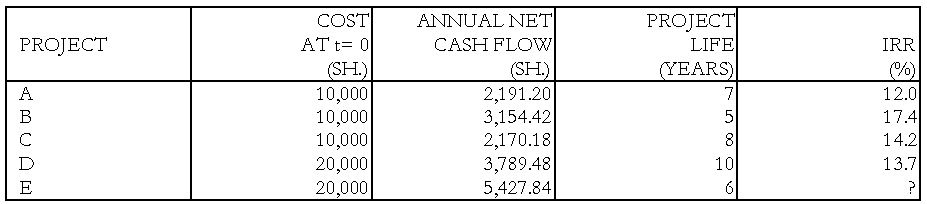 (a) Find the break points in the MCC schedule
(b) Determine the cost of each capital structure component.
(c) Calculate the weighted average cost of capital in the interval between each break in the
MCC schedule.
(d) Calculate the IRR for Project E.
(e) Construct a graph showing the MCC and IOS schedules.
(f) Which projects should LEI accept?
(a) Find the break points in the MCC schedule
(b) Determine the cost of each capital structure component.
(c) Calculate the weighted average cost of capital in the interval between each break in the
MCC schedule.
(d) Calculate the IRR for Project E.
(e) Construct a graph showing the MCC and IOS schedules.
(f) Which projects should LEI accept?
Date posted:
April 20, 2021
-
Dove Construction Company Ltd made a Sh.100 million bondage 5 years ago when interest rates were
substantially high. The interest rates have now fallen and the firm wishes to retire this old debt and replace it with a new and cheaper one. Given here below are the details about the two bond issues:
Old Bonds: The outstanding bonds have a nominal value of Sh.1,000 and 24% coupon interest rate. They
were issued 5 years ago with a 15-year maturity. They were initially sold a their nominal value of Sh.1,000 and the firm incurred Sh.390,000 in floatation costs. They are callable at Sh.1,120.
New Bonds: The new bonds would have a Sh.1,000 nominal value and a 20% coupon interest rate. They
would have a 10-year maturity and could be sold at their par value. The issuance cost of the new bonds
would be Sh.525,000.
Assume the firm does not expect to have any overlapping interest and is in the 35% tax bracket.
Required:
a) Calculate the after-tax cash inflows expected from the unamortized portion of the old bond's
issuance cost.
b) Calculate the annual after-tax cash inflows from the issuance of the new bonds assuming the 10-year
amortization.
c) Calculate the after-tax cash outflow from the call premium required to retire the old bonds.
d) Determine the incremental initial cash outlay required to issue the new bonds.
e) Calculate the annual cash-flow savings, if any, expected from the bond refunding.
f) If the firm has a 14% after-tax cost of debt, would you recommend the proposed refunding and
reissue? Explain.
Date posted:
April 20, 2021