a) T
b) 55 – 40 = 15 g
c) Fractional crystallization
johnmulu answered the question on April 27, 2017 at 06:44
-
The curves below show how the electrical conductivity of hydrochloric and ethanoic acids vary with concentration.
(Solved)
The curves below show how the electrical conductivity of hydrochloric and ethanoic acids vary with concentration.
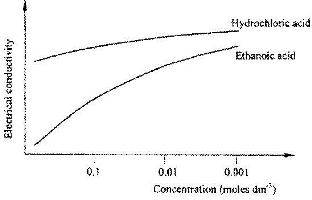
Explain why the electrical conductivity of 0.01 M hydrochloric acid is higher than that of 0.01 M ethanoic acid
Date posted:
April 21, 2017
.
Answers (1)
-
The solubility curve of potassium nitrate is shown below
(Solved)
The solubility curve of potassium nitrate is shown below
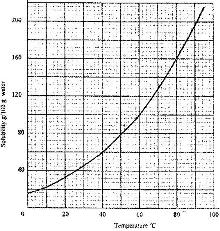
a) Determine the solubility of potassium nitrate at 50oC
b) determine the molar concentration of saturated potassium nitrate at 50o(K = 39.0; 0 = 16.0; N = 14.0 and density of water 1g/cm3)
Date posted:
April 21, 2017
.
Answers (1)
-
The graph shows how the pH value of soil in a farm changed over a period of time
(Solved)
The graph shows how the pH value of soil in a farm changed over a period of time
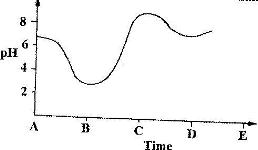
i) Describe how the pH of the soil can be determined
ii) State one factor that may have been responsible for the change in the soil pH in the time interval AB.
Date posted:
April 21, 2017
.
Answers (1)
-
The set-up below was used to demonstrate the effect of heat on hard water
(Solved)
The set-up below was used to demonstrate the effect of heat on hard water
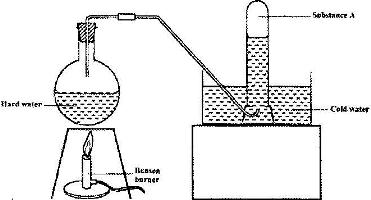
a) Name substance A.
b) Explain why the heating of hard water produced substance A.
Date posted:
April 21, 2017
.
Answers (1)
-
The flow chart below shows the various stages of water treatment. Study it and answer the questions that follow.
(Solved)
The flow chart below shows the various stages of water treatment. Study it and answer the questions that follow.
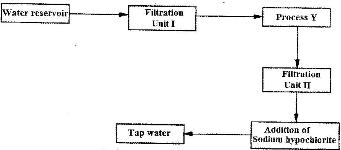
i) Which substance are likely to be removed in filtration unit I?
ii) What is the name of the process Y?
iii) What is the purpose of:
I. Process Y
II. Addition of sodium hypochlorite
Date posted:
April 21, 2017
.
Answers (1)
-
The table below shows the tests carried out on separate samples of water drawn from a well and the results obtained.
(Solved)
The table below shows the tests carried out on separate samples of water drawn from a well and the results obtained.
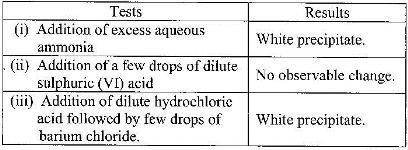
a) Identify the cation and the anion present in the water.
b) Write an ionic equation for the reaction which takes place in test (iii).
Date posted:
April 21, 2017
.
Answers (1)
-
The table below shows the solubility of a salt at various temperatures
(Solved)
The table below shows the solubility of a salt at various temperatures
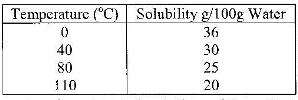
What would happen if a sample of a saturated solution of the salt at 40o C is heated to 80oC.Explain
Date posted:
April 21, 2017
.
Answers (1)
-
Study the flow chart below and answer the questions that follow
(Solved)
Study the flow chart below and answer the questions that follow
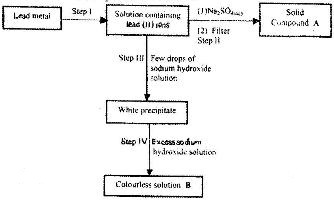
Name:
i) The reagent used in step I
ii) Compound A
Date posted:
April 21, 2017
.
Answers (1)
-
The flow charts below show an analysis of a mixture R that contains two salts. Study the analysis and answer the questions that follow.
(Solved)
The flow charts below show an analysis of a mixture R that contains two salts. Study the analysis and answer the questions that follow.
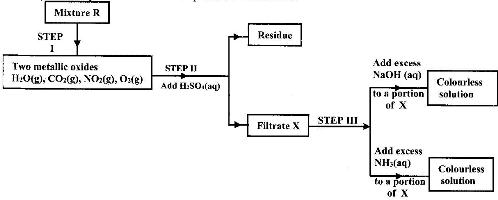
i) What condition is necessary for the process in step I to take place.
ii) Write an ionic equation for the reaction between the cation in filtrate X and aqueous ammonia
iii) What observation would indicate the presence of NO2(g) in step I?
iv) State how water vapour, in step I could be identified.
Date posted:
April 21, 2017
.
Answers (1)
-
In an experiment, soap solution was added to three separate samples of water. The table below shows the volumes of soap solutions required to form lather with 1000cm3 of each sample of water before and after boiling.
(Solved)
In an experiment, soap solution was added to three separate samples of water. The table below shows the volumes of soap solutions required to form lather with 1000cm3 of each sample of water before and after boiling.

a) Which water sample is likely to be soft? Explain
b) Name the cause of change in the volume of soap solution used in sample III
Date posted:
April 21, 2017
.
Answers (1)
-
The diagram below represents the set-up that was used to prepare and collect hydrogen chloride gas in the laboratory.
(Solved)
The diagram below represents the set-up that was used to prepare and collect hydrogen chloride gas in the laboratory.
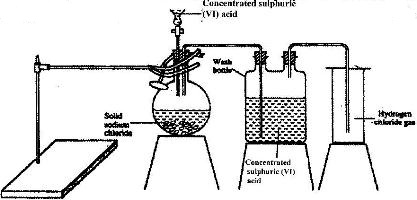
a) State the purpose of concentrated sulphuric (VI) acid in the wash bottle.
b) Write an equation for the reaction between dry hydrogen chloride gas and heated iron
Date posted:
April 21, 2017
.
Answers (1)
-
The diagram below is representation of an industrial process for the manufacture of a bleaching powder.
(Solved)
The diagram below is representation of an industrial process for the manufacture of a bleaching powder.
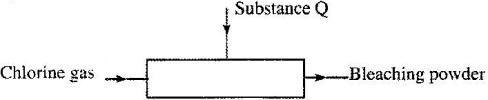
i) Name substance Q.
ii) When the bleaching powder is added to water during washing, a lot of soap is used. Explain.
Date posted:
April 21, 2017
.
Answers (1)
-
The set-up below was used to prepare dry hydrogen chlorine gas, and investigate its effect on the heated iron fillings
(Solved)
The set-up below was used to prepare dry hydrogen chlorine gas, and investigate its effect on the heated iron fillings
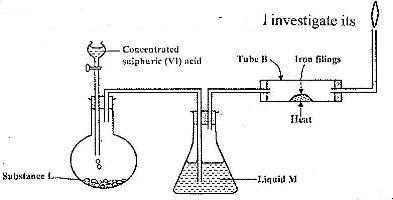
i) Name the substance L.
ii) Name liquid M
iii) What will be observed in tube B?
iv) Why is the gas from tube B burnt?
Date posted:
April 21, 2017
.
Answers (1)
-
A gas jar full of chlorine water was inverted over water and allowed to stand for some time.
a) State and explain two observations made in the gas jar after some times.
(Solved)
A gas jar full of chlorine water was inverted over water and allowed to stand for some time.
a) State and explain two observations made in the gas jar after some times.
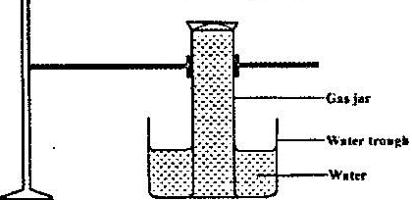
b) Write the equation for the reaction between chlorine and hot concentrated potassium hydroxide
Date posted:
April 21, 2017
.
Answers (1)
-
The diagram below represents a setup for large scale manufacture of hydrochloric acid. Study it and answer the questions that follow
(Solved)
The diagram below represents a setup for large scale manufacture of hydrochloric acid. Study it and answer the questions that follow
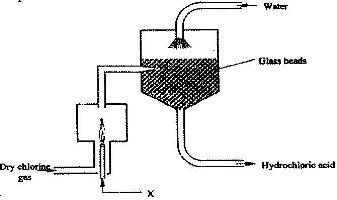
a) Name substance X.
b) What is the purpose of the glass beads?
c) Give two uses of hydrochloric acid
Date posted:
April 21, 2017
.
Answers (1)
-
In an experiment, dry chlorine gas was reacted with aluminium as shown in Figure 1.
(Solved)
In an experiment, dry chlorine gas was reacted with aluminium as shown in Figure 1.
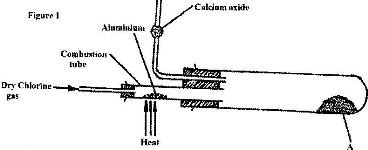
i) Name substance A.
ii) Give two reasons why calcium oxide is used in the set up.
Date posted:
April 20, 2017
.
Answers (1)
-
In an experiment, a test-tube full of chlorine water was inverted in chlorine water as shown in the diagram below and the set up left in sunlight for one day
(Solved)
In an experiment, a test-tube full of chlorine water was inverted in chlorine water as shown in the diagram below and the set up left in sunlight for one day
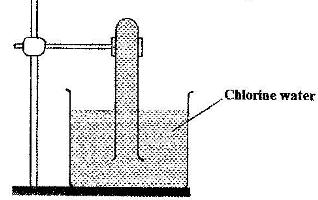
After one day, a gas was found to have collected in the test-tube
a) Identify the gas
b) What will happen to the pH of the solution in the beaker after one day? Give an explanation
Date posted:
April 20, 2017
.
Answers (1)
-
The diagram below represents the set-up that was used to prepare and collect hydrogen chloride gas in the laboratory
(Solved)
The diagram below represents the set-up that was used to prepare and collect hydrogen chloride gas in the laboratory
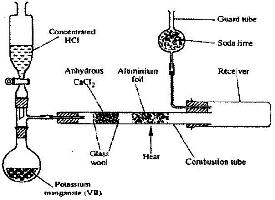
a)State the purpose of concentrated sulphuric (VI) acid in the wash bottle.
b) Hydrogen chloride gas is dissolved in water to make hydrochloric acid. State one use of hydrochloric acid.
Date posted:
April 20, 2017
.
Answers (1)
-
The set-up below was used to prepare hydrogen chloride gas and react it with iron powder.Study it and answer the questions that follow.
(Solved)
The set-up below was used to prepare hydrogen chloride gas and react it with iron powder.Study it and answer the questions that follow.
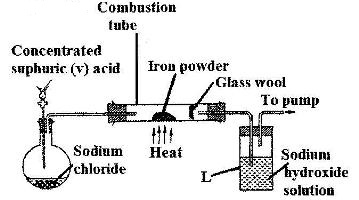
At the end of the reaction, the iron powder turned into a light green solid
a) Identify the light green solid
b) At the beginning of the experiment, the pH of the solution in container L was about 14. At the end, the pH was found to be 2. Explain.
Date posted:
April 20, 2017
.
Answers (1)
-
A student set out to prepare iron (III) chlorine using the apparatus shown in the diagram below.
(Solved)
A student set out to prepare iron (III) chlorine using the apparatus shown in the diagram below.
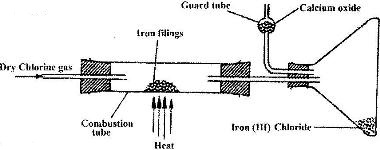
i) Explain why: I. It is necessary to pass chlorine gas through the apparatus before heating begins
II. calcium oxide would be preferred to calcium chloride in the guard tube
ii) What property of iron (III) chloride makes it possible to be collected as shown in the diagram?
Date posted:
April 20, 2017
.
Answers (1)