Mixture turns from red to colourless since equilibrium shifts to the left.
sharon kalunda answered the question on April 1, 2019 at 06:37
-
The diagram below shows the appearance of two pieces of paper placed in different parts of a non-luminous flame of a Bunsen burner and removed...
(Solved)
The diagram below shows the appearance of two pieces of paper placed in different parts of a non-luminous flame of a Bunsen burner and removed quickly before they caught fire.
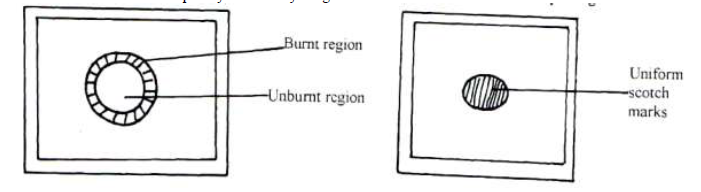
(a) What do the experiments show about the outer region of the flame?
(b) From the above experiment, which part of the flame is better to use for heating? Give a reason
Date posted:
March 29, 2019
.
Answers (1)
-
Ammonia gas was passed into water as shown below.
(Solved)
Ammonia gas was passed into water as shown below.
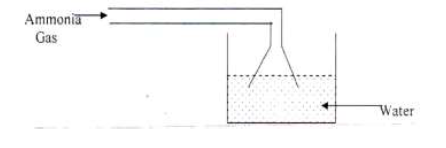
(a) When a red litmus paper was dropped into the resulting solution; it turned blue.Give a reason to this observation.
(b) What is the function of the funnel?
Date posted:
March 29, 2019
.
Answers (1)
-
The following diagram represents a set-up that can be used in the laboratory to prepare and collect a sample of chlorine gas:
(Solved)
The following diagram represents a set-up that can be used in the laboratory to prepare and collect a sample of chlorine gas:
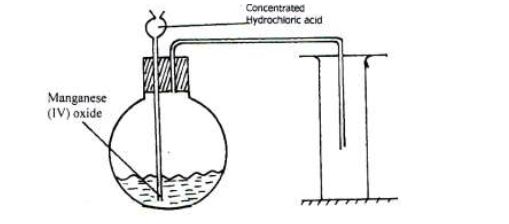
a)No gas bubbles were produced in the above experiment. Explain the observation.
(b) Complete the following equation.
Cl2(g) + H2O(l)---------->
(c) Describe the bleaching property of chlorine water
Date posted:
March 29, 2019
.
Answers (1)
-
During purification of copper by electrolysis, 1.48g of copper were deposited when a current was passed through aqueous copper (II) sulphate for 2 ½ hours....
(Solved)
During purification of copper by electrolysis, 1.48g of copper were deposited when a current was passed through aqueous copper (II) sulphate for 2 ½ hours. Calculate the amount of current that was passed.(Cu = 63.5; IF = 96500C)
Date posted:
March 29, 2019
.
Answers (1)
-
Two experiments were carried out as follows and the volume of hydrogen gas evolved measured at intervals of 10 seconds for 100 seconds.
(Solved)
Two experiments were carried out as follows and the volume of hydrogen gas evolved measured at intervals of 10 seconds for 100 seconds.
i) 8cm of magnesium ribbon was added to 1M HCl(aq)
(ii) 8cm of magnesium ribbon was added to 0.5M HCl(aq)
Graphs of volume of hydrogen gas evolved against time were plotted as shown below.
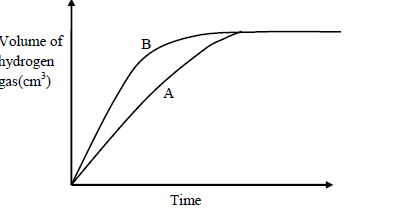
a) Which of the graphs was obtained for reaction (i). Explain.
(b) Explain the general shape of the graphs.
Date posted:
March 29, 2019
.
Answers (1)
-
Sulphur (IV) oxide gas was bubbled into acidified potassium chromate (VI) and iron (III) sulphate solutions respectively.Explain the observations made in each case.
(Solved)
Sulphur (IV) oxide gas was bubbled into acidified potassium chromate (VI) and iron (III) sulphate solutions respectively.Explain the observations made in each case.
i) With potassium chromate (VI).
(ii) With iron (III) sulphate.
Date posted:
March 29, 2019
.
Answers (1)
-
The solubility of salt Y at 600 is 40g/100g of water and 48g/100g of water at 1000C.
(i) How much salt Y would saturate 190g of...
(Solved)
The solubility of salt Y at 600 is 40g/100g of water and 48g/100g of water at 1000C.
(i) How much salt Y would saturate 190g of water at 1000C.
(ii) 150g of saturated solution of Y at 1000C is cooled to 600C. Calculate the mass of Y that crystallizes out.
Date posted:
March 29, 2019
.
Answers (1)
-
Four solutions of pH 7, 2, 8.5 and 13 respectively were each reacted with calcium turnings. Identify two solutions in which hydrogen gas would be...
(Solved)
Four solutions of pH 7, 2, 8.5 and 13 respectively were each reacted with calcium turnings. Identify two solutions in which hydrogen gas would be produced. Explain each case.
Date posted:
March 29, 2019
.
Answers (1)
-
Describe how you would prepare a dry sample of zinc carbonate in the laboratory starting with zinc chloride solid.
(Solved)
Describe how you would prepare a dry sample of zinc carbonate in the laboratory starting with zinc chloride solid.
Date posted:
March 29, 2019
.
Answers (1)
-
The diagrams below represent a list of apparatus which are commonly used in a chemistry laboratory:-
(Solved)
The diagrams below represent a list of apparatus which are commonly used in a chemistry laboratory:-
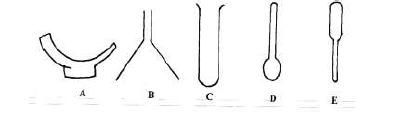
(a) Give the correct order of the apparatus, using the letters only, show the correct arrangement that can be used to prepare and investigate the nature of PH of a sample of onion solution.
(b) Name one chemical substance and apparatus that is needed in the experiment.
Date posted:
March 29, 2019
.
Answers (1)
-
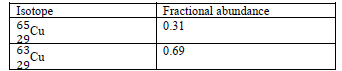
Use the information in the table below to determine the relative atomic mass of copper.
(Solved)
Use the information in the table below to determine the relative atomic mass of copper.
Date posted:
March 29, 2019
.
Answers (1)
-
The curve shown below was obtained when solid naphthalene was heated to boiling.
(Solved)
The curve shown below was obtained when solid naphthalene was heated to boiling.
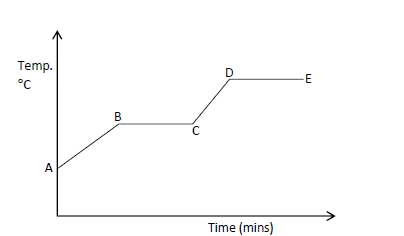
(a) Explain in molecular terms the changes occurring in portions.
(i) AB.
(ii) DE.
(b) What is the significance of portion BC?
Date posted:
March 29, 2019
.
Answers (1)
-
3.22g of hydrated sodium sulphate, Na2SO4.XH2O were heated to a constant mass of 1.42g. Determine the value of X in the formula. (Na = 23.0,...
(Solved)
3.22g of hydrated sodium sulphate, Na2SO4.XH2O were heated to a constant mass of 1.42g. Determine the value of X in the formula. (Na = 23.0, S = 32.0, O = 16.0, H = 1).
Date posted:
March 29, 2019
.
Answers (1)
-
The figure below shows a set-up used in electrolysis of lead iodide.
(Solved)
The figure below shows a set-up used in electrolysis of lead iodide.
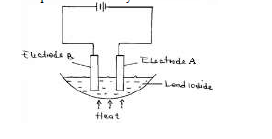
(a) Why is heating necessary?
(b) Write the equation of the reaction that occurs at the cathode.
(c) At which electrode does reduction occurs.
Date posted:
March 29, 2019
.
Answers (1)
-
Draw a dot (.)/cross (X) diagram to show bonding in Cl2O. (Cl = 17, O = 8).
(Solved)
Draw a dot (.)/cross (X) diagram to show bonding in Cl2O. (Cl = 17, O = 8).
Date posted:
March 29, 2019
.
Answers (1)
-
The following chromatogram was obtained in an experiment to investigate the components present in certain dyes.
(Solved)
The following chromatogram was obtained in an experiment to investigate the components present in certain dyes.
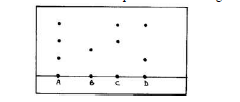
(a) Which two dyes when mixed would produce A?
(b) Which dye is pure?
(c) Indicate on the diagram the solvent front.
Date posted:
March 29, 2019
.
Answers (1)
-
Dry hydrogen chloride gas was passed over heated iron wool as shown below.
(Solved)
Dry hydrogen chloride gas was passed over heated iron wool as shown below.
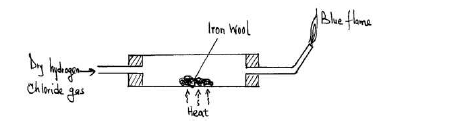
(a) State the observation made in the combustion tube at the end of the experiment.
(b) Write the equation for the reaction taking place:-
(i) In the combustion tube.
(ii) Leading to production of the blue flame.
Date posted:
March 29, 2019
.
Answers (1)
-
The diagram below is a set-up of apparatus used to react ammonia gas with iron (IV) chloride solution.
(Solved)
The diagram below is a set-up of apparatus used to react ammonia gas with iron (IV) chloride solution.
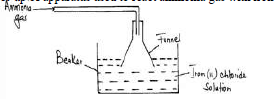
(a) State the observation made in the beaker after a few minutes.
(b) Explain why the funnel is used to deliver the ammonia into the solution.
Date posted:
March 29, 2019
.
Answers (1)
-
100cm³ of sulphur (IV) oxide takes 20 seconds to diffuse through a porous plate. What volume of oxygen gas would diffuse through the same plate...
(Solved)
100cm³ of sulphur (IV) oxide takes 20 seconds to diffuse through a porous plate. What volume of oxygen gas would diffuse through the same plate in 30 seconds under similar conditions. (S = 32, O = 16).
Date posted:
March 29, 2019
.
Answers (1)
-
In the down’s process (used for extraction of sodium) a certain salt is added to lower the melting point of sodium chloride from 8000C to...
(Solved)
In the down’s process (used for extraction of sodium) a certain salt is added to lower the melting point of sodium chloride from 8000C to about 6000C.
(i) Identify the salt added.
(ii) Why is it necessary to lower the temperature?
(iii) Give one use of sodium.
Date posted:
March 29, 2019
.
Answers (1)