
Financial management is concerned with making decisions about the provisions and use of a firm's finances. A rational approach to decision-making necessitates a fairly clear idea of what the objectives of the decision maker are or, more importantly, of what are the objectives of those on behalf of whom the decisions are being made.
There is little agreement in the literature as to what objectives of firms are or even what they ought to be. However, most financial management textbooks make the assumption that the objective of a limited
company is to maximize the wealth of its shareholders. This assumption is normally justified in terms of
classical economic theory. In a market economy firms that achieve the highest returns for their investors will be the firms that are providing customers with what they require. In turn these companies, because they provide high returns to investors, will also find it easiest to raise new finance. Hence the so called invisible hand theory will ensure optimal resource allocation and this should automatically maximize the overall economic welfare of the nation.
This argument can be criticized on several grounds. Firstly it ignores market imperfections. For example it might not be in the public interest to allow monopolies to maximize profits. Secondly it ignores social needs like health, police, defense etc.
From a more practical point of view directors have a legal duty to run the company on behalf of their
shareholders. This however begs the question as to what do shareholders actually require from firms.
Another justification from the individual firm's point of view is to argue that it is in competition
with other firms for further capital and it therefore needs to provide returns at least as good as the
competition. If it does not it will lose the support of existing shareholders and will find it difficult to raise funds in the future, as well as being vulnerable to potential take-over bids.
Against the traditional and legal view that the firm is run in order to maximize the wealth of
ordinary shareholders, there is an alternative view that the firm is a coalition of different groups: equity shareholders, preference shareholders and lenders, employees, customers and suppliers. Each of these groups must be paid a minimum return to encourage them to participate in the firm. Any excess wealth created by the firm should be and is the subject of bargaining between these groups.
At first sight this seems an easy way out of the „objectives? problem. The directors of a company
could say Let's just make the profits first, then we'll argue about who gets them at a later
stage. In other words, maximizing profits leads to the largest pool of benefits to be distributed among
the participants in the bargaining process. However, it does imply that all such participants must value
profits in the same way and that they are all willing to take the same risks.
In fact the real risk position and the attitude to risk of ordinary shareholders, loan creditors and employees are likely to be very different. For instance, a shareholder who has a diversified portfolio is likely not to be so worried by the bankruptcy of one of his companies as will an employee of that company, or a supplier whos main customer is that company. The problem of risk is one major reason why there cannot be a single simple objective which is common to all companies.
Separate from the problem of which goal a company ought to pursue are the questions of which
goals companies claim to pursue and which goals they actually pursue.
Many objectives are quoted by large companies. Sometimes these are included in their annual accounts.
Examples are:
To produce an adequate return for shareholders;
To grow and survive autonomously;
To improve productivity;
To give the highest quality service to customers;
To maintain a contented workforce;
To be technical leaders in their field;
To be market leaders;
To acknowledge their social responsibilities.
Some of these stated objectives are probably a form of public relations exercise. At any rate, it is possible to classify most of them into four categories which are related to profitability:
Pure profitability goals eg, adequate return for shareholders.
(ii) Surrogate goals of profitability eg, improving productivity, happy workforce. Constraints on profitability eg, acknowledging social responsibilities, no pollution, etc.
Dysfunctional goals.
The last category are goals which should not be followed because they do not benefit in the long
run. Examples here include the pursuit of market leadership at any cost, even profitability. This may
arise because management assumes that high sales equal high profits which is not necessarily so.
In practice the goals which a company actually pursues are affected to a large extent by the management.
As a last resort, the directors may always be removed by the shareholders or the shareholders could vote for a take-over bid, but in large companies individual shareholders lack voting power and information. These companies can, therefore, be dominated by the management.
There are two levels of argument here. Firstly, if the management do attempt to maximize profits, then they are in a much more powerful position to decide how the profits are „carved up? than are the shareholders.
Secondly, the management may actually be seeking „prestige? goals rather than profit maximization.
Such goals might include growth for its own sake, including empire building or maximizing turnover for its sake, or becoming leaders in the technical field for no reason other than general prestige. Such goals are usually dysfunctional.
The dominance of management depends on individual shareholders having no real voting power, and in this
respect institutions have usually preferred to sell their shares rather than interfere with the management of companies. There is some evidence, however, that they are now taking a more active role in major company decisions.
From all that has been said above, it appears that each company should have its own unique decision model.
For example, it is possible to construct models where the objective is to maximize profit subject to first fulfilling the target levels of other goals. However, it is not possible to develop the general theory of financial management very far without making an initial simplifying assumptions about objectives. The objective of maximizing the wealth of equity shareholders seems the least objectionable.
Kavungya answered the question on April 21, 2021 at 21:00
-
Discuss how government actions can influence the tasks of the financial manager and explain how these actions can affect the attainment of financial objectives.
(Solved)
Discuss how government actions can influence the tasks of the financial manager and explain how these actions can affect the attainment of financial objectives.
Date posted:
April 21, 2021
.
Answers (1)
-
Maltec plc is a company that has diversified into five different industries in five different countries. The investments are each approximately equal in value. The...
(Solved)
Maltec plc is a company that has diversified into five different industries in five different countries. The investments are each approximately equal in value. The company's objective is to reduce risk
through diversification, and it believes that the return on any investment is not correlated with the return on any other investment. The estimated risk and return (in present value terms) of the five investments are shown below:
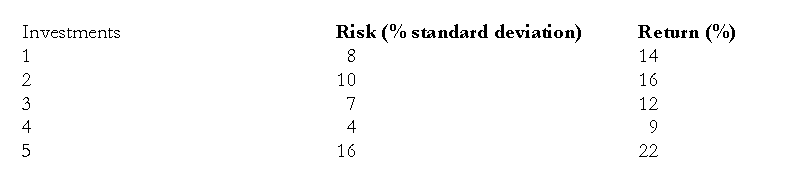
Required:
(a) Estimate the risk and return of the portfolio of five investments, and briefly explain the significance of your results.
(b) Discuss the validity to investors of Maltec's objective of risk reduction through international
diversification.
Date posted:
April 21, 2021
.
Answers (1)
-
Outline the potential problems in the achievement of synergies.
(Solved)
Outline the potential problems in the achievement of synergies.
Date posted:
April 20, 2021
.
Answers (1)
-
Explain the possible synergies that might occur in mergers and acquisitions.
(Solved)
Explain the possible synergies that might occur in mergers and acquisitions.
Date posted:
April 20, 2021
.
Answers (1)
-
Briefly discuss the meaning and importance of the terms 'delta', 'theta' and 'vega' (also known as
kappa or lamba) in option pricing.
(Solved)
Briefly discuss the meaning and importance of the terms 'delta', 'theta' and 'vega' (also known as
kappa or lamba) in option pricing.
Date posted:
April 20, 2021
.
Answers (1)
-
The managers of Strayer plc are investigating a potential Sh.25 million investment. The investment would be a diversification away from existing mainstream activities and into...
(Solved)
The managers of Strayer plc are investigating a potential Sh.25 million investment. The investment would be a diversification away from existing mainstream activities and into the printing industry. Sh.6 million of the investment would be financed by internal funds, Sh.10 million by a rights issue and Sh.9 million by long term loans. The investment is expected to generate pre-tax net cash flows of approximately Sh.5 million per year, for a period of ten years. The residual value at the end of year ten is forecast to be Sh.5 million after tax. As the investment is in an area that the government wishes to develop, a subsidized loan of Sh.4 million out of the total Sh.9 million is available. This will cost 2% below the company's normal cost of long-term debt finance, which is 8%.
Strayer's equity beta is 0.85, and its financial gearing is 60% equity, 40% debt by value. The average
equity beta in the printing industry is 1.2, and average gearing 50% equity, 50% debt by market value.
The risk free rate is 5.5% per annum and the market return 12% per annum.
Issue costs are estimated to be 1% for debt financing (excluding the subsidized loan), and 4% for
equity financing. These costs are not tax allowable.
The corporate tax rate is 30%.
Required:
(a) Estimate the Adjusted Present Value (APV) of the proposed investment.
(b) Comment upon the circumstances under which APV might be a better method of evaluating a
capital investment than Net Present Value (NPV).
Date posted:
April 20, 2021
.
Answers (1)
-
Components Manufacturing Corporation (CMC) has an all-common-equity capital structure. It has 200,000 shares of Sh.2 par value common stock outstanding. When CMC's founder, who has...
(Solved)
Components Manufacturing Corporation (CMC) has an all-common-equity capital structure. It has 200,000 shares of Sh.2 par value common stock outstanding. When CMC‟s founder, who has also its research director and most successful inventor; retired unexpectedly to the South Pacific in late 2000, CMC was left suddenly and permanently with materially lower growth expectations and relatively few attractive new investment opportunities. Unfortunately, there was no way to replace the founder's contributions to the firm.
Previously, CMC found it necessary to plow back most of its earnings to finance growth, which averaged 12 percent per year. Future growth at a five percent rate is considered realistic, but that level would call for an increase in the dividend payout. Further, it now appears that new investment projects with at least the 14 percent rate of return required by CMC's stockholders (ks= 14%) would amount to only Sh.800,000 for 2001in comparison to a projected Sh.2,000,000 of net income. If the existing 20 percent dividend payout were continued, retained earnings would be Sh.1.6 million in 2001, but as noted, investments that yield the 14 percent cost of capital would amount to only Sh.800,000.
The one encouraging thing is that the high earnings from existing assets are expected to continue, and
net income of Sh.2 million is still expected for 2001. Given the dramatically changed
circumstances, CMC's management is reviewing the firm's dividend policy.
(a) Assuming that the acceptable 2001 investment projects would be financed entirely by earnings
retained during the year, calculate DPS in 2001 if CMC follows the residual divided policy.
(b) What payout ratio does your answer to part a imply for 2001?
(c) If a 60 percent payout ratio is maintained for the foreseeable future, what is your estimate of
the present market price of the common stock? How does this compare with the market price
that should have prevailed under the assumptions existing just before the news
about the founder's retirement? If the two values of P0 are different, comment on why.
(d) What would happen to the price of the stock if the old 20 percent payout were continued? Assume
that if this payout is maintained, the average rate of return on the retained earnings will fall to 7.5
percent and the new growth rate will be
g = (1.0 – Payout ratio)(ROE)
= (1.0 – 0.2)(7.5%) = (0.8)(7.5%) = 6.0%
Date posted:
April 20, 2021
.
Answers (1)
-
Lancaster Engineering Inc. (LEI) has the following structure, which it considers to be optimal:
LEI's expected net income this year is Sh.34,285.72; its established dividend payout...
(Solved)
Lancaster Engineering Inc. (LEI) has the following structure, which it considers to be optimal:
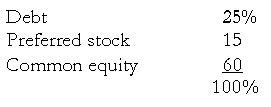
LEI's expected net income this year is Sh.34,285.72; its established dividend payout ratio is 30
percent; its marginal tax rate is 40 percent; and investors expect earnings and dividends to grow at a
constant rate of nine percent in the future. LEI paid a dividend of Sh.3.60 per share last hear, and its stock currently sells at a price of Sh.60 per share.
LEI can obtain new capital in the following ways:
Common: New common stock has a flotation cost of ten percent for up to Sh.12,000 of new stock and
20percent for all common stock over Sh.12,000.
Preferred: New preferred stock with a dividend of Sh.11 can be sold to the public at a price of Sh.100
per share. However, flotation costs of Sh.5 per share will be incurred for up to Sh.7,500 of preferred stock, and flotation costs will rise to Sh.10 per share, or ten percent, on all preferred stock over Sh.7,500.
Debt: Up to Sh.5,000 of debt can be sold at an interest rate of 12 percent; debt in the range of Sh.5,001 to Sh.10,000 must carry an interest rate of 14 percent; and all debt over Sh.10,000 will have an interest rate of 16 percent.
LEI has the following independent opportunities:
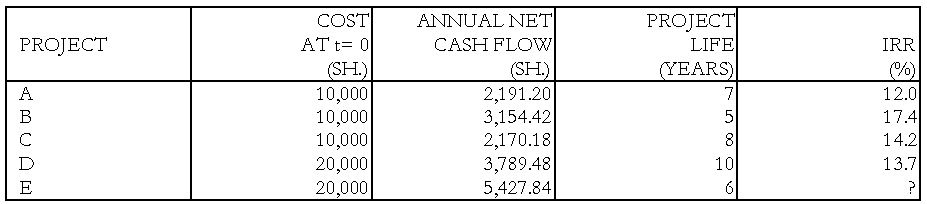
(a) Find the break points in the MCC schedule
(b) Determine the cost of each capital structure component.
(c) Calculate the weighted average cost of capital in the interval between each break in the
MCC schedule.
(d) Calculate the IRR for Project E.
(e) Construct a graph showing the MCC and IOS schedules.
(f) Which projects should LEI accept?
Date posted:
April 20, 2021
.
Answers (1)
-
Dove Construction Company Ltd made a Sh.100 million bondage 5 years ago when interest rates were
substantially high. The interest rates have now fallen and the...
(Solved)
Dove Construction Company Ltd made a Sh.100 million bondage 5 years ago when interest rates were
substantially high. The interest rates have now fallen and the firm wishes to retire this old debt and replace it with a new and cheaper one. Given here below are the details about the two bond issues:
Old Bonds: The outstanding bonds have a nominal value of Sh.1,000 and 24% coupon interest rate. They
were issued 5 years ago with a 15-year maturity. They were initially sold a their nominal value of Sh.1,000 and the firm incurred Sh.390,000 in floatation costs. They are callable at Sh.1,120.
New Bonds: The new bonds would have a Sh.1,000 nominal value and a 20% coupon interest rate. They
would have a 10-year maturity and could be sold at their par value. The issuance cost of the new bonds
would be Sh.525,000.
Assume the firm does not expect to have any overlapping interest and is in the 35% tax bracket.
Required:
a) Calculate the after-tax cash inflows expected from the unamortized portion of the old bond's
issuance cost.
b) Calculate the annual after-tax cash inflows from the issuance of the new bonds assuming the 10-year
amortization.
c) Calculate the after-tax cash outflow from the call premium required to retire the old bonds.
d) Determine the incremental initial cash outlay required to issue the new bonds.
e) Calculate the annual cash-flow savings, if any, expected from the bond refunding.
f) If the firm has a 14% after-tax cost of debt, would you recommend the proposed refunding and
reissue? Explain.
Date posted:
April 20, 2021
.
Answers (1)
-
Your firm is considering the acquisition of a new fork lift truck. It is uncertain about whether to purchase the truck outright or to finance...
(Solved)
Your firm is considering the acquisition of a new fork lift truck. It is uncertain about whether to purchase the truck outright or to finance it through a leasing arrangement with Kasneb Bank Ltd. The purchase price is Sh.5,200,000 and it will have a salvage value of Sh.400,000 at the end of its 8-year useful life. The annual lease cost would be Sh.996,000 for 8 years.
The company uses the straight-line method for analysis investment decisions.
The company can borrow funds (to purchase the forklift) at 22% and it has an effective tax rate of
35%. Its after tax cost of capital is 12%.
Required:
a) Analyze the decision situation and advise the firm about the appropriate acquisition method.
b) If the company could get a 20% investment allowance on this investment, how would this affect
your answer in (a) above?
Date posted:
April 20, 2021
.
Answers (1)
-
MK Ltd is comprised of 4 major projects, details of which as follows:
The risk free rate is 5% and the market return is 14% p.a....
(Solved)
MK Ltd is comprised of 4 major projects, details of which as follows:

The risk free rate is 5% and the market return is 14% p.a. The standard deviation or the market return is 13%.
Required:
a) Evaluate whether or not the share price of MK Ltd is overvalued or undervalued.
b) Discuss why your results in (a) above might not correctly identify whether or not the share price of MK Ltd is undervalued or overvalued.
Date posted:
April 20, 2021
.
Answers (1)
-
Mr. K. Patel has an investment capital of Sh.1,000,000. He wishes to invest in two securities, A and B in
the following proportion; Sh.200,000 in security...
(Solved)
Mr. K. Patel has an investment capital of Sh.1,000,000. He wishes to invest in two securities, A and B in
the following proportion; Sh.200,000 in security A and Sh.800,000 in security B.
The returns on these two securities depend on the state of the economy as shown below:

Required:
i) Compute the expected portfolio return
ii) Determine the correlation coefficient between security A and security B
iii) Calculate the portfolio risk
iv) Calculate the reduction in risk due to portfolio diversification
Date posted:
April 20, 2021
.
Answers (1)
-
With the help of a diagram show the difference between an efficient portfolio and an optimum portfolio.
(Solved)
With the help of a diagram show the difference between an efficient portfolio and an optimum portfolio.
Date posted:
April 20, 2021
.
Answers (1)
-
Distinguish between one-period rationing and multi-period rationing with specific reference to capital rationing.
(Solved)
Distinguish between one-period rationing and multi-period rationing with specific reference to capital rationing.
Date posted:
April 20, 2021
.
Answers (1)
-
Proton Ltd. has a capital structure consisting of Sh.250 million in 12% debentures and Sh.150 million in
ordinary shares of Shs.10 par value. The company distributes...
(Solved)
Proton Ltd. has a capital structure consisting of Sh.250 million in 12% debentures and Sh.150 million in
ordinary shares of Shs.10 par value. The company distributes all its net earnings as dividends.
The finance manager of Proton Ltd. intends to raise an additional Sh.50million to finance an
expansion programme and is considering three financing options.
Option one: Issue an 11% debenture stock
Option two: Issue 13% cumulative preference shares
Option three: Issue additional ordinary shares of Sh.10 par value.
The corporation tax rate is 30%.
Required:
Calculate the earnings before interest and tax (EBIT ) and the earnings per sharee (EPS)at the
point of indifference between the following financing options:
i) Option one and option three
ii) Option two and option three
Date posted:
April 20, 2021
.
Answers (1)
-
Two firms, A Ltd and B Ltd. operate in the same industry. The two firms are similar in all aspects
except for their capital structures.
The following...
(Solved)
Two firms, A Ltd and B Ltd. operate in the same industry. The two firms are similar in all aspects
except for their capital structures.
The following additional information is available:
1. A Ltd is financed using Sh.100 million worth of ordinary shares.
2. B Ltd is financed using Sh.50 million in ordinary shares and Sh.50 million in 7% debentures
3. The annual earnings before interest and tax are Sh.10million for both firms. These earnings are
expected to remain constant indefinitely.
4. The cost of equity in A Ltd is 10%
5. The corporate tax rate is 30%
Required:
Using the Modigliani and Miller (MM) model, determine the following:
i) The market value of A Ltd. and B Ltd.
ii) The weighted average cost of capital of A Ltd and B Ltd.
Date posted:
April 20, 2021
.
Answers (1)
-
Huge Ltd. is contemplating a complete share acquisition of Tiny Ltd. Huge Ltd is offering three of its
shares for every two shares of Tiny Ltd....
(Solved)
Huge Ltd. is contemplating a complete share acquisition of Tiny Ltd. Huge Ltd is offering three of its
shares for every two shares of Tiny Ltd. The data is relating to the two companies are shown below:
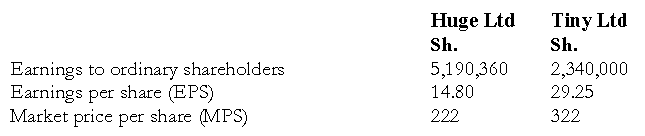
The corporate tax rate is 30%
Required:
i) Determine the maximum offer price that will not dilute the EPS of Huge Ltd.
ii) Compute the premium payable to the shareholders of Tiny Ltd
iii) Given that the growth rate of Huge Ltd. is 8% while that of Tiny Ltd is 12%, compute the combined
growth rate of the two companies
Date posted:
April 19, 2021
.
Answers (1)
-
Discuss the Modigliani and Miller's (MM) dividend irrelevancy proposition.
(Solved)
Discuss the Modigliani and Miller's (MM) dividend irrelevancy proposition.
Date posted:
April 19, 2021
.
Answers (1)
-
Distinguish between the residual dividend theory and clientele preference theory as they relate to dividend policy formulation.
(Solved)
Distinguish between the residual dividend theory and clientele preference theory as they relate to dividend policy formulation.
Date posted:
April 19, 2021
.
Answers (1)
-
Mr. Charles Kabazi has a capital of Sh.1,000,000 which he wishes to invest in three sectors of
the economy; agriculture, service and manufacturing. The funds will...
(Solved)
Mr. Charles Kabazi has a capital of Sh.1,000,000 which he wishes to invest in three sectors of
the economy; agriculture, service and manufacturing. The funds will be allocated as follows:
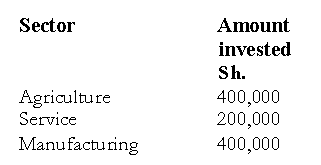
Details on the possible future economic states, their probabilities of occurrence and the expected return
for each of the sectors are presented below:

Required:
i) Determine the risk associated with the investment in each of the three sectors above.
ii) Determine the expected portfolio return
Date posted:
April 19, 2021
.
Answers (1)