(a) An increase in current causes an increase in temperature which in turn causes an increase in resistance.
(b) R = $\frac{V}{I} = \frac{2.5}{1.2}$ = 2.08 ohms
(c) From the graph, a current of 0.4 A corresponds to a p.d. of 1 V
johnmulu answered the question on May 23, 2017 at 12:24
-
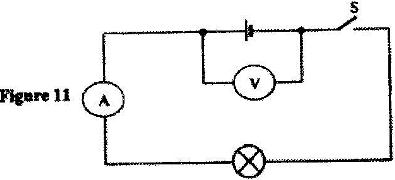
In figure 11 the voltmeter reads 2.1 V when the switch is open. When the switch is closed, the voltmeter reads 1.8 V and the ammeter reads 0.1 A.
(Solved)
In figure 11 the voltmeter reads 2.1 V when the switch is open. When the switch is closed, the voltmeter reads 1.8 V and the ammeter reads 0.1 A.
 ()
()
Determine:
(i) The e.m.f of the cell.
(ii) The internal resistance of the cell.
(iii) The resistance of the lamp.
Date posted:
May 23, 2017
.
Answers (1)
-
The cell in Figure 10 has an e.m.f of 2.1 V and negligible internal resistance.
(Solved)
The cell in Figure 10 has an e.m.f of 2.1 V and negligible internal resistance.
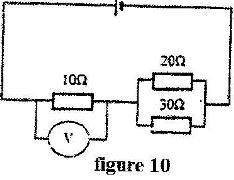
Determine the
(i) Total resistance in the circuit
(ii) Current in the circuit
(iii) Reading of the voltmeter
Date posted:
May 23, 2017
.
Answers (1)
-
Figure 4 shows an electrical circuit. When the switch is closed the ammeter reading is 0.3 A.
(Solved)
Figure 4 shows an electrical circuit. When the switch is closed the ammeter reading is 0.3 A.
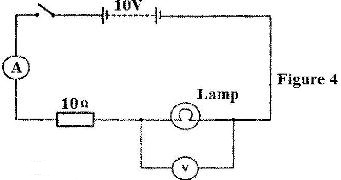
Determine the voltmeter reading.
Date posted:
May 23, 2017
.
Answers (1)
-
The diagram in Fig. 2 represent an electric circuit in which five resistors are connected to be a battery of e.m.f. 4.0 V and of negligible internal resistance.
(Solved)
The diagram in Fig. 2 represent an electric circuit in which five resistors are connected to be a battery of e.m.f. 4.0 V and of negligible internal resistance.
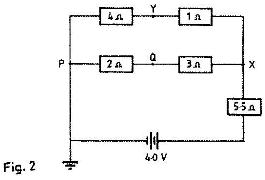
Determine:
(i) The current flowing through the 5.5 resistor
(ii) The potential difference between Y and Q.
Date posted:
May 23, 2017
.
Answers (1)
-
Figure 10 shows a trolley of weight 20 N pulled by a force of 4 N from the bottom to the top of an inclined plane at a uniform speed.
(Solved)
Figure 10 shows a trolley of weight 20 N pulled by a force of 4 N from the bottom to the top of an inclined plane at a uniform speed.
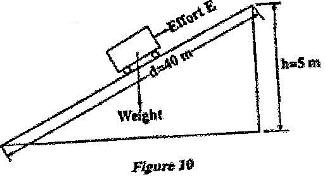
(i) State the value of the force acting downwards along the inclined plane.
(ii) Explain how the value in part (a)(i) is obtained.
Date posted:
May 16, 2017
.
Answers (1)
-
Figure 10 shows a pulley system used to raise a load by applying an effort of 500 N
(Solved)
Figure 10 shows a pulley system used to raise a load by applying an effort of 500 N
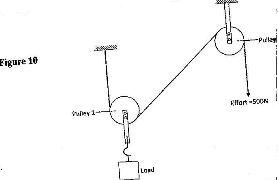
State the:
(i) Velocity ratio of the system.
(ii) Purpose of pulley 2.
(iii) Given that the machine has an efficiency of 80%, determine the maximum load that can be raised.
Date posted:
May 16, 2017
.
Answers (1)
-
Figure 16 shows a screw jack whose screw has a pitch of 1 mm, and has a handle of 25 cm long.
(Solved)
Figure 16 shows a screw jack whose screw has a pitch of 1 mm, and has a handle of 25 cm long.
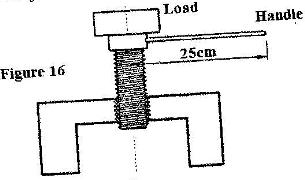
Determine the velocity ratio of the jack.
Date posted:
May 16, 2017
.
Answers (1)
-
Figure 7 shows a mass of 30 kg being pulled from point P to point Q, with a force of 200 N parallel
(Solved)
Figure 7 shows a mass of 30 kg being pulled from point P to point Q, with a force of 200 N parallel to an inclined plane. The distance between P and Q is 22.5 m. In being moved from P and Q the mass is raised through a vertical height of 7.5 m.
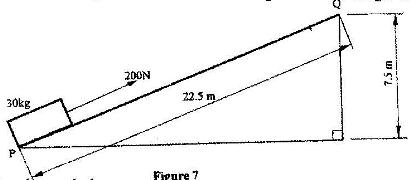 Determine the work done:
(I) By the force;
(II) On the mass;
(III) To overcome friction.
Date posted:
May 16, 2017
.
Answers (1)
-
Figure 5 shows two pulley systems being used to raise different loads. The pulleys are identical.
(Solved)
Figure 5 shows two pulley systems being used to raise different loads. The pulleys are identical.
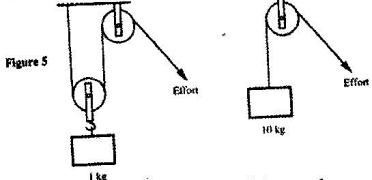
State one reason why system B may have a higher efficiency than system A.
Date posted:
May 16, 2017
.
Answers (1)
-
Two identical spherical steel balls are released from the top of two tall jars containing liquids L1 and L2 respectively. Figure 3 shows the velocity-time graph of the motion of the balls.
(Solved)
Two identical spherical steel balls are released from the top of two tall jars containing liquids L1 and L2 respectively. Figure 3 shows the velocity-time graph of the motion of the balls.
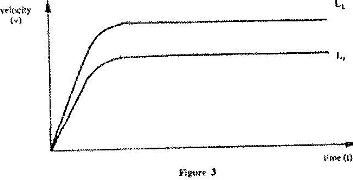
Explain the nature of the curves and state why they are different.
Date posted:
May 16, 2017
.
Answers (1)
-
Figure 9 shows graph of velocity against time for a ball bearing released at the surface of viscous liquid.
(Solved)
Figure 9 shows graph of velocity against time for a ball bearing released at the surface of viscous liquid.
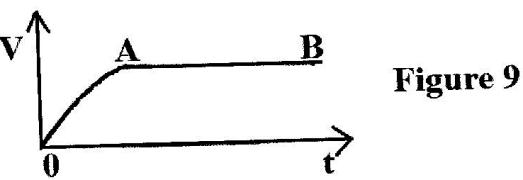
Explain the motion of the ball bearing for parts.
(i) OA
(ii) AB
Date posted:
May 15, 2017
.
Answers (1)
-
Figure 9 shows a velocity-time graph for the motion of a certain body.
(Solved)
Figure 9 shows a velocity-time graph for the motion of a certain body.
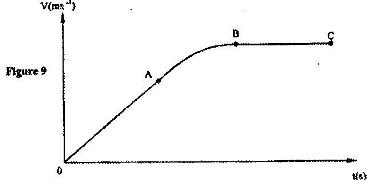
Describe the motion of the body in the region;
(i) OA; (ii) AB; (iii) BC;
Date posted:
May 15, 2017
.
Answers (1)
-
Figure 5 shows air flowing through a pipe of different cross-sectional areas. Two pipes A and B are dipped into water.
(Solved)
Figure 5 shows air flowing through a pipe of different cross-sectional areas. Two pipes A and B are dipped into water.
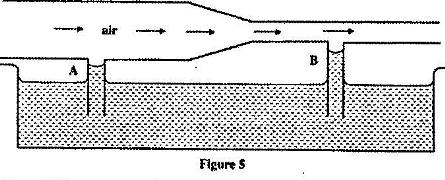
Explain the cause of the difference in the levels of water in the pipes A and B.
Date posted:
May 15, 2017
.
Answers (1)
-
Figure 6 shows two inflated balloons hanging vertically on light threads.
(Solved)
Figure 6 shows two inflated balloons hanging vertically on light threads.
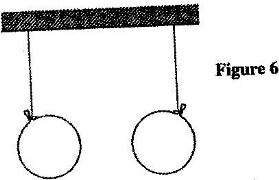
When a stream of air is blown in the space between the balloons, they are observed to move towards each other. Explain this observation
Date posted:
May 15, 2017
.
Answers (1)
-
Figure 12 shows a displacement - time graph for a progressive wave
(Solved)
Figure 12 shows a displacement - time graph for a progressive wave
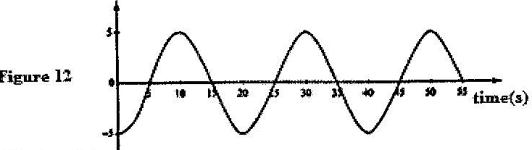
i) State the amplitude of the wave
ii) Determine the frequency of the wave.
Date posted:
April 19, 2017
.
Answers (1)
-
The three springs shown in figure 7 are identical and have negligible weight. The extension produced on the system of springs is 20 cm.
(Solved)
The three springs shown in figure 7 are identical and have negligible weight. The extension produced on the system of springs is 20 cm.
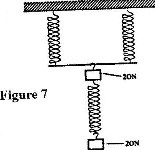
Determine the constant of each spring.
Date posted:
April 19, 2017
.
Answers (1)
-
Figure 2 shows a spring balance. Its spring constant is 125Nm-1. The scale spreads over a distance of 20 cm.
(Solved)
Figure 2 shows a spring balance. Its spring constant is 125Nm-1. The scale spreads over a distance of 20 cm.
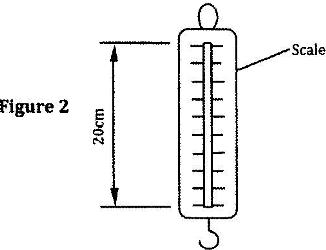
Determine the maximum weight that can be measured using the spring.
Date posted:
April 19, 2017
.
Answers (1)
-
The three springs shown in Figure 5 are identical and have negligible weight. The extension produced on the system of springs is 20 cm.
(Solved)
The three springs shown in Figure 5 are identical and have negligible weight. The extension produced on the system of springs is 20 cm.
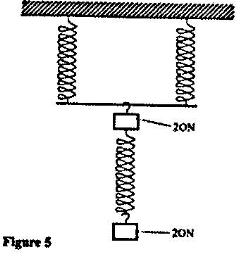
Determine the constant of each spring
Date posted:
April 19, 2017
.
Answers (1)
-
The spiral spring shown in Figure 4 are identical. Each spring has a spring constant k = 300 N/m
(Solved)
The spiral spring shown in Figure 4 are identical. Each spring has a spring constant k = 300 N/m
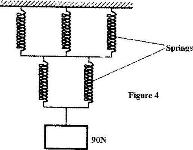
Determine the total extension caused by the 90 N weight. (Ignore the weight of the springs and connecting rods)
Date posted:
April 19, 2017
.
Answers (1)
-
Figure 7 shows a simple electric bell circuit
(Solved)
Figure 7 shows a simple electric bell circuit
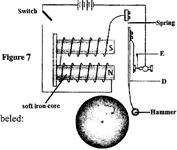
i) Name the parts labeled:
I) D
II) E
ii) When the switch is closed, the hammer hits the gong repeatedly. Explain why?
I) The hammer hits the gong.
II) The hammer hits the gong repeatedly
Date posted:
April 19, 2017
.
Answers (1)