- A summing amplifier is an inverted OP-amp that can accept two or more inputs. The output voltage of a summing amplifier is proportional to the negative of the algebraic sum of its input voltages.
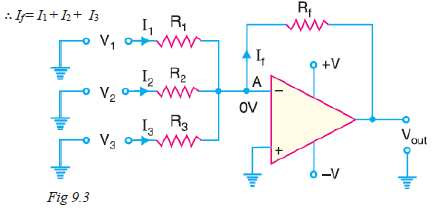
Hence the name summing amplifier. Fig. 9.3 shows a three-input summing amplifier but any number of inputs can be used. Three voltages V
1, V
2 and V
3 are applied to the inputs and produce currents I
1, I
2 and I
3. Using the concepts of infinite impedance and virtual ground, you can see that inverting input of the OP- amp is at virtual ground (0V) and there is no current to the input. This means that the three input currents I
1, I
2 and I
3 combine at the summing point A and form the total current (I
f) which goes through R
f as shown in Fig. 9.3.
- When all the three inputs are applied, the output voltage is:
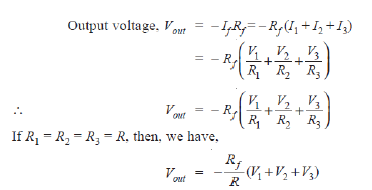
- Thus the output voltage is proportional to the algebraic sum of the input voltages (of course neglecting negative sign). An interesting case results when the gain of the amplifier is unity. In that case, R
f = R
1 = R
2 = R
3 and output voltage is
V
out = – (V
1 + V
2 + V
3)
- Thus, when the gain of summing amplifier is unity, the output voltage is the algebraic sum of the input voltages.
Summing amplifier with gain greater than unity: When Rf is larger than the input resistors, the amplifier has a gain of R
f /R where R is the value of each input resistor. The general expression for the output voltage is;
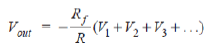
- As you can see, the output voltage is the sum of input voltages multiplied by a constant determined by the ratio R
f /R.
Wilfykil answered the question on
August 16, 2019 at 09:44