-
Study the flow diagram showing the role of the pancreas in controlling blood glucose concentration;
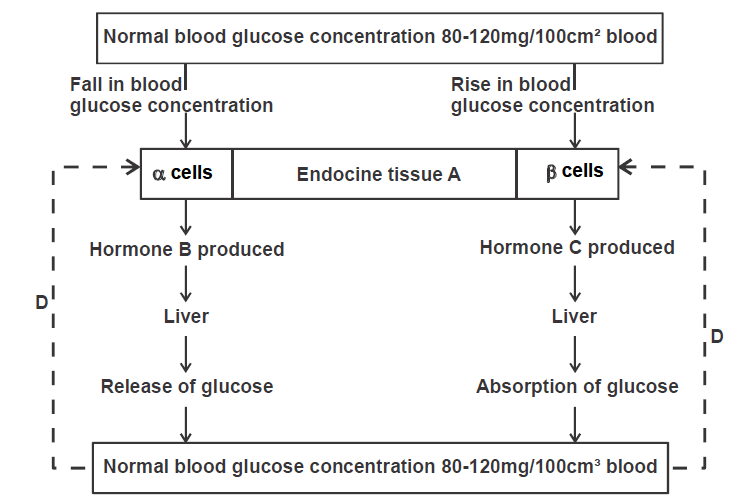 i) Name the endocrine tissue labelled A.
ii) Name the hormone B produced by a cells.
iii) Name the hormone C produced by the B cells.
iv) Name the process represented by the dotted lines.
v) Briefly describe how hormone B brings about a rise in blood glucose concentration when it reaches
the liner.
i) Name the endocrine tissue labelled A.
ii) Name the hormone B produced by a cells.
iii) Name the hormone C produced by the B cells.
iv) Name the process represented by the dotted lines.
v) Briefly describe how hormone B brings about a rise in blood glucose concentration when it reaches
the liner.
Date posted:
September 18, 2019
-
The diagram below represents the process that brings about blood clotting.
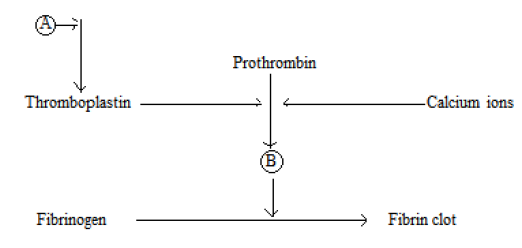 a) Name the substances A and B.
b) Name one source of calcium ions in the diet.
c) Name one more other role of calcium in the body.
d) Name the blood cells that are involved in blood clotting.
e) List down three structural adaptations of the red blood cells to their functions.
a) Name the substances A and B.
b) Name one source of calcium ions in the diet.
c) Name one more other role of calcium in the body.
d) Name the blood cells that are involved in blood clotting.
e) List down three structural adaptations of the red blood cells to their functions.
Date posted:
September 18, 2019
-
Use the nitrogen cycle below to answer the questions that follow.
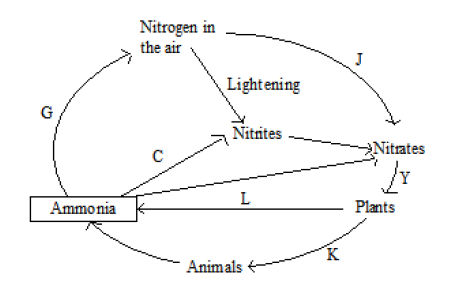 a) Name the processes represented by
i) G
ii) Y
iii) K
b) Name the group of organisms that cause processes
i) C
ii) J
iii) L
c) Name the state in which nitrogen exist in
i) Plant tissue
ii) Atmosphere
a) Name the processes represented by
i) G
ii) Y
iii) K
b) Name the group of organisms that cause processes
i) C
ii) J
iii) L
c) Name the state in which nitrogen exist in
i) Plant tissue
ii) Atmosphere
Date posted:
September 18, 2019
-
The diagram below represents a food web from lake Nakuru National Park.
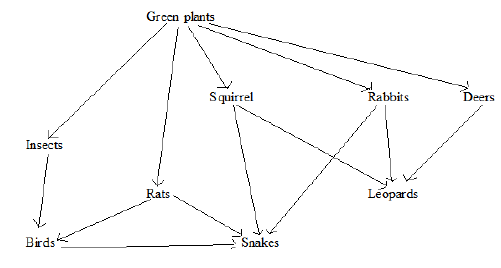 a) i) Identify the organism with the largest biomass.
ii) Give a reason for your answer in a (i) above.
b) From the food web, isolate a food chain ending with snakes as tertiary consumers.
c) i) Name any two organisms not shown in the food web but would be present in the ecosystem.
ii) What is the role of the organisms stated in c (i) above?
d) From the food web, snakes and leopards feed on rabbits. What name is given to this kind of competition?
e) From the food web, name an organism that may be both a secondary and a tertiary consumer.
a) i) Identify the organism with the largest biomass.
ii) Give a reason for your answer in a (i) above.
b) From the food web, isolate a food chain ending with snakes as tertiary consumers.
c) i) Name any two organisms not shown in the food web but would be present in the ecosystem.
ii) What is the role of the organisms stated in c (i) above?
d) From the food web, snakes and leopards feed on rabbits. What name is given to this kind of competition?
e) From the food web, name an organism that may be both a secondary and a tertiary consumer.
Date posted:
September 18, 2019
-
In an experiment two equal volumes of solution L and M were placed into visking tubing. The visking tubing was suspended into beakers containing equal volumes of solutions K. The set –up is as shown in the diagram A and B. The set-up was allowed to stand for 45 minutes and results are as shown in the diagrams.
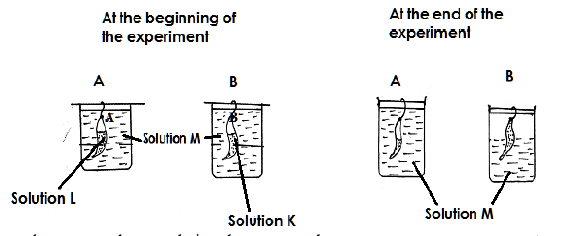 (a) Name the process that was being demonstrated.
(b) Explain the results that were obtained at the end of the experiment in
(i) Set-up A.
(ii) Set up B.
(a) Name the process that was being demonstrated.
(b) Explain the results that were obtained at the end of the experiment in
(i) Set-up A.
(ii) Set up B.
Date posted:
September 18, 2019
-
Name two regions in human body that displays counter-current flow system.
Date posted:
September 17, 2019
-
State the type of placentation found in the following fruits.
i) Pawpaw
ii) Orange
iii) Bean pod
Date posted:
September 17, 2019
-
After an ecological study of feeding relationship students constructed the food web below.
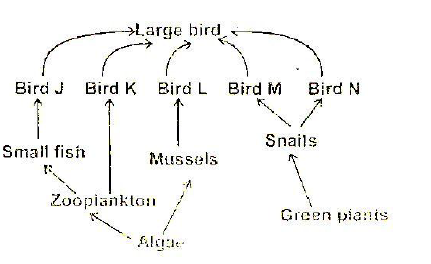 a) Name the process through which energy from the sun is incorporated into the food web.
b) State the mode of feeding of the birds in the food web.
c) Name two ecosystems in which the organisms in the food web live.
d) From the information in the food web, construct a food chain with the large bird as a quaternary consumer.
e) What would happen to the organism in the food web if bird N migrated?
f) Not all the energy from one trophic level is available to the next level. Explain.
g) i) Two organisms which play a role in the ecosystem are not included in the food web. Name them.
ii) State the role played by the organisms named in g (i) above.
h) i) State three human activities that would affect the ecosystems.
a) Name the process through which energy from the sun is incorporated into the food web.
b) State the mode of feeding of the birds in the food web.
c) Name two ecosystems in which the organisms in the food web live.
d) From the information in the food web, construct a food chain with the large bird as a quaternary consumer.
e) What would happen to the organism in the food web if bird N migrated?
f) Not all the energy from one trophic level is available to the next level. Explain.
g) i) Two organisms which play a role in the ecosystem are not included in the food web. Name them.
ii) State the role played by the organisms named in g (i) above.
h) i) State three human activities that would affect the ecosystems.
Date posted:
September 17, 2019
-
The diagram shows a set up to investigate anaerobic respiration in germinating bean seed.
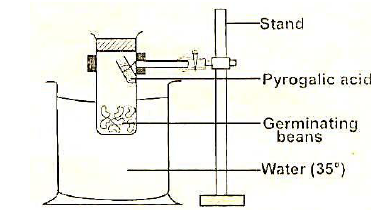 a) What is the purpose of the pyrogallic acid?
b) State the importance of the water bath in the experiment.
c) Write a word equation for anaerobic respiration taking place in the germinating beans.
d) Explain why plants can only respire anaerobically for a short period of time.
e) What would be product if the process was taking place in animal muscle?
f) Distinguish between obligate and facultative Anaerobes.
g) Name the site for anaerobic respiration in a cell.
a) What is the purpose of the pyrogallic acid?
b) State the importance of the water bath in the experiment.
c) Write a word equation for anaerobic respiration taking place in the germinating beans.
d) Explain why plants can only respire anaerobically for a short period of time.
e) What would be product if the process was taking place in animal muscle?
f) Distinguish between obligate and facultative Anaerobes.
g) Name the site for anaerobic respiration in a cell.
Date posted:
September 17, 2019
-
Leaves are the organs of photosynthesis. The following diagram shows what happens in a plant leaf during photosynthesis.
 a) Give two ways in which leaves are adapted to absorb light.
b) Name the gases labeled X and Y
c) Explain why it is an advantage for plant to store carbohydrates in form of starch rather than as sugar.
d) Describe what happens during dark stage of photosynthesis.
a) Give two ways in which leaves are adapted to absorb light.
b) Name the gases labeled X and Y
c) Explain why it is an advantage for plant to store carbohydrates in form of starch rather than as sugar.
d) Describe what happens during dark stage of photosynthesis.
Date posted:
September 17, 2019
-
Study the diagram shown below and answer the questions that follow.
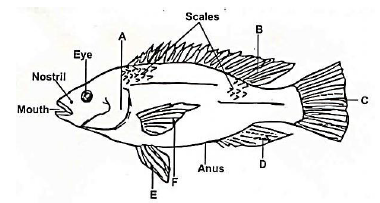 a. i) Name the phylum to which the specimen belongs.
ii) State the class to which the organism belongs and give two reasons.
b. What term is used to describe the body shape of the organism in photograph/ diagram below.
c. i) Name the parts labeled A and B.
ii) State the function of the parts labeled C and D.
d. Using observable features from the diagram, state two adaptations of the organisms to locomotion in water.
a. i) Name the phylum to which the specimen belongs.
ii) State the class to which the organism belongs and give two reasons.
b. What term is used to describe the body shape of the organism in photograph/ diagram below.
c. i) Name the parts labeled A and B.
ii) State the function of the parts labeled C and D.
d. Using observable features from the diagram, state two adaptations of the organisms to locomotion in water.
Date posted:
September 17, 2019
-
Explain why the carrying capacity of wild animals is higher than that of cattle for a unit mass.
Date posted:
September 17, 2019
-
A student at Kaloleni High School picked an organism by the shore of the Indian Ocean. After examining it very carefully,she formed an opinion that the organism belongs to class Arachnida. She then classified it as follows:-
Kingdom – Animalia
Phylum – Arthropoda
Class – Arachnida
(a) Identify one mistake in her classification.
(b) List down two characteristics that she could have used in placing the organism in class Arachnida.
Date posted:
September 17, 2019
-
The diagram below represents the nitrogen cycle.
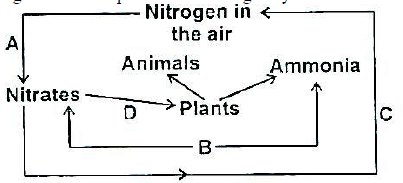 a) State the process labeled A and D.
b) Name the group of organism labeled .
c) Name the compound represented by B.
d) i) Name the group of plants which promote process A.
ii) State the part of the plant where process A takes place.
e) How would excess pesticides in the soil interfere with process A.
a) State the process labeled A and D.
b) Name the group of organism labeled .
c) Name the compound represented by B.
d) i) Name the group of plants which promote process A.
ii) State the part of the plant where process A takes place.
e) How would excess pesticides in the soil interfere with process A.
Date posted:
September 17, 2019
-
Active yeast cells were added to dilute sugar solution in a container. The mixture was left in a warm room. After a few hour bubbles of gases were observed escaping from the mixture.
a) Write an equation to represent the chemical process
b) What is the importance of the type of reaction in industries?
Date posted:
September 17, 2019
-
Four cylinders of potato were carefully dried on blotting paper and weighed. Each piece weighed 3g. One was placed in each as shown in the drawing below.
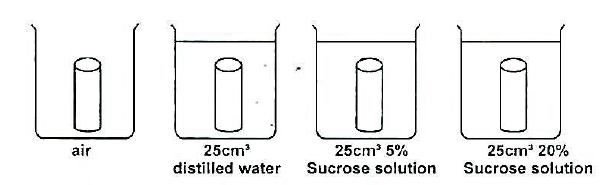 a) After 48hours, which potato would be the heaviest
b) Name the substance whose movement was responsible for the weight changes in potato cylinders.
c) Name the process which was responsible for this movement in tubes B, C and D.
a) After 48hours, which potato would be the heaviest
b) Name the substance whose movement was responsible for the weight changes in potato cylinders.
c) Name the process which was responsible for this movement in tubes B, C and D.
Date posted:
September 17, 2019
-
In an experiment, Euglena was put in a petri dish. One side of the petri dish was illuminated and the other kept dark as shown below.
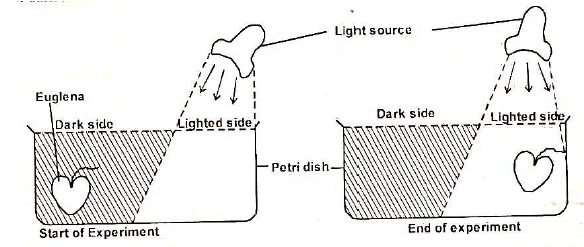 a) Name this type of response.
b) State the significance of this type of response in an organism.
c) Other than light, outline other two factors that may cause change of position in Euglena and state the respective type of response.
d) If the above experiment was repeated using a young potted seedling, name the type of response which will be observed.
e) Explain the behavior of the seedling after 3 days.
a) Name this type of response.
b) State the significance of this type of response in an organism.
c) Other than light, outline other two factors that may cause change of position in Euglena and state the respective type of response.
d) If the above experiment was repeated using a young potted seedling, name the type of response which will be observed.
e) Explain the behavior of the seedling after 3 days.
Date posted:
September 17, 2019
-
What is the process that leads to addition or loss of one or more chromosomes?
Date posted:
September 17, 2019
-
Study the diagram below and answer the questions that follow.
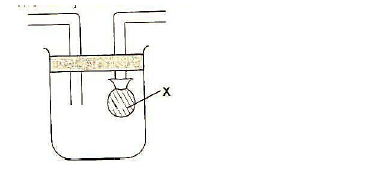 a) Identify the apparatus.
b) State the functions of the part labeled x.
a) Identify the apparatus.
b) State the functions of the part labeled x.
Date posted:
September 17, 2019
-
The set apparatus was assembled by a group of students to investigate some physiological process.
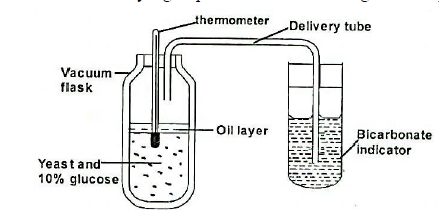 a) i) Give two aims of the experiment.
ii) Explain observations expected after 24hrs.
b) Before the experiment, the glucose was boiled the cooled.
i) Why was it necessary to boil the solution?
ii) What was the importance of the oil layer in the experiment?
c) Describe a control experiment for the set up?
d) Suggest one industrial application of the process being investigated?
a) i) Give two aims of the experiment.
ii) Explain observations expected after 24hrs.
b) Before the experiment, the glucose was boiled the cooled.
i) Why was it necessary to boil the solution?
ii) What was the importance of the oil layer in the experiment?
c) Describe a control experiment for the set up?
d) Suggest one industrial application of the process being investigated?
Date posted:
September 17, 2019
-
In an experiment, three healthy rabbits were fed with equal amounts of carbohydrates. After 1 hour their blood sugar glucose concentration was measured at 30 minutes intervals for 3 hour. The results are as shown in the table below.
 a.(i) Calculate the mean glucose concentration 1mg/ml of blood at 60 and 180 minutes.
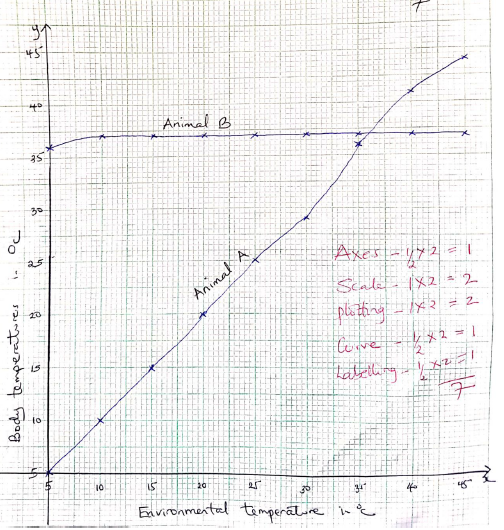 (ii) On the grid provided plot a graph of mean glucose concentration against time.
(iii) What was the mean concentration in the blood after 75 minutes?
(iv)Why was it necessary to use 3 rabbits in the experiment?
v) Account for differences in mean glucose concentration between initial time and 180 minutes.
(b) Name three products of digestion other than glucose
(c) What is the fate of excess glucose in:
(i) Plants?
(ii) Animals ?
(ii) On the grid provided plot a graph of mean glucose concentration against time.
(iii) What was the mean concentration in the blood after 75 minutes?
(iv)Why was it necessary to use 3 rabbits in the experiment?
v) Account for differences in mean glucose concentration between initial time and 180 minutes.
(b) Name three products of digestion other than glucose
(c) What is the fate of excess glucose in:
(i) Plants?
(ii) Animals ?
Date posted:
September 17, 2019
-
The diagram below shows a section through the mammalian skin.
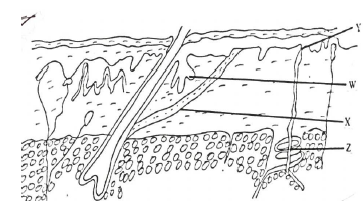 a. Name the parts labeled Y and X
b. State the function of the parts labeled W and Z
c. Explain the changes that occur on the skin when it is cold
a. Name the parts labeled Y and X
b. State the function of the parts labeled W and Z
c. Explain the changes that occur on the skin when it is cold
Date posted:
September 17, 2019
-
The diagram below shows a flow chart of blood clotting mechanism in a human.
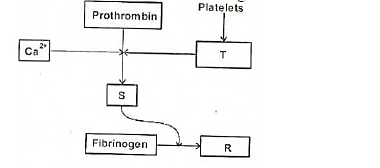 a) Name the enzymes represented by the letters T and S.
b) Name the final products of the mechanism represented by letter R.
a) Name the enzymes represented by the letters T and S.
b) Name the final products of the mechanism represented by letter R.
Date posted:
September 17, 2019
-
The diagram below represents the vertical section of a fruit.
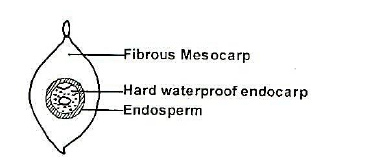 a) Suggest the possible agent of dispersal of this fruit.
b) Explain two observable features that adapt the fruit to its mode of dispersal.
a) Suggest the possible agent of dispersal of this fruit.
b) Explain two observable features that adapt the fruit to its mode of dispersal.
Date posted:
September 17, 2019
-
A cross between a red flowered plants and white flowered plants produced plants with pink flowers. Using letter R to represent the gene for red color and W for white.
a) What were the parental genotypes?
b) Work out the cross between f1 generations.
c) State the phenotypic and genotypic ratios of the f2 generations.
Date posted:
September 17, 2019
-
The flow diagram below represents passage of a meal through the human digestive system. Study the diagram and answer the questions that follow.
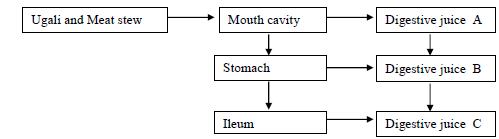 (a) Name the physical process that will occur in mouth cavity
(b) Name the digestive juices B and C
B...........................
C...........................
(c) Explain two ways in which the digestive system is protected from corrosive effects of digestive juices.
(d) Name the hormone that stimulate secretion of juice B.
(e) Identify two contents of digestive juice A
(a) Name the physical process that will occur in mouth cavity
(b) Name the digestive juices B and C
B...........................
C...........................
(c) Explain two ways in which the digestive system is protected from corrosive effects of digestive juices.
(d) Name the hormone that stimulate secretion of juice B.
(e) Identify two contents of digestive juice A
Date posted:
September 17, 2019
-
Name the source of hydrochloric acid in the mammalian stomach.
Date posted:
September 17, 2019
-
An experiment shown below was a set up to investigate a certain physiological process in plants.
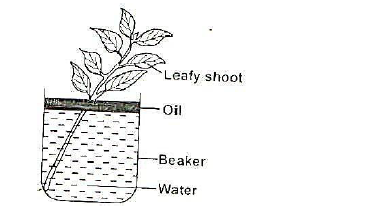 a) What process was being investigated? (1 mark)
b) What effect will the following have on the observation made in (a) above?
i) Fanning the shoot
ii) Removing all the leaves from the shoot.
iii) Placing the set up in the dark.
a) What process was being investigated? (1 mark)
b) What effect will the following have on the observation made in (a) above?
i) Fanning the shoot
ii) Removing all the leaves from the shoot.
iii) Placing the set up in the dark.
Date posted:
September 17, 2019
-
The following diagram of a leaf shows what happens in a plant leaf during photosynthesis.
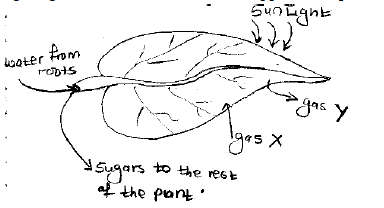 (a) State two ways in which leaves are adapted to absorb light.
(b) Name the gases labeled x and y.
(c) Name the tissues that transports:-
(i) Water into the leaf.
(ii) Sugar to other parts of the plant.
(d) Explain why it is an advantage for the plant to store carbohydrates as starch rather than as sugars.
(a) State two ways in which leaves are adapted to absorb light.
(b) Name the gases labeled x and y.
(c) Name the tissues that transports:-
(i) Water into the leaf.
(ii) Sugar to other parts of the plant.
(d) Explain why it is an advantage for the plant to store carbohydrates as starch rather than as sugars.
Date posted:
September 16, 2019
-
The apparatus below illustrate breathing in a mammal.
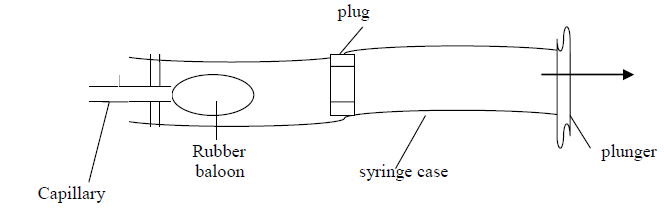 (a) Describe what happens if the rubber plug is pulled in the direction shown by the arrow.
(b) Give the parts of mammal represented by:-
(i) Capillarity tube.
(ii) Rubber plug.
(a) Describe what happens if the rubber plug is pulled in the direction shown by the arrow.
(b) Give the parts of mammal represented by:-
(i) Capillarity tube.
(ii) Rubber plug.
Date posted:
September 16, 2019