-
In February 2007, the International Accounting Standing Board ( IASB) published for comment an exposure draft of a proposed International Financial Reporting Standard (IFRS) for small and Medium Enterprises( SMEs).
Required:
i) Outline three benefits that SMEs will derive from adopting IFRS.
ii) Highlight three challenges that could face SMEs in complying with IFRS.
Date posted:
February 13, 2019
-
The approved estimates and actual expenditure details for the Ministry of Planning and Development for the year 2001/2002 were as follows:
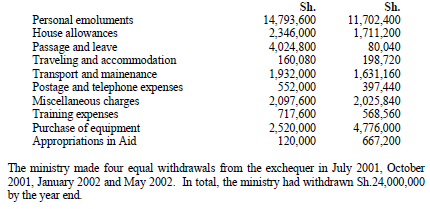 Prepare:
(i) The General Account of Vote.
(ii) The Exchequer Account
(iii) The Paymaster General Account.
(iv) Statement of assets and liabilities as at 30 June 2002.
Prepare:
(i) The General Account of Vote.
(ii) The Exchequer Account
(iii) The Paymaster General Account.
(iv) Statement of assets and liabilities as at 30 June 2002.
Date posted:
February 13, 2019
-
The following are details relating to approved estimates and actual expenditure for a certain government department for the financial year ended 30 June 2003
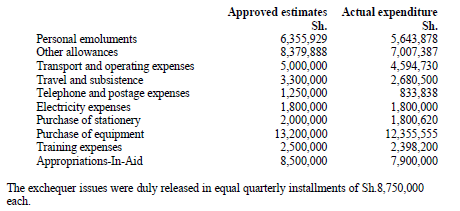 Prepare:
i) Paymaster general account.
ii) Exchequer account.
iii) General account of vote
iv) Statement of assets and liabilities as at 30 June 2003.
Prepare:
i) Paymaster general account.
ii) Exchequer account.
iii) General account of vote
iv) Statement of assets and liabilities as at 30 June 2003.
Date posted:
February 13, 2019
-
Briefly explain the following terms in relation to government accounting:
(i) Exchequer over issues.
(ii) Paymaster General
(iii) Vote on account.
(iv) Commitment accounting.
Date posted:
February 13, 2019
-
The approved Estimates and Actual Expenditure details for vote E45 of ministry ABC for the financial year 2004/2005 were as follows:
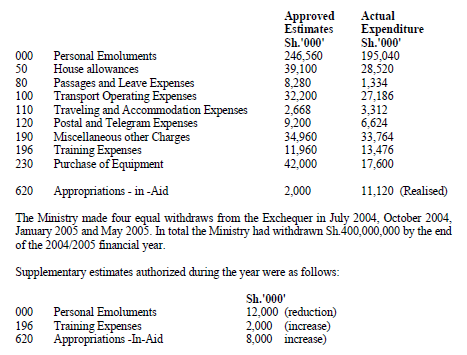 Required:
a) Appropriation account for the year ended 30 June 2005
b) General Account of vote for the year ended 30 June 2005.
c) Exchequer Account for the year ended 30 June 2005
d) Paymaster General (PMG) account for the year ended 30 June 2005
e) Statement of assets and liabilities as at 30 June 2005.
Required:
a) Appropriation account for the year ended 30 June 2005
b) General Account of vote for the year ended 30 June 2005.
c) Exchequer Account for the year ended 30 June 2005
d) Paymaster General (PMG) account for the year ended 30 June 2005
e) Statement of assets and liabilities as at 30 June 2005.
Date posted:
February 13, 2019
-
Outline the powers of the Auditor General in the exercise of his duties
Date posted:
February 13, 2019
-
The following information was extracted from the books of the Ministry of Commerce and Industrialization for the fiscal year ended 30 June 2011:
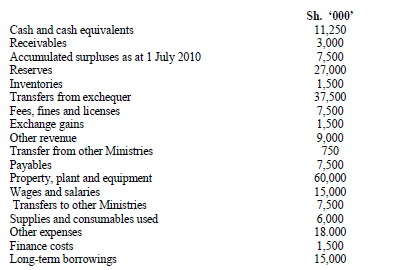
 Prepare:
(i) Statement of financial performance for the year ended 30 June 2011.
(ii) Statement of financial position as at 30 June 2011.
Prepare:
(i) Statement of financial performance for the year ended 30 June 2011.
(ii) Statement of financial position as at 30 June 2011.
Date posted:
February 13, 2019
-
Explain two requirements that should be met for government grants to be recognized in the financial statements in the context of International Accounting Standard (IAS) 20.
Date posted:
February 13, 2019
-
In the context of International Accounting Standard (1AS) 21, distinguish between the accounting treatment for foreign currency transactions "on initial recognition" and "at the end of subsequent reporting periods".
Date posted:
February 13, 2019
-
List the circumstances under which a subsidiary should be excluded from the consolidated financial statement
Date posted:
February 12, 2019
-
Explain four circumstances in which a parent company is exempted from consolidating investments in subsidiaries in accordance with International Accounting Standards (IAS)27- Consolidated and separate financial statements
Date posted:
February 12, 2019
-
Auma Ltd. acquired 80% of the ordinary shares of Sakwa Ltd. on 31 October 2009 for Sh. 117 million. At this date, the net assets of Sakwa Ltd. were Sh. 127.5 million. The fair value of the non-controlling interest on the acquisition date was Sh.28.5 million.
Calculate the value of goodwill using the two methods
Date posted:
February 12, 2019
-
Distinguish between the full method and the partial method of determining goodwill arising on acquisition of a subsidiary company
Date posted:
February 12, 2019
-
Briefly explain three circumstances in which a parent company need not present consolidated financial statements in accordance with International Accounting Standard (IAS ) 27 ,Consolidated and Separate financial Statements
Date posted:
February 12, 2019
-
Differentiate between full consolidation and equity method of accounting for subsidiaries and associate companies
Date posted:
February 12, 2019
-
International Accounting Standard (IAS) 28, Investment in Associates prescribes the use of the equity method of accounting for investments in associates over which the investor has significant influence.
Required:
i) Describe the term "significant influence" in the context of IAS 28.
ii) Explain four circumstances under which the investor is exempted from use of the equity method.
Date posted:
February 12, 2019
-
Explain the circumstances in which an entity is permitted to change its accounting policies.
Date posted:
February 12, 2019
-
What meetings of creditors must be held and for what purpose in the course of a creditors’ voluntary winding up?
Date posted:
February 12, 2019
-
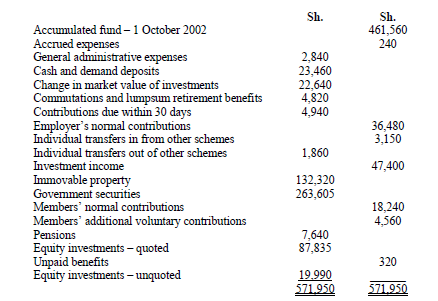
The following trial balance was extracted from the books of ABC Retirement Benefits Scheme for the year ended 30 September 2003:
Date posted:
February 12, 2019
-
Briefly explain the meaning of the term “abatement”
Date posted:
February 12, 2019
-
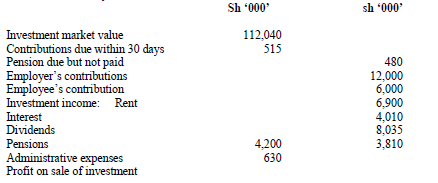
The following trial balance was extracted by the trustees of XYZ Retirement Benefit Scheme as at 31 May 2007

Date posted:
February 12, 2019
-
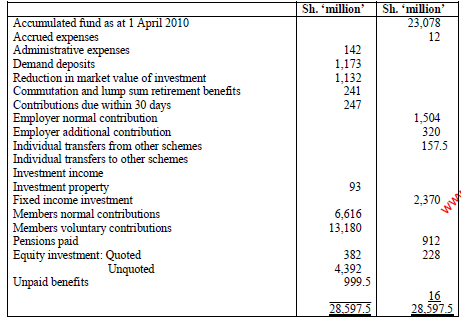
The following trial balance was extracted from the books of Juhudi Retirement Benefits Scheme as at 31 March 2011:
Date posted:
February 11, 2019
-
Outline four categories of expenses that should be recognized in the income statement in accordance with International Accounting standard (IAS) 19 “Employee benefits”
Date posted:
February 11, 2019
-
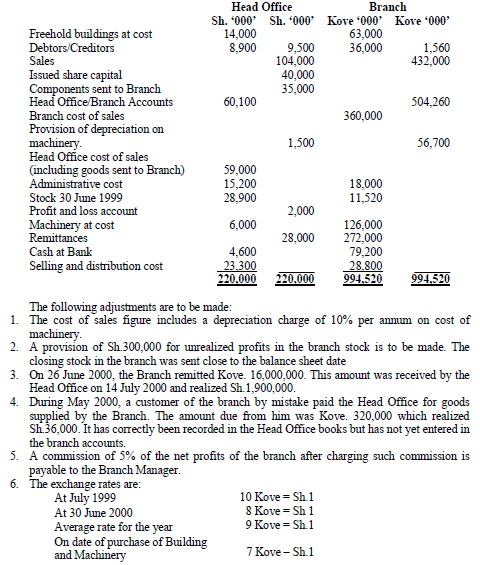
Mwenyeji Limited exported some of its products through an overseas branch whose currency is “Kove”. The trial balances of the Head Office and the Branch as at 30 June 2000 are as follows:
Date posted:
February 11, 2019
-
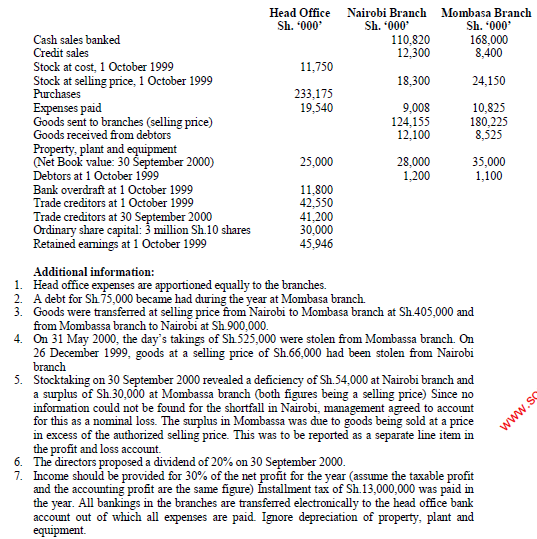
Trendsetters Limited operates two branches, one in Nairobi and one in Mombassa. These two branches are supplies from a warehouse in Athi River town where the Head Office of the Company is situated. All purchases are made at the head office. Goods are charged to both branches all selling price, which is head office cost plus 50%. All cash receipts in the branches are banked daily. The following figures relate to the company’s performance for the year ended 30 September 2000 and financial position as at that date.
Date posted:
February 11, 2019
-
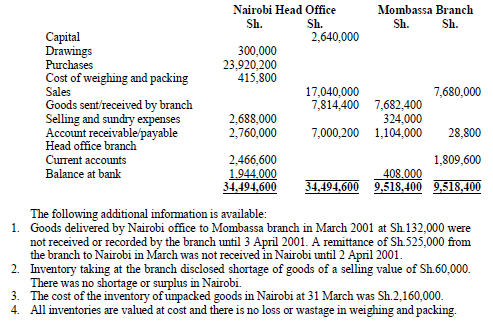
Joshua set up a business on 1 April 2000 in Nairobi with a branch in Mombasa. Purchases are made exclusively by Nairobi office where goods are weighed and packed before sale. The branch handles packed goods only from Nairobi and these are charged thereto at packed cost plus 10%. All sales by both branches are at a uniform gross profit of 25% on the packed cost.
The following balances have been extracted from the books of the business as at 31 March 2001
Date posted:
February 11, 2019
-
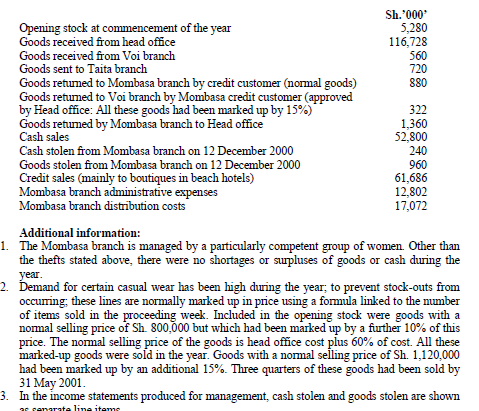
Victoria Gowns is a fashionable ladies-wear chain of clothing stores, started in Kakamega, but now present in all the major towns in Kenya and in Kampala, Uganda and in Dar-essalaam, Tanzania. The accounts of all the branches are maintained in the books of the head office, now situated in Nairobi. The figures below that refer to goods are stated at selling prices, following figures relate to transactions carried out by the Mombasa branch in the year ended 31 May 2001:
Date posted:
February 11, 2019
-
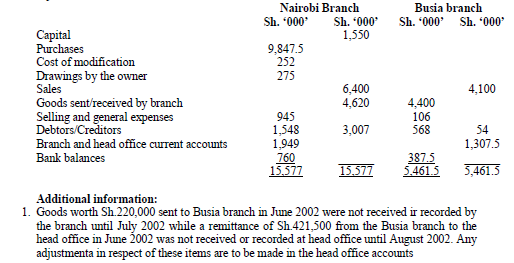
Traders Limited operates two branches one in the head office in Nairobi and the other in Busia. Purchases of stock are made exclusively by the head office branch which does some modification to the stocks before they are sold. Goods are sent to the Busia branch at modified cost plus 10% and all sales by both Busia branch and head office branch are made at a gross profit of 25% on the modified goods.
The trial balances as at 30 June 2002 before taking account of the under mentioned adjustments were:

Date posted:
February 11, 2019
-
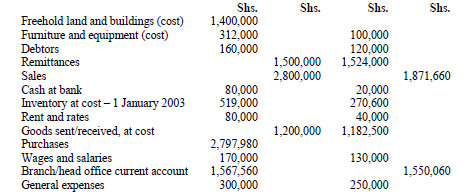
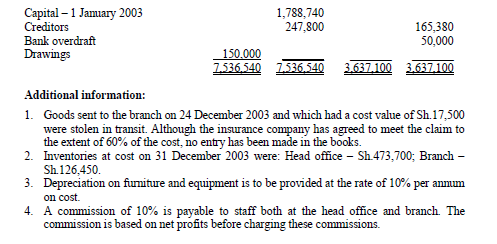
Mr. Mwadafu operates a sole proprietorship dealing in cement. The business has a head office in Mombasa and a branch in Athi River. The branch maintains its own books. As at 31 December 2003, the trial balances of the head office and the branch were as follows:
Date posted:
February 11, 2019
-
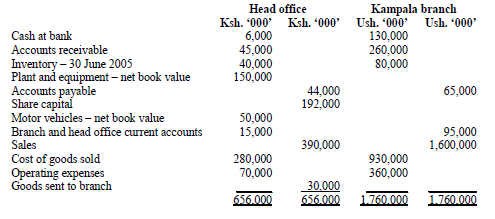
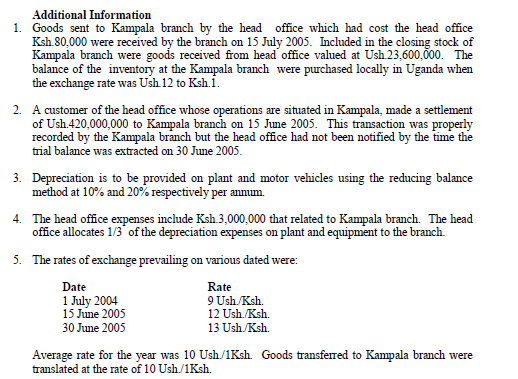
Beta East Africa Ltd. manufactures tubeless tyres at its head office plant located in Nairobi. It operates an overseas outlet at Kampala which maintains its own books of account. The tyres are transferred to the branch at head office cost plus 25% mark-up. All sales are at a uniform margin of 50%.
The trial balances extracted from the books o both the head office and the Kampala branch
as at 30 June 2005 were as follows:
Date posted:
February 11, 2019