-
Carbon and silicon are in the same group of the periodic table. Silicon (iv) oxide melts at 2440°c while solid carbon (iv) oxide sublimes at -70°c. In terms of structure and bonding, explain this difference.
Date posted:
December 21, 2017
-
Describe how a double aqueous ammonium ii sulphate can be prepared using the following reagents: aqueous ammonia, dilute sulphuric acid and iron metal.
Date posted:
December 18, 2017
-
State and explain the observation that would be made when hydrogen chloride gas is bubbled into a solution of silver nitrate.
Date posted:
December 17, 2017
-
Between methanol and propanol, which has a higher boiling point?
Date posted:
December 13, 2017
-
Name any three parts of the Bunsen burner and name their functions
Date posted:
December 3, 2017
-
Apart from the Bunsen burner, name other sources of heat used in the laboratory
Date posted:
December 3, 2017
-
Give 3 apparatus used for measuring accurate specific volume of liquids.
Date posted:
December 3, 2017
-
Give the reasons why most laboratory apparatus are made of glass
Date posted:
December 3, 2017
-
Name the uses of the following laboratory apparatus.
- Desiccator
- Deflagrating spoon
- Tongs
-Crucible.
Date posted:
December 3, 2017
-
A piece of burning sulphur was lowered into a gas jar filled with oxygen and containing aqueous litmus solution as shown.
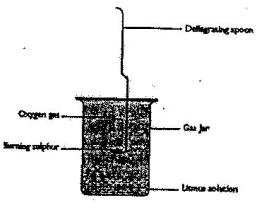 (a)State two observations made during the experiment.
(b)Write an equation for the burning xof sulphur in air.
(a)State two observations made during the experiment.
(b)Write an equation for the burning xof sulphur in air.
Date posted:
November 28, 2017
-
The diagram below shows some apparatus used in the laboratory
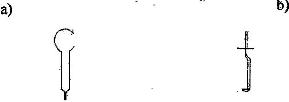 Name the apparatus and state their uses.
Date posted:
November 28, 2017
-
The set up below shows the apparatus used for the preparation of nitrogen (i) oxide
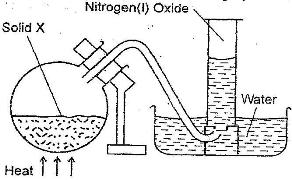 (a)(i)Name solid X
(ii)What precautions is taken when heating solid X
(b)Nitrogen (i) oxide does not burn but a magnesium ribbon continues burning in the gas.Explain
(a)(i)Name solid X
(ii)What precautions is taken when heating solid X
(b)Nitrogen (i) oxide does not burn but a magnesium ribbon continues burning in the gas.Explain
Date posted:
November 27, 2017
-
Study the table below and answer the questions that follow
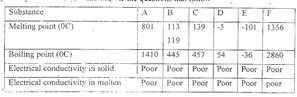 (i)Select a substance with a giant metallic structure.Explain
(ii)Substance A and C conduct electricity in molten state at room temperature.What is the difference in
their conductivity?
(iii)Select a substance which is in gaseous state.Explain
(i)Select a substance with a giant metallic structure.Explain
(ii)Substance A and C conduct electricity in molten state at room temperature.What is the difference in
their conductivity?
(iii)Select a substance which is in gaseous state.Explain
Date posted:
November 27, 2017
-
The table below gives some properties of substances I,II,III and IV.Study it and answer the questions that follows
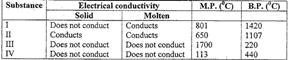 What type of structure exist in substances?
I............................
II...........................
III..........................
IV...........................
What type of structure exist in substances?
I............................
II...........................
III..........................
IV...........................
Date posted:
November 24, 2017
-
Study the reaction scheme below and answer the question that follow
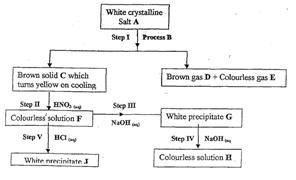 Name(i)Salt A
(ii)Process B
(iii)Solid C
(iv)Brown gas D
(v)Gas E
(VI)Salt in solution F
(VII)Precipitate G
(viii)complex ion in solution H
Name(i)Salt A
(ii)Process B
(iii)Solid C
(iv)Brown gas D
(v)Gas E
(VI)Salt in solution F
(VII)Precipitate G
(viii)complex ion in solution H
Date posted:
November 24, 2017
-
The diagram below shows a set-up which was used by a student to investigate the effect of electricity on molten lead (ii)bromide before and after heating the lead (II)bromide
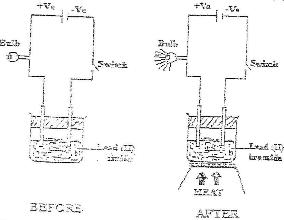 (a)On heating lead (II) bromide,the bulb lit brightly.Before heating,the bulb did not light.
Explain
(b)Write ionic equations to show the reaction taking place on lead(II) bromide
(i)At the anode
(ii)At the cathode
(c)State and explain one important precaution that this student should have taken while performing this
experiment
(a)On heating lead (II) bromide,the bulb lit brightly.Before heating,the bulb did not light.
Explain
(b)Write ionic equations to show the reaction taking place on lead(II) bromide
(i)At the anode
(ii)At the cathode
(c)State and explain one important precaution that this student should have taken while performing this
experiment
Date posted:
November 23, 2017
-
The diagram below represents a burning jiko.
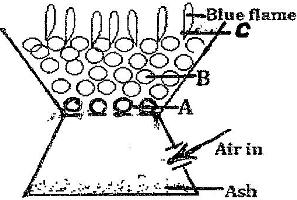 (a)Write down the equation for the reactions taking place at;
A.........................
B.........................
(b)Why is it dangerous to use a jiko in a closed room
(a)Write down the equation for the reactions taking place at;
A.........................
B.........................
(b)Why is it dangerous to use a jiko in a closed room
Date posted:
November 22, 2017
-
Name the first 10 elements of the periodic table of elements in their correct order.
Date posted:
November 17, 2017
-
The diagram below was used to prepare an alkane in the laboratory
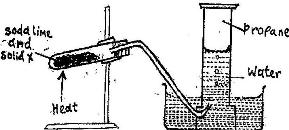 (i)Write the formular of solid X
(ii)Explain why calcium oxide is added to the mixture above
(iii)Write a balanced equation for the reaction that occurs in the flask
(i)Write the formular of solid X
(ii)Explain why calcium oxide is added to the mixture above
(iii)Write a balanced equation for the reaction that occurs in the flask
Date posted:
November 16, 2017
-
Starting with copper metal describe how a sample of crystals of copper 2 chloride may be prepared
Date posted:
November 16, 2017
-
Explain the change in mass that occurs when solid copper(II)nitrate is heated in open crucible.
Date posted:
November 15, 2017
-
If an umbrella is touched with a finger on inner surface when it is raining it allows the rain water to leak through. Give a reason
Date posted:
November 12, 2017
-
An aqueous solution of hydrogen chloride gas reacts with manganese (IV) oxide to form chlorine gas while a solution of hydrogen chloride in methylbenzene does not react with manganese (IV) oxide. Explain
Date posted:
November 12, 2017
-
(a) What is air pollution?
(b) State four gaseous substances present in unpolluted air
Date posted:
November 9, 2017
-
Describe how you can differentiate between Lead (II) ions and Calcium ions using Sodium chloride
Date posted:
November 9, 2017
-
Explain the following observations.
a)Aluminium is used in the manufacture of pans and sufurias.
b)Magnesium Oxide has a higher melting point than sodium oxide
c)Solid sodium chloride does not conduct electricity whereas molten sodium chloride does
Date posted:
November 8, 2017
-
When sulphur is heated in a boiling tube in the absence of air, the yellow crystals melt into a golden yellow mobile liquid at 113oC. The liquid turns into a dark brown viscous mass at 180oC. At 400oC the brown liquid becomes less viscous and flows easily. Explain these observations
Date posted:
November 8, 2017
-
Chlorine gas was bubbled through water and the solution exposed to sunlight for a few hours.State and explain the observations made.
Date posted:
November 8, 2017
-
When aluminium chloride is dissolved in water, the resulting solution has a PH of 3. Explain.
Date posted:
November 8, 2017
-
Explain why potassium hydroxide is not a suitable reagent for testing carbon (IV) oxide
Date posted:
November 8, 2017