-
Figure 3 shows the main features of a cathode ray tube (CRT) of a cathode ray oscilloscope (CRO).
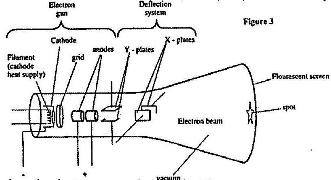 (i) Describe how the electrons are produced in the tube.
(ii) State and explain the function of the grid.
(iii) State what would be observed on the screen if an a.c voltage is connected across the y-plates.
(i) Describe how the electrons are produced in the tube.
(ii) State and explain the function of the grid.
(iii) State what would be observed on the screen if an a.c voltage is connected across the y-plates.
Date posted:
June 5, 2017
-
Give the major earthquake zones of the world.
Date posted:
June 5, 2017
-
Figure 15, shows two coils A and B placed close to each other. A is connected to a steady D.C. Supply and a switch, B is connected to a sensitive galvanometer.
 (i) The switch is now closed. State the observations made on the galvanometer.
(ii) Explain what would be observed if the switch is then open.
(i) The switch is now closed. State the observations made on the galvanometer.
(ii) Explain what would be observed if the switch is then open.
Date posted:
June 5, 2017
-
Explain ways in which the earth's crust is affected by earthquakes.
Date posted:
June 5, 2017
-
Describe how a parasitic cone is formed.
Date posted:
June 5, 2017
-
Discuss ways in which volcanic mountains influence human activities positively.
Date posted:
June 5, 2017
-
Explain the characteristics of a composite volcano.
Date posted:
June 5, 2017
-
Explain how a sill is formed.
Date posted:
June 5, 2017
-
Discuss how Mt.Kenya was formed.
Date posted:
June 5, 2017
-
Name volcanic features found in the rift valley of Kenya.
Date posted:
June 5, 2017
-
Figure 11 shows a test-tube whose cross-sectional area is 2 cm2 partially filled with lead shot floating vertically in water.
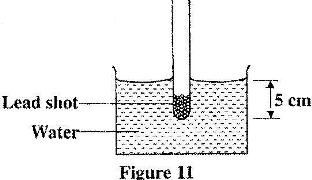 (i) Determine the: volume of the water displaced;
(ii) Determine weight of water displaced.
(iii) State the combined weight of the test-tube and the lead shot.
(i) Determine the: volume of the water displaced;
(ii) Determine weight of water displaced.
(iii) State the combined weight of the test-tube and the lead shot.
Date posted:
June 5, 2017
-
Figure 13 shows a hydrometer with a thin stem floating in water in a beaker.
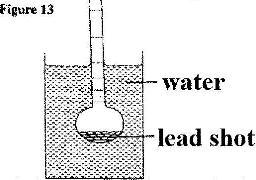 State with a reason what is observed on the hydrometer when the temperature of the water is raised.
Date posted:
June 5, 2017
-
Explain four ways in which features resulting from faulting are of significance to the economy of Kenya.
Date posted:
June 5, 2017
-
Figure 13 shows a log of wood of mass 20 kg submerged in water in a pond and held in position by a string fixed to the bottom of the pond.
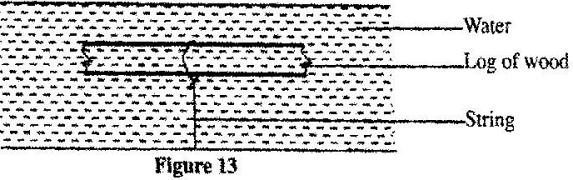 Given that the density of water is 1000 kgm -3 and that of wood is 800 kgm -3, determine the;
(i) Volume of the log.
(ii) Upthrust of the log.
(iii) Tension in the string.
Given that the density of water is 1000 kgm -3 and that of wood is 800 kgm -3, determine the;
(i) Volume of the log.
(ii) Upthrust of the log.
(iii) Tension in the string.
Date posted:
June 5, 2017
-
Discuss ways in which faulting influence drainage systems.
Date posted:
June 5, 2017
-
Discuss the significance of faulting to human activities.
Date posted:
June 5, 2017
-
Apart from compressional,name other processes that may cause faulting.
Date posted:
June 5, 2017
-
Apart from the Rift Valley,name other relief features that were formed as a result of faulting.
Date posted:
June 5, 2017
-
Discuss the effects of faulting.
Date posted:
June 5, 2017
-
The system in Figure below is in equilibrium.
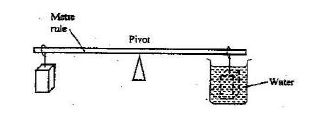 When temperature of the water is raised the system is observed to tilt to the right. State the reason for this observation.
Date posted:
June 5, 2017
-
Figure 14 shows a cork floating on water and held to the bottom of the beaker by a thin thread.
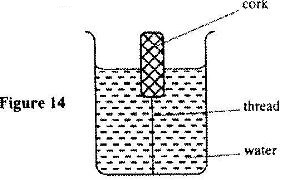 (i) Name the forces acting on the cork
(ii) Describe how each of the forces mentioned in (i) above changes when water is added into the beaker until it fills up.
(i) Name the forces acting on the cork
(ii) Describe how each of the forces mentioned in (i) above changes when water is added into the beaker until it fills up.
Date posted:
June 5, 2017
-
Explain the difference between a normal fault and a reverse fault.
Date posted:
June 5, 2017
-
Figure 13 shows a simple hydrometer.
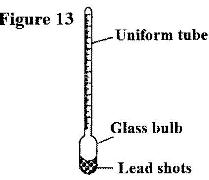 (i) State the purpose of the lead shots in the glass bulb.
(ii) How would the hydrometer be made more sensitive?
(iii) Describe how the hydrometer is calibrated to measure relative density.
(i) State the purpose of the lead shots in the glass bulb.
(ii) How would the hydrometer be made more sensitive?
(iii) Describe how the hydrometer is calibrated to measure relative density.
Date posted:
June 5, 2017
-
Figure 8 shows a container with small holes at the bottom in which wet clothes have been put. When the container is whirled in air at high speed as shown, it is observed that the clothes dry faster.
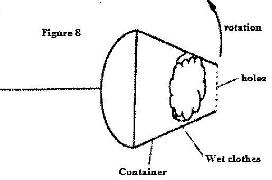 Explain how the rotation of the container causes the clothes to dry faster.
Date posted:
June 2, 2017
-
Figure 8 shows a car of mass M moving along a curved part of the road with a constant speed.
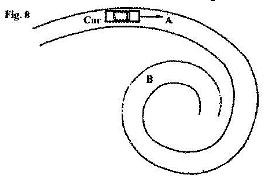 Explain the fact that the car is more likely to slide at B than at A if the speed is not changed.
Date posted:
June 2, 2017
-
cFigure 16, shows a graph of magnification against object distance, for an object placed in front of a lens of focal length 20 cm.
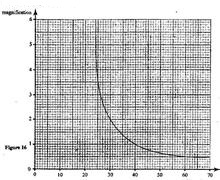 Using the graph;
(i) State the effect on the size of the image when the object distance is increased from 25 cm.
(ii) Determine the distance between the object and the lens when the image is same size as the object.
(iii) Determine the image distance when the object distance is 25 cm.
Using the graph;
(i) State the effect on the size of the image when the object distance is increased from 25 cm.
(ii) Determine the distance between the object and the lens when the image is same size as the object.
(iii) Determine the image distance when the object distance is 25 cm.
Date posted:
June 2, 2017
-
Discuss the effects of Fold Mountains on human activities.
Date posted:
May 29, 2017
-
Apart from fold mountains,name other features resulting from folding.
Date posted:
May 29, 2017
-
Name fold mountains found in Africa.
Date posted:
May 29, 2017
-
Name the effects of the movement of tectonic plates.
Date posted:
May 29, 2017