-
Read the poem below and then answer the questions that follow
"Sympathy"
I know what the caged bird feels, alas!
When the sun is bright on the upland slopes;
When the wind stirs soft through the springing grass
And the river flows like a stream of glass;
When the first bird sings and the first bud opens,
And the faint perfume from its petals steals-
I know what the caged bird feels!
I know why the caged bird beats his wing
Till its blood is red on the cruel bars;
For he must fly back to his perch and cling
When he rather would be on the branch a swing;
And a pain still throbs in the old, old scars
And they pulse again with a keener sting-
I know why he beats his wing!
I know why the caged bird sings, ah me,
When his wing is bruised and his blossom sore;
When he beats his bars and would be free;
It is not a song of joy or glee,
But a prayer that he sends from his heart's deep core,
But a plea, that upward to heaven he flings –
I know why the caged bird sings!
(Adapted from the poem by Paul Laurence Dunbar in America Negro Poetry, edited by Arna Bontemps. New York: Hill and Waug 1974.)
(a). Explain briefly what the poem is about (3 mks)
(b). What does the poet focus on in each of the three stanzas? Give your
answer in note form. (6 mks)
(c). How would you describe the persona's feelings towards the caged bird?
(4 mks)
(d). What can we infer about the persona's own experiences? (3 mks)
(e). Identify a simile in the first stanza and explain why it is used. (2 mks)
(f). Explain the meaning of the following lines
(i). And the faint perfume from its petals steals. (1 mark)
(ii). And they pulse again with a keener sting. (1 mark)
Date posted:
April 2, 2019
-
List the advantages of Dynamic RAM over Static RAM.
Date posted:
April 2, 2019
-
0.5kg of naphthalene contained in an aluminium can of mass 0.4kg is melted in a water bath and raised to a temperature of 100oC . Calculate the total heat given out when the can and its contents are allowed to cool to room temperature, 20oC . Neglect losses by evaporation during heating process and give your answer to the nearest kilojoule.(For naphthalene melting point = 80oC , Specific heat capacity for both liquid and solid =2100J/KgK; specific latent heat of fusion = 170000J/Kg.For aluminium: specific heat capacity = 900J/Kg/k
Date posted:
April 2, 2019
-
State and explain the parts of a floppy disk.
Date posted:
April 2, 2019
-
Figure below shows a test tube partially filled with water. An ice wrapped in wire gauze is placed at the bottom of the test-tube. It is then held in the flame of a bunsen burner as shown below
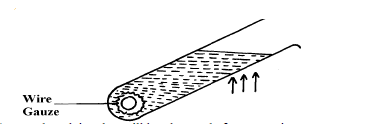 State and explain what will be observed after some time
Date posted:
April 2, 2019
-
The Brewing Night
It was that memorable night when I heard it.
Yes, I heard it all.
That night sleep deserted me,
Mocked at me and tantalized me;
So I lay awake, sharp in all my senses.
It was long past midnight:
Time dragged on, the clock wouldn't chime;
The dog wouldn't bark, nor the babies cry;
It was a moonless and windless night;
The whole universe seemed to stagnate
In dark, dreary, dead slumber
What was amiss? I knew not.
The dead quietness and solitude
Seemed to be eternal, - but
Waves of babbling and muttering
Began to trickle through the streets;
A distant roaring if heavy trucks filled the air,
Hurried footsteps echoed through the street.
What was a miss? I knew not.
I pulled my curtain
And there I saw it all
Heavy boots thick uniforms and solid helmets
Dimly discernible under the pale street lamp
The atmosphere stood stiff and solid with
Browny - faced and clenched-teeth determination.
The night had pused with passions high and wild;
The streets were stained with new portraits framed;
The wheel changed hands and new plans were filled.
The morning saw the country strangely dressed
And everyone attended the rally.
To hear the eloquence from a strange face,
And everyone quietly nodded and said, 'yes'
(By Yusuf O. Kassam, in poem from East Africa.)
(a) Explain what the poem is about
(b) ln what way was the night described in the poem peculiar?
(c) What was amiss? I knew not. (Rewrite as one sentence beginning: I did)
(d) Paraphrase in one sentence what the persona saw when he or she pulled curtain to see.
(e) What is the significance of stanza two?
(f) Explain the meaning of the title.
Date posted:
April 2, 2019
-
Read the following poem and answer the questions that follow.
Betrothed by Obyero Qdhiambo
The bride, they said
Had gone through school
Primary secondary university upwards
Three thousand shillings is not enough
For having fed her
schooled her
employed her
Three thousand shillings is not enough
For having borne her
Cared for her
doctored her
And "she is pure"
Three thousand shillings is not enough
Look at her silky black hair
Darker and finer than that
Flywhisk there
Look at her forehead, a
nice wide trace between
hair line and eyes:
"She is immensely intelligent".
Look at her eyes .Yes, look again
Two diviners' cowries spread out
Symbolically on the divination mat
Deep profound intelligent
Look at those lips "ndugu"- - - - -
Three thousand shillings is not enough
even to shake her by the hand.
"Fathers, this is what we walked with!
Three thousand shillings
As a token of our
Love
For your daughter and you
Our intended kin
It was just a token
the size of a token does not reflect
The size of the heart that bringeth it
My heart is full to the brim with
Love
For her and you my intended kin"
But young man, you say, you love
And you possible expect love
But, young man, don't you
Don't you really feel
Three thousand shillings is not enough
even to get love?
Three thousand is not enough!
(From an ‘Anthology of East Africa Poetry’ Editing by A.D Amateshe, Longman, UK 1988)
1. Briefly explain what the poem is about? (2 mks)
2. Which qualities make the bride such a special person according to her kin?
(4 mks)
3. Identify the adjectives in the comparative degree. 2 mks)
4. Identify the metaphor in the fifth stanza and explain it’s meaning
(4 mks)
5. Why do you think the line "Three thousand shillings is not enough" is repeated several times? (2 mks)
6. How would you describe the bride's kin? Illustrate your answer (4 mks)
7. What do we learn about the society from this poem? (2 mks)
Date posted:
April 2, 2019
-
The figure below shows two identical thermometers. Thermometer A has a blackened bulb while thermometer B has a silvery bulb. A candle is placed equidistant between the two thermometers.
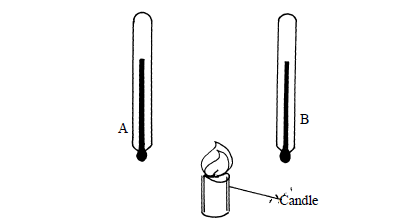 State with a reason the observations made after some time
Date posted:
April 2, 2019
-
Read the following poem and answer the questions that follow.
CITY LIFE
When I am in a great city, I know that I despair.
I know there is no hope for us, death waits, it is useless to care,
For oh the poor people, that are flesh of my flesh,
I, that am flesh of their flesh,
When I see the iron hooked into their faces
their poor, their fearful faces
I scream in my soul, for I know I cannot
Take the iron hooks out of their faces, that make them so drawn,
Nor cut the invisible wires of steel that pull them.
Back and forth, to work,
Back and forth to work,
Like fearful and corpse-like fishes hooked and being played.
By some malignant fisherman on an unseen shore where he does not choose to land them yet, hooked fishes of the factory world.
(D.H. Lawrence (1885 - 1930)
1. Identify and explain the mood in the poem (2 mks)
2. Identify and explain the appropriateness of 3 poetic features used in the poem (6 mks)
3. In one sentence summarize the persona perception of the city life? (1 mark)
4. If you were to recite this poem how would you make it emotional? (2 mks)
5. Explain the meaning of the word ‘malignant’ (1 mark)
Date posted:
April 2, 2019
-
What are the advantages of Magnetic Disks?
Date posted:
April 2, 2019
-
Figure below shows a cross-section of a vacuum flask
 (i) Name the parts labelled A and B on the diagram
(ii) Explain how the heat losses are minimized when hot liquid is poured into the flask
(i) Name the parts labelled A and B on the diagram
(ii) Explain how the heat losses are minimized when hot liquid is poured into the flask
Date posted:
April 2, 2019
-
Read the passage below and then answer the questions that follow.
The acceptance of the Christian church meant the 'outright rejection of all the Africans- customs. It meant rejection of those values and rituals that held us together: It meant adopting what in effect was a debased European middle - class mode of living and behaviour. The European missionary had attacked the primitive rites of our people, had condemned our beautiful African dances, the images of our gods, recoiling from their suggestion of satanic sensuality. The early African convert did the same, often with even greater zeal, for he had to prove how Christians he was through this rejection of his past and roots. The conflict between the Kenya people and the missionary churches, the subsequent setting up of African independent churches, and the religious aspects of the Mau Mau liberation movement, were direct results of the culture conflict initiated by the missionary holy zeal. The break away churches all over Kenya tried to create a form of worship and evolve an education more in thee and harmony with people's hopes, incorporating as some did the best in our traditional approach to God and the universe. They wanted in the words of Professor Alan Ogot and the Reverend F.B Welbourn, to build a place to feel at home.
The church in Kenya today is a creation of the Europeans missionaries. And we have said the missionaries were part of the momentous upheaval in our history - the coming of the colonialism. Or rather, missionaries were part of the momentous upheaval in our history - the coming of colonialism, or rather, missionaries, settlers and administrators were agents of European imperialism. It has been said with truth that the trader and the settler followed the skirts and shirt - cuffs of the missionary. In some places in Africa, political power was established at the request and instigation of the missionaries of the imperialist's country. Livingstone and Cecil Rhodes, Dr. Arthur and Lord Delamere, were these not part of that movement that came into such a fatal collision with our way of life and identity?
(Adapted from "Church, Culture and politics". In Ngugi wa Thiongo's Homecoming).
i) Mention any two things that show that the author disapproves of the conversion of Africans to Christianity. (2 marks)
ii) What does the writer find wrong with the initial education offered by the missionaries. (2 marks)
iii) List any two "benefits" that came to be associated with education
(2 marks)
iv) How did the Africans respond to the missionary Holy Zeal"?
(4 marks)
v) What relationship does the writer see between the missionary and the imperialist? (2 marks)
vi) What is the writer's attitude towards African culture? Give reasons for your answer. (4 marks)
vii) Explain the meaning of the following expressions as they are used in the passage (4 marks)
Robbed people of their soul
Promise of a European heaven
Momentous upheaval
Fatal collision
Date posted:
April 2, 2019
-
A jet delivering 0.44g of dry steam per second, at 100oC is directed on to crushed ice at 0.0oC contained in an unlagged copper can which has a hole in the base. 4.44g of water at 0.0oC flow out of the hole per second.
(i) How many joules of heat are given out per second by condensing steam and cooling to 0.0oC of water formed?(Latent heat of vaporization of steam = 2.26 x 10⁶JKg-1,c for water = 4200JKg-1K-1)
(ii) How much heat is taken in per second by the ice which melts?
(iii) Suggest why these amounts above are different
Date posted:
April 2, 2019
-
Outline the differences between Hard disks & Floppy diskettes.
Date posted:
April 2, 2019
-
A block of metal of mass 150g at 100oC is dropped into a logged calorimeter of heat capacity
40J/k containing 100g of water at 25oC. The temperature of the resulting mixture is 34oC.
(Specific heat capacity of water = 4200J/KgK)
Determine;-
(i) Heat gained by calorimeter
(ii) Heat gained by water
(iii) Heat lost by the metal block
(iv) Specific heat capacity of the metal block
Date posted:
April 2, 2019
-
What are the differences between magnetic disks and magnetic tapes.
Date posted:
April 2, 2019
-
In the eighteenth century, the field of science was virtually closed to women. In France, the countess wrote a highly regarded book about Newtonian physics, but its very excellence spoke against her. The manuscript was so good that it was widely assumed that it had been written by the countess's tutor rather than by the countess herself. Sadly enough, the tutor Samuel Konig, did nothing to discourage the rumours about the books7 authorship. Instead, he took full credit for the countess's efforts. In England, the leading nation in science, the situation was worse. Women were strictly prohibited from admission to scientific societies. Indeed the English denied women access to all forms of scientific study.
Italy, however, was something of an exception to the general European rule, and a number of provincial scientific societies did admit women. It is perhaps not surprising, then, that the one woman who crashed the barriers erected against her gender was an Italian, Laura Bassi (1711 -1778). Bassi actually became a respected scientific figure at a time when women were generally thought to be too intellectually limited for the rigors of scientific study. By all accounts, she thoroughly disproved the sexist notion that women and the sciences were opposed to one another.
Bassi was one of the lucky women of her era. Her father was an enlightened lawyer in Bologna, Italy, who believed that women should be educated. Thus, young Laura was schooled by the family physician, Gaetano Tacconi. By the age of twenty she was familiar with scientific concepts of the times, particularly Newtonian physics. Because her father encouraged her to display her erudition at social gatherings, Bassi's reputation as a learned woman grew. Tested by a group of professors and scholars anxious to prove that a woman could not possibly be so clever, Bassi astonished the sceptics with her intelligence, learning, and eloquence. Local scholars were so impressed that in 1731 they invited her to join the Bologna Institute of Sciences and to study for a degree at the University of Bologna. On May 12, 1732, Bassi became only the second woman ever to gain an academic degree. A few months later, she became the world's first female professor
But despite her breakthrough, those in charge of the University of Bologna had very rigid ideas about what Bassi could or could not do as a professor. For example, she had no say over her schedule. To the University's leaders, she was an intriguing oddity. They might trot her out for display to curious visiting scholars, but they would not let her lecture on a regular basis. Nor, for that matter, could she pursue her own studies or research. Still, Bassi was not an easy woman to control, and to a degree, she managed to go her own way.
In 1 749, to escape university restrictions, Bassi began offering private lessons in experimental physics. She also began championing Newtonian physics at a time when it was relatively unknown in Italy, and she promoted Newton's findings about gravity even in the face of widespread intellectual resistance. In addition, Bassi corresponded with the leading physicists of the day Thus, she kept her country abreast of new scientific theories.
In 1 776, when Bassi was sixty five, the university acknowledged her contributions to scientific thought by bestowing upon her an unheard of honour of a woman: She was appointed chair of experimental physics, and her husband, the father of her eight children, was appointed her assistant.
Contrary to expectation, Bassi's achievement did not pave the way for other women. This is because many of her male colleagues had been disturbed by her extraordinary progress and were reluctant to let any other female follow her footsteps. After Bassi's death in 1778, it took more than a century, and the arrival of Marie Curie, for another woman to find herself at home in the male-dominated world of science.
Adapted from Reading for Results by Laraine Fleming (2008) New York Houghton Mifflin
(a) Why was it widely assumed that the countess's tutor had written the book on Newtonian physics? (2 marks)
(b) In what way was France better than England in the treatment of women interested in the sciences? (3 marks)
(c) Rewrite the following sentence using the word "surprisingly".
(1 mark)
It's perhaps not surprising, then that the one woman who crashed the barriers erected against her gender was an Italian, Laura Bassi.
(d) According to the passage, what was a professor expected to do?
(3 marks)
(e) For what selfish purpose did the University of Bologna use Bassi?
(2 marks)
(f) What evidence is given to show that Bassi was difficult to control?
(3 marks)
(g) Why do you think the author mentions the fact that Bassi had eight children? (3 marks)
(h) Explain the meaning of the following expressions as used in the passage.
(3 marks)
Erudition .............................................
To a degree.........................................
Find herself at home…………………
Date posted:
April 2, 2019
-
Give the similarities between magnetic disks and magnetic tapes.
Date posted:
April 2, 2019
-
A block of metal of mass 300g at 1000c is dropped into a logged calorimeter of heat capacity40Jk-1, containing 200g of water at 200c. The temperature of the resulting mixture is 340c
Determine:
(i) Heat gained by calorimeter.
(ii) Heat gained by water.
(iii) Heat lost by the metal block.
(iv) Specific heat capacity of the metal block.
Date posted:
April 2, 2019
-
Read the following oral poem and answer the questions that follow:
The poor man knows not how to eat with a rich man.
When they eat fish, he eats the head.
Invite a poor man and he rushes in
Licking his lips and upsetting the plates.
The poor man has no manners; he comes along with the blood of lice under his nails.
The face of a poor man is lined
From hunger that thirst in his belly.
Poverty is no state for any mortal man.
It makes him a best to be fed on grass.
Poverty is unjust. If it befalls a man,
Though he is nobly born, he has no power with God.
(Anonymous from Swahili poetry by L. Harries)
a) What evidence is there to show that this is an oral poem? Identify and illustrate any two such features. (4 marks)
b) Describe a probable situation in which such a poem could be performed
(3 marks)
c) If you were to do a solo performance of this oral poem, what element would you emphasize? (6 marks)
d) What does the phrase --- 'with the blood of lice under his nails' reveal about the poor man? (2 marks)
e) Describe with illustrations the tone of this poem. (3 marks)
f) Explain the meaning of the following
i) He eats the head
ii) He has no power with God
Date posted:
April 2, 2019
-
Explain CD-ROMs (Compact Disc Read Only Memory).
Date posted:
April 2, 2019
-
Read the following oral poem and answer the questions that follow:
One hand cannot manage work
A threshing stick cannot thresh millet with one hand.
Some hands breed hatred at the eating time
Nobody hates being assisted.
Let millet be threshed
Let it be threshed, let it be threshed
Cut a threshing stick for me
A lazy wife
Is taken back to her parents
When the rain fails
It blames the wind
And a lazy woman
Blames the threshing stick
Cut a threshing stick for me -ii
My co-wife cut me a threshing stick
You woman, owner of this occasion
Remember that work is the stomach
Take care not to starve us
The threshing sticks are sounding
Let the millet leave the threshing ground.
(Adapted from oral literature of the Embu and Mbeere by Ciarunji Chesaina)
a) What kind of oral poem is this? (3 marks)
b) Identify and illustrate the oral features of this poem. (6 marks)
c) What does this poem tell us about the role and place of women in this society? (4 marks)
d) According to this poem, which moral values were emphasized in this community? (3 marks)
e) Explain the meaning of the following lines
i) Some hands breed hatred at eating time.
ii) Remember that work is the stomach (4 marks
Date posted:
April 2, 2019
-
A mass of 2kg is attached to a string of length 50 cm. It is whirled in a circle in a vertical plane
at 10 revolution per second about a horizontal axis. Calculate the tension in the string when the
mass is at the :-
(a)Highest point of the circle.
(b) Lowest part of the circle.
Date posted:
April 2, 2019
-
Read the following poem and answer the questions that follow.
The owner of yam peels his yam in the house:
A neighbour knocks at the door.
The owner of yam throws his yam in the bedroom:
The neighbour says, 'I just heard
A sound, Kere Kere, that's why I came.
'The owner of yam replies,
'That was nothing, I was sharpening two knives.
'The neighbour says again, 'I still heard
Something like bi sound behind your door.
The owner of yam says,
'I merely tried my door with a mallet.
'The neighbour says again,
'What about this huge fire burning on your hearth?'
The fellow replies,
'I am merely warming water for my bath.
'The neighbour persists,
'Why is your skin all white, when this is not the Harmattan season?
The fellow is ready with his reply,
"I was rolling on the floor when I heard of the Agadapidi."
The owner of yam starts to shout,
There cannot be peace.
Unless the owner of food is allowed to eat his food!'
(Yoruba, Nigerian. Translated by ULLI BEIER) From Sunburst. Edited by lan Gordon)
a) What is this poem about? (2 marks)
b) How do we know that the neighbor is not convinced by the owner of yam's explanations? (3 marks)
c) Which character traits are revealed about the owner of yam? (4 marks)
d) Identify the features of this poem that indicate that it is an oral poem
(4 marks)
e) Why do you think the owner of yam begins to shout? (3 marks)
f) What features of oral performance would you emphasis in delivering the last speech of the owner of yam? (4 marks
Date posted:
April 2, 2019
-
List the advantages of CD-R (Recordable).
Date posted:
April 2, 2019
-
(a) What is a riddle? (3 marks)
(b) i) State one riddle in mother tongue or Kiswahili and provide the
English translation. (2 marks)
Explain the imagery in the solution to your riddle (2 marks)
c) Describe the stages in a riddling session (5 marks)
d) Who is the audience in a riddling session? (2 marks)
e) State any four functions of fiddles (2 marks)
f) Distinguish between a riddle and a puzzle (2 marks)
Date posted:
April 2, 2019
-
Give the reasons why Optical discs are not mostly used in microcomputer systems as secondary storage media.
Date posted:
April 2, 2019
-
Read the oral narrative below and then answer the questions that follow.
Nyasaye (God) wanted to put a stop to the rampages of death-death which claims the lives of everyone
Young and old
Boys and girls
Men and women
Strangers and kinsmen;
Death which kills
The innocent and the guilty
Chiefs and their subjects
The healthy and the sick
The wise and the foolish.
So one day he sent a servant to earth with a message for all his people. 'send me an offering of fresh, untainted fat,' he ordered. 'It should be as clean and sparkling as the moon.'Hearing this, the people slaughtered a goat, removed its pure white fat, and placed it in a clay dish overspread with fine fresh leaves.
Now they summoned Ngo’ngruok, also known as Haniafu the Chameleon, and ordered him to take their offering to Nyasaye. They also fashioned a long pole that reached up to heaven where Nyasaye dwells in his glory. This was the path Ng’ongruok would follow when carrying their offering.
But Ng’onguruok accidentally soiled the fat with his clumsy feet, and on his arrival before Nyasaye, presented a dirty and unsightly offering. Nyasaye was furious and rejected it, shouting: 'tell the people of earth that because of this insult they must continue to die, just as their ancestors have done!'
Ng’ongruok descended from heaven delivered Nyasaye’s message, and returned the offering to the people. Ever since then, alas death has continued to ravage human beings. For his clumsiness, Ngo’ngruok was cursed by the people. Hence, he must always walk on all fours, and his steps must be hesitant and slow. That is why you will always see him carrying one leg raised from the ground as he tries to decide exactly where to tread.
(Adapted from: keep my words by B. Onyange-gutu and A.A Roscoe)
i) What would you do in order to capture the audience’s attention before you begin to tell this story? (2mks)
…………………………………………………………ii) Explain two ways in which you would make the narration of lines 20 to 23 of the story effective (4mks)
……………………………………………………………………
iii) Mention two ways in which you would know that you audience in this story is fully participating in the performance. (4mks)
……………………………………………
b) For each of the words below write another word that is pronounced in the same way.
Heir…………………………………………………
Weather…………………………………………….
Base………………………………………………..
Mourning………………………………………….
Date posted:
April 2, 2019
-
Read the story below and answer the questions that follow
Once upon a time, there lived a young woman who ran away from home to secretly marry her warrior lover out in the wilderness. The warrior directed the young woman to a place in the forest where he would meet her. He said to her, 'When you get to a fork along the path take the right path.' Then the warrior went ahead to await her arrival in the forest.
The young woman took off, and when she got to the fork that the warrior had mentioned, she followed the left path, forgetting which path the warrior had instructed her to follow.
As the girl walked on, she came upon an ogre who said to her, 'hey, young woman where are going? Do you have anything to say now that I’m going to eat you?' the girl answered in song
Not here my dear
Let us go to the water hole
Where you can eat me
And have a drink
Oh my dear warrior, where was it?
And so it happened that this was very bushy country. The ogre led the young woman on, and when they got to another spot, he said to her, ' I am now going to eat you here.' The girl broke into song, urging him not to eat her.
They went further, and the young woman kept hoping that the warrior would hear her voice. As they walked on, the ogre asked the young girl: ' shall I eat you hear'The girl sang again
Not here my dear
Let us go to the water hole
Where you can eat me
And have a drink
Oh dear warrior, where was it?
But the warrior had still not heard her. When they got to a cave by a river, the ogre collected branches and leaves on which to place the young woman’s flesh after he had slaughtered her. When he brought one type of leaf, the girl objected to having her flesh laid on ordinary leaves preferring the sweet- scented leaves of the Matasia plant. The ogre brought another kind of leaf nut the girl also rejected it, until eventually the sweet- smelling leaves of Matassia plant were brought. When the ogre asked the girl whether those were the right type of leaves, she said: Yes, these are the ones.' The ogre then laid the leaves down on the ground and lit a big fire. All this while, the girl was continuously singing the same song.
Just when the ogre was about to jump on the young woman, the warrior suddenly emerged from the bush. The young woman said to the ogre, 'It is now your skinny flesh that will be laid on those leaves.' The warrior killed the ogre and placed him on the bed of leaves and took the girl away. And that is the end of the story.
(Adopted from 'a young woman and an ogre' in Oral Literature of the Maasai, by
Naomi Kipury. Nairobi: EAEP 1983)
i. If you were performing this story, how would you say the words of the warrior? ( 1 mark)
ii. What could the warrior lover have done to improve on his giving of directions ( 1 mark)
iii. How would you deliver the first speech of the ogre?( 2 mks)
iv. The song is sung for both the ogre and the warrior lover. How would you perform it to show this? ( 2 mks)
v. As the story teller, how would you say the sentence: ' just when the ogre was about to jump on the young woman, the warrior suddenly emerged from the bush.' ( 2 mks)
vi. How do you think the audience would react when the warrior lover rivers? ( 1 mark)
Date posted:
April 2, 2019
-
DAUGHTER: (shortly having arrived home from school) Good afternoon,
Daddy
FATHER: (Sitting complacently in the sofa, reading a newspaper. Looking up…..) Good afternoon (Resumes reading)
DAUGHTER: (Holding out her school report form) Daddy, I’m excited. My teacher said I was the best improved. I was………..
FATHER: Oh, you were? Me, I used to be number one. I was absolutely unbeatable.
DAUGHTER: Chemistry has been a particular headache ( now looking at the report form which she thought her father would want to see), but this time…….
FATHER: (Stretching his arms, looking preoccupied)
Chemistry for me was particular easy.
I never scored anything less than 90%
DAUGHTER: Dad, I was going to tell you that this time…….
FATHER: (Absent minded) by the way, where is your mum?
DAUGHTER: Mum is in the garden picking vegetables. But dad, you’re not listening to my story. I was telling you about Chemistry
FATHER: You mean you have a story about chemistry? Chemistry is not about stories. It is hard science.
DAUGHTER: It’s about my improvement……..
FATHER: (laughing) me, it wasn’t matter of improvement. I was always at the top of the class
DAUGHTER: Daddy, I give up. You’re not listening
FATHER: (looking surprised) Listening? I heard you: you were talking about improvement in chemistry, weren’t you?
DAUGHTER: anyway, Dad. Thank you for paying attention. Enjoy your newspaper.
FATHER: Oh yes, I’m reading an interesting story about politics
Date posted:
April 2, 2019