-
Highlight the key features of short forms; proverbs, riddles, tongue-twisters, puns and jokes:
Date posted:
April 23, 2019
-
Similarities between tongue twisters and proverbs.
Date posted:
April 23, 2019
-
State the main features of panegyric (praise) songs:
Date posted:
April 23, 2019
-
Compare and contrast myths and legends
Date posted:
April 23, 2019
-
Highlight typical, key and specific features and functions of every type of song:
a)Love songs
b)Wedding songs
c)War songs
d)Sacred songs
e)Work songs
f)Initiation/ Circumcision songs
g)Dirges/ Funeral songs
h)Lullabies
i)Singing games
Date posted:
April 23, 2019
-
Identify 15 types of oral/ poems songs with their respective alternative names if applicable.
Date posted:
April 23, 2019
-
Highlight key themes typical to legends
Date posted:
April 23, 2019
-
Explain the aspects of integration that exist between oral songs and oral poetry
Date posted:
April 23, 2019
-
Describe the poetic language/structure evident in songs
Date posted:
April 23, 2019
-
State 10 features of an oral song/poem
Date posted:
April 23, 2019
-
Highlight 10 general features of songs.
Date posted:
April 23, 2019
-
State at least 12 typical features of narratives and songs/ poems
Date posted:
April 23, 2019
-
State story telling devices that would enliven the narrative; if employed.
Date posted:
April 23, 2019
-
State at least 5 factors/ cues/ oral devices that make a story interesting/ thrilling/ captivating.
Date posted:
April 23, 2019
-
Outline the conventional ways of attracting attention.
Date posted:
April 23, 2019
-
List ways in which the audience can contribute towards a successful delivery of a narrative.
Date posted:
April 23, 2019
-
List the body languages that show alertness on the part of audience
Date posted:
April 23, 2019
-
State at least 5 key characteristics of the 8 sub-genres/ sub-categories of oral narratives.
a) Legends
b) Myths
c) Dilemma tales/ narratives
d) Aetiological/ Explanatory narratives
e) Trickster narratives/ tales/ stories
f) Ogre/ monster narratives
g) Fables
h) Parables
Date posted:
April 23, 2019
-
Define the term Control of fullness as used in garment construction
Date posted:
April 17, 2019
-
A Doll's House: Compare and contrast Mrs. Linde and Nora at the end of the play.
Date posted:
April 17, 2019
-
Explain the reason as to why Torvald constantly reprimand Nora for her wastefulness and foolishness while simultaneously supporting her behavior? What insight does this contradiction give us into Torvald and Nora’s relationship.
A Doll's House
Date posted:
April 17, 2019
-
Compare Torvald’s and Nora’s attitudes toward money from A Doll's House
Date posted:
April 17, 2019
-
Explain why different characters use the words 'free' and 'freedom'. How does the use of these words change throughout the play: A Doll's House
Date posted:
April 17, 2019
-
Explain the ways in which A Doll's House explore social issues.
Date posted:
April 17, 2019
-
How could the submissive, selfish and silly Nora of the first two acts transform herself into an independent woman by the end of the last act? Is the transformation realistic?
Based on A Doll's House.
Date posted:
April 17, 2019
-
Read the poem below and then answer the questions that follow
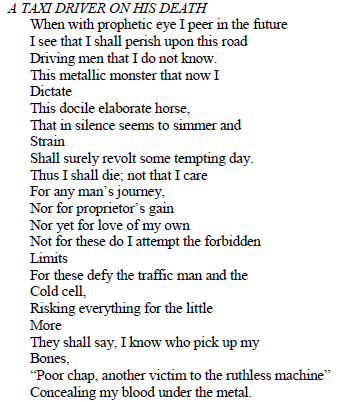 Questions
a. Whose point of view is this poem written? (2 mks)
b. What risk does the taxi driver take? (3 mks)
c. For what reason does the taxi driver do this job despite the risk? (1 mk)
d. What is the attitude of the taxi driver towards this job? (4 mks)
e. Illustrate three styles used in this poem (6 mks)
f. Explain the following words and expressions as used in the poem (4 mks)
(i) I peer in the future
(ii)This metallic monster
(iii) Shall surely revolt some tempting day
(iv) Little little more. (3 mks)
Questions
a. Whose point of view is this poem written? (2 mks)
b. What risk does the taxi driver take? (3 mks)
c. For what reason does the taxi driver do this job despite the risk? (1 mk)
d. What is the attitude of the taxi driver towards this job? (4 mks)
e. Illustrate three styles used in this poem (6 mks)
f. Explain the following words and expressions as used in the poem (4 mks)
(i) I peer in the future
(ii)This metallic monster
(iii) Shall surely revolt some tempting day
(iv) Little little more. (3 mks)
Date posted:
April 17, 2019
-
Read the following poem and answer the questions that follow.
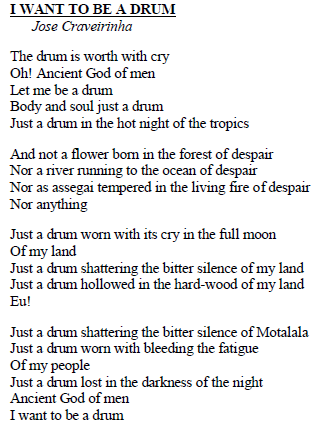
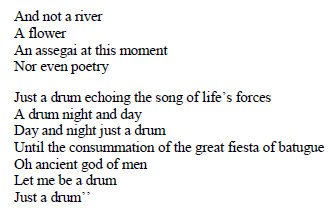 QUESTIONS
(a) State and illustrate fully the themes in the poem (4 mks)
(b) Explain the significance of the title in relation to the poem (3 mks)
(c) Why do you think the persona wants to be a drum? (3 mks)
(d) Discuss the relevance of the second stanza to the rest of the poem (3 mks)
(e) Name one sound poetic device used in the poem and explain its significance (2 mks)
(f) What is the mood in this poem? Explain how this mood is brought out (4 mks)
(g) Give another suitable title to this poem (1 mk)
QUESTIONS
(a) State and illustrate fully the themes in the poem (4 mks)
(b) Explain the significance of the title in relation to the poem (3 mks)
(c) Why do you think the persona wants to be a drum? (3 mks)
(d) Discuss the relevance of the second stanza to the rest of the poem (3 mks)
(e) Name one sound poetic device used in the poem and explain its significance (2 mks)
(f) What is the mood in this poem? Explain how this mood is brought out (4 mks)
(g) Give another suitable title to this poem (1 mk)
Date posted:
April 17, 2019
-
Read the poem below and answer the questions that follow.
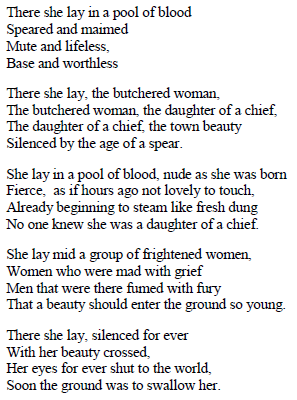 QUESTIONS.
(i). What is the poem talking about? (4 mks)
(ii) What is the poets attitude toward death? (4 mks)
(iii) Illustrate 3 poetic styles used in this poem (6 mks)
(iv) What is the mood of this poem? (2 mks)
(v) Give the meaning of the following words as used in the poem. (4 mks)
(v
i) The butchered woman
(ii) That beauty should enter the ground so young.
(iii) With her beauty crossed
(iv) Soon the ground was to swallow her.
QUESTIONS.
(i). What is the poem talking about? (4 mks)
(ii) What is the poets attitude toward death? (4 mks)
(iii) Illustrate 3 poetic styles used in this poem (6 mks)
(iv) What is the mood of this poem? (2 mks)
(v) Give the meaning of the following words as used in the poem. (4 mks)
(v
i) The butchered woman
(ii) That beauty should enter the ground so young.
(iii) With her beauty crossed
(iv) Soon the ground was to swallow her.
Date posted:
April 17, 2019
-
'You reap what you Sow.' By referring closely to the play A Doll’s House by Henrik Ibsen, write a composition in support of this line
Date posted:
April 16, 2019
-
Selflessness should have limits. To what extent do you agree with the assertion? Draw your supporting evidence from the play A Doll’s House
Date posted:
April 16, 2019