-
Figure 10 shows a fire alarm circuit
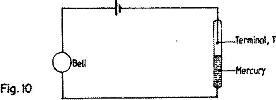 Explain how the alarm functions
Date posted:
April 13, 2017
-
Figure 1 shows a circuit diagram for controlling the temperature of a room
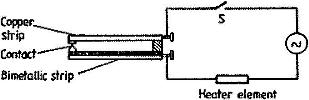 i) State and explain the purpose of the bimetallic strip.
ii) Describe how the circuit controls the temperature when the switch S is closed.
i) State and explain the purpose of the bimetallic strip.
ii) Describe how the circuit controls the temperature when the switch S is closed.
Date posted:
April 13, 2017
-
Figure 3 shows the arrangement of molecules in the three states of matter
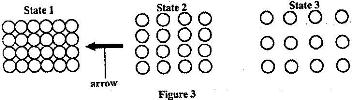 a) Name the process represented by the arrow.
b) State the reason for the arrangement of molecules in state 3.
a) Name the process represented by the arrow.
b) State the reason for the arrangement of molecules in state 3.
Date posted:
April 13, 2017
-
Figure 4 (i) shows a beaker filled with water. Some potassium permanganate was gently introduced at the bottom of the beaker at the position shown
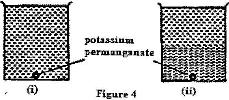 Figure 4 (ii) shows the appearance of the liquid after about 30 minutes. Explain how this appearance was caused
Date posted:
April 13, 2017
-
Figure 3 shows two cylinders of different cross-sectional areas with a tube. The cylinder contain an incompressible fluid and are fitted with piston of cross-sectional areas 4 cm2 and 24 cm2
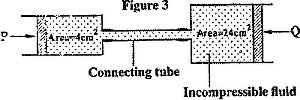 Opposing forces P and Q are applied to the pistons such that the pistons do not move. If the pressure on the smaller piston is 5 Ncm-2, determine force Q.
Date posted:
April 13, 2017
-
Figure 2 shows some air trapped by mercury in a glass tube. The tube is inverted in a dish containing mercury.
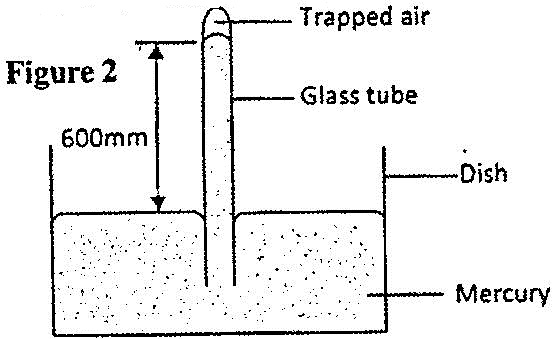 Given that the atmospheric pressure is 760 mmHg and the height of mercury column in the tube is 600 mm, determine the pressure of the air trapped in mmHg
Date posted:
April 13, 2017
-
Figure 14 shows a lift pump.
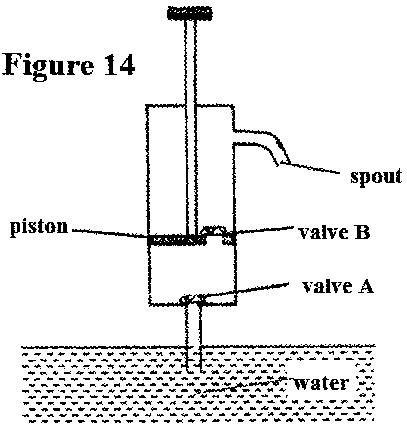 Explain why, when the piston is:
(i) pulled upwards, valve A opens while valve B closes.
(ii) Pushed downwards, valve A closes while valve B opens
Explain why, when the piston is:
(i) pulled upwards, valve A opens while valve B closes.
(ii) Pushed downwards, valve A closes while valve B opens
Date posted:
April 13, 2017
-
Figure 9 shows a syringe full of water. It has two identical holes A and B drilled along its cylinder. The cylinder nozzle is closed
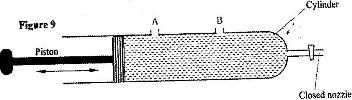 State with a reason how the speed of the jets of water from A and B compare when the piston is pushed into the cylinder.
Date posted:
April 13, 2017
-
Figure 2 shows two cylinders containing a liquid and connected with a tight-fitting flexible tube. The cylinders are fitted with air-tight pistons A and B as shown
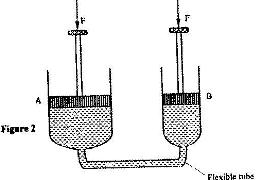 When equal forces, F, are applied on the pistons as shown it is observed that piston A moves up while B moves up while B moves down. Explain this observation
Date posted:
April 13, 2017
-
Figure 3 shows the levels of two liquids A and B after some air has been sucked out of the tubes through the tap. Use this information and the figure to answer questions
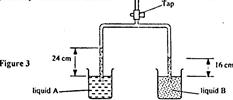 State the reason for the rise in the levels of the liquids when air is sucked from the tubes
Date posted:
April 13, 2017
-
Figure 2 (a) and 2 (b) shows capillary tubes inserted in water and mercury respectively
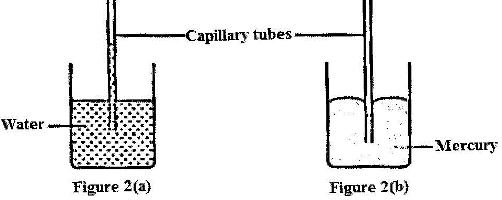 It is observed that in the water the meniscus in the capillary tube is higher than the meniscus in the beaker, while in mercury the meniscus in the capillary tube is lower than the meniscus in the beaker. Explain these observations.
Date posted:
April 13, 2017
-
Figure 6 (a) and 6 (b) shows capillary tubes inserted in water and mercury respectively
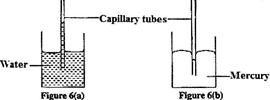 It is observed that in water the meniscus in the capillary tube is higher than the meniscus in the beaker. While in mercury the meniscus in the capillary tube is lower than the meniscus in the beaker. Explain these observations
Date posted:
April 13, 2017
-
Figure 6 shows a small toy boat floating on water in a basin. X and Y are two points near the toy.
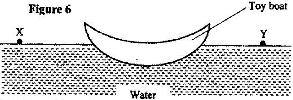 When a hot metal rod is dipped into the water at point X, the toy is observed to move towards Y. Explain this observation
Date posted:
April 13, 2017
-
Figure 8 shows water drops on two surfaces. In figure 8 (a) the glass surface is smeared with wax while in figure 8 (b) the glass surface is clean.
 Explain the difference in the shapes of the drops
Date posted:
April 13, 2017
-
Figure 4 shows a capillary tube placed in through mercury.
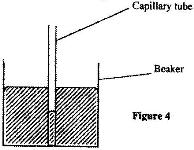 Give a reason why the level of mercury in the capillary tube is lower than in the beaker
Date posted:
April 13, 2017
-
The diagram in Fig. 4 shows two glass tubes of different diameters dipped in water
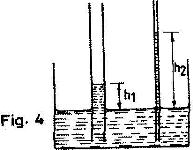 Explain why h2 is greater than h1
Date posted:
April 13, 2017
-
Figure 2 (a) shows the initial reading of burette used to measure the volume of oil. After 50 drops of the oil were run out, the final reading was as shown in figure 2 (b)
 Determine the volume of one drop of oil
Date posted:
April 13, 2017
-
Figure 1 shows a measuring cylinder containing some water
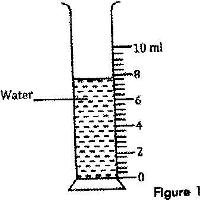 Determine the reading on the measuring cylinder, after three drops of water each of volume 0.6 cm3 are added.
Date posted:
April 13, 2017
-
In an experiment to measure the density of a liquid, a student filled a burette with a liquid to the 0 cm 3 mark. Figure 1 shows a section of the burette showing the level of the liquid after 54.5 g of the liquid had been run out
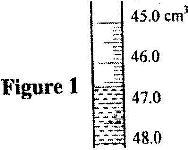 Determine the density of the liquid
Date posted:
April 13, 2017
-
Figure 1 shows the reading on a burette after 55 drops of a liquid have been used.
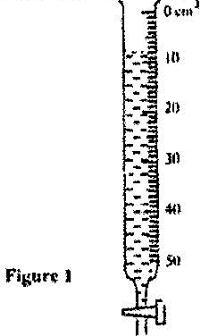 If the initial reading was at zero mark, determine the volume of one drop.
Date posted:
April 13, 2017
-
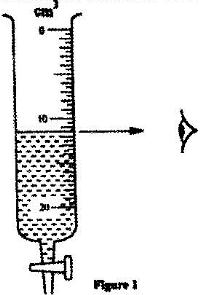
Figure 1 shows a burette partly filed with a liquid. The burette was initially full to the mark 0. If the quantity of the liquid removed has a mass of 22 g, determine the density of the liquid
Date posted:
April 13, 2017
-
Fig 1 shows a fencing post whose length is being measured using a strip of a measuring tape
 Use this information to answer the questions
a) State the accuracy of the post
b) What is the length of the post?
Use this information to answer the questions
a) State the accuracy of the post
b) What is the length of the post?
Date posted:
April 13, 2017
-
Fig. 1 shows a measuring cylinder, which contains water initially at level A. A solid of mass 11 g is immersed in the water, the level rises to B.
 Determine the density of the solid. (Give your answer to 1 decimal point)
Date posted:
April 13, 2017
-
What is meant by donor impurity in semiconductors?
Date posted:
February 22, 2017
-
Describe how a p-type semiconductor is formed.
Date posted:
February 21, 2017
-
It is observed that alpha particles have a lower penetrating power than beta particles. Explain this observation.
Date posted:
February 21, 2017
-
What is meant by Radioactivity?
Date posted:
February 21, 2017
-
Define the term half-life of a radioactive material.
Date posted:
February 21, 2017
-
A radioactive nuclide of atomic number Z emits a beta particle and gamma rays. State the atomic number of the nuclide.
Date posted:
February 21, 2017
-
In a sample there are 5.12 x 10²⁰ atoms of krypton -92 initially. If the half-life of krypton-92 is 3.0 s, determine the number of atoms that will have decayed after 6 s.
Date posted:
February 21, 2017