-
Two herbivorous mammal species were introduced into an ecosystem at the same time and in equal numbers. The graph below represents their populations during the first seven years. Study the graph and answer the questions that follow.
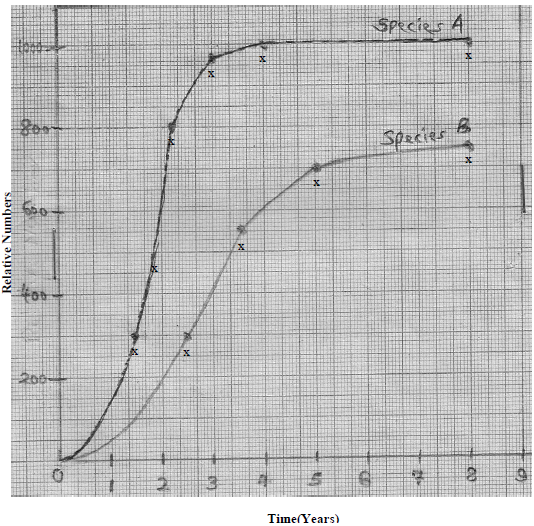 (a) (i) Which species has a better competitive ability?
(ii) Give a reason for your answer.
(b) Account for the shape of the curve for spicies A between;
(i) One year and three years
(ii) 4 years and eight years.
(c) A natural predator of species A was introduced into the ecosystem. With a reason, state how the
population of each species would be affected?
(d) State four other biotic factors of the ecosystem which affects organisms distribution in their habitat other than the one illustrated in the above graph.
(e) Name the instruments used to measure the following;
(i) Light intensity.
(ii) Light penetration in water.
(iii) Speed of wind.
(iv) Atmospheric pressure
(a) (i) Which species has a better competitive ability?
(ii) Give a reason for your answer.
(b) Account for the shape of the curve for spicies A between;
(i) One year and three years
(ii) 4 years and eight years.
(c) A natural predator of species A was introduced into the ecosystem. With a reason, state how the
population of each species would be affected?
(d) State four other biotic factors of the ecosystem which affects organisms distribution in their habitat other than the one illustrated in the above graph.
(e) Name the instruments used to measure the following;
(i) Light intensity.
(ii) Light penetration in water.
(iii) Speed of wind.
(iv) Atmospheric pressure
Date posted:
September 30, 2019
-
The diagram below represents two process underwent by a plant cell.
 (a) Identify process X
(b) Name the state of the cell after undergoing process
(i) X.
(ii) Z .
(c) Name the substance which is found in parts labelled;
(i) P.
(ii) Y .
(d) Name parts labelled M and Q.
(e) Name the cell organelle which is usually referred to as 'cell’s kitchen'.
(a) Identify process X
(b) Name the state of the cell after undergoing process
(i) X.
(ii) Z .
(c) Name the substance which is found in parts labelled;
(i) P.
(ii) Y .
(d) Name parts labelled M and Q.
(e) Name the cell organelle which is usually referred to as 'cell’s kitchen'.
Date posted:
September 30, 2019
-
In an experiment to analyze a 200cm3 sample of air was treated with pyrogallic acid. This reduced its volume to 168cm3. Potassium hydroxide was then added and the volume of gas reduced further to 160cm3.
(a) What was the role of pyrogallic acid?
(b) What was the role of potassium hydroxide?
(c) Calculate the percentage of oxygen and percentage of carbon (iv) oxide in the sample
(d) Suggest the likely biological source of carbon (iv)oxide gas.
(e) State the behavior of external intercostal muscles during exhalation.
(f) Explain why smokers are more prone to respiratory tract infections than the non- smokers
Date posted:
September 30, 2019
-
The diagram below represents a nitrogen cycle.
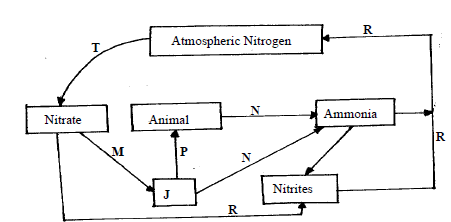 (a) Name the groups of organism represented by J.
(b) Name the process represented by R,P,M and N.
(c) Name one process represented by T.
(d) (i) Name a structure in roots involved in process M.
(ii) State one adaptation of the structure named in d (i) above to its function
(a) Name the groups of organism represented by J.
(b) Name the process represented by R,P,M and N.
(c) Name one process represented by T.
(d) (i) Name a structure in roots involved in process M.
(ii) State one adaptation of the structure named in d (i) above to its function
Date posted:
September 30, 2019
-
In a capture-recapture exercise to estimate population size of dragon flies on a stretch of rivers, 250flies were first caught and marked. Two days later 500 flies were caught in the second capture and out of this, 50 flies had marks on their bodies. Estimate the population size of the flies. (show your working)
Date posted:
September 30, 2019
-
Pregnancy would persist after the expiry of the fifth month of pregnancy even if the two ovaries are surgically removed from the body of female individual. Give an account for this.
Date posted:
September 30, 2019
-
State the adaptive structural differences between nephrons of desert and fresh water animals.
Date posted:
September 30, 2019
-
During cold weather, very small mammals eat more than their own weight of food per day whereas large mammals eat food which is only a small fraction of their weight. Give an explanation for this.
Date posted:
September 30, 2019
-
A student examining pond water came across a certain living organisms which he drew as shown below.
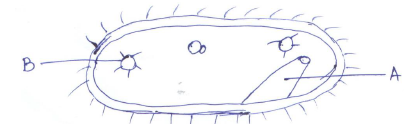 i) Identify the organism shown above.
ii) State the kingdom of the above organism.
iii) Name the structure labeled A.
iv) State the function of the part labeled B.
i) Identify the organism shown above.
ii) State the kingdom of the above organism.
iii) Name the structure labeled A.
iv) State the function of the part labeled B.
Date posted:
September 30, 2019
-
State the circumstances in which more blood Sugar may be found in the hepatic portal vein than in any other blood vessels.
Date posted:
September 30, 2019
-
The diagram below is that of a gill of a fish.
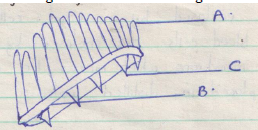 a) Name the parts labeled A and B.
b) State the function of part labeled C.
c) Explain how structure labeled A is adapted to its function.
a) Name the parts labeled A and B.
b) State the function of part labeled C.
c) Explain how structure labeled A is adapted to its function.
Date posted:
September 30, 2019
-
The table below shows how variation in environmental temperature relate to the body temperatures of two different types of animals A and B.
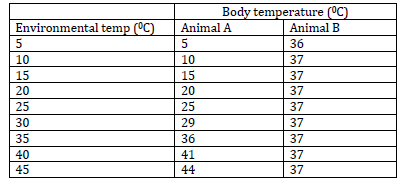 (a) Using the information in the table above, plot a graph on same axes of body temperatures animals against environmental temperature.
(b) With reference to thermoregulation, state the general name given to animals of the A and B types.
A - type animals
B - type animals
(c) What three advantages do B-type animals have over A-type animals?
(d) Briefly describe how B-type
i) Physiologically respond to heat
ii) Physiologically respond to cold
(a) Using the information in the table above, plot a graph on same axes of body temperatures animals against environmental temperature.
(b) With reference to thermoregulation, state the general name given to animals of the A and B types.
A - type animals
B - type animals
(c) What three advantages do B-type animals have over A-type animals?
(d) Briefly describe how B-type
i) Physiologically respond to heat
ii) Physiologically respond to cold
Date posted:
September 25, 2019
-
The figure below shows a model which was used by a group of Form 2 students to show the effect of or action of intercostal muscles on the movement of ribs.
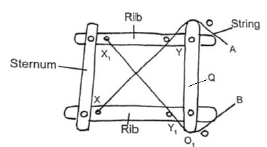 (a) How does the sternum move when;
(i) String A is pulled tight.
(ii) String B is pulled tight.
(b) Between string A and B, which one represents;
(i) External intercostal muscles?
(ii) Internal intercostal muscles?
(c) What does structure Q represent in an animal
(a) How does the sternum move when;
(i) String A is pulled tight.
(ii) String B is pulled tight.
(b) Between string A and B, which one represents;
(i) External intercostal muscles?
(ii) Internal intercostal muscles?
(c) What does structure Q represent in an animal
Date posted:
September 25, 2019
-
Broad and thin lips are inheritable characteristics in humans. When a homozygote broad lipped man is married to a homozygote thin lipped woman, all the children in the family are broad lipped. In a particular family, a woman that is heterozygote for broad lips is married to a man whose parents were both thin lipped. Let B represent gene for broad lips.
(a) Work out the genotypes of the children in that family. (Use a punnet square
(b) Work out the phenotypic ratio and genotypic ratio of the resulting children from the crossing in (a) above
(c) Give two sex- linked traits in man.
Date posted:
September 25, 2019
-
The diagram below represents a stage in the development of human foetus.
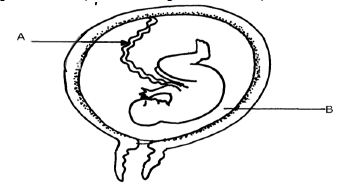 (a) State one function of each of the structures labelled A and B.
(b) Apart from the size of the foetus what else from the diagram illustrates that parturition was about to occur.
(a) State one function of each of the structures labelled A and B.
(b) Apart from the size of the foetus what else from the diagram illustrates that parturition was about to occur.
Date posted:
September 25, 2019
-
student peeled off a piece of epidermis from an onion leaf and observed it under a microscope. He counted 10 cells across the diameter of the field of view. He then placed a transparent ruler across the field of view and observed the following.
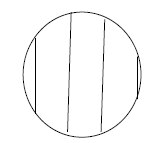 Calculate the size of one cell in μm. show your working
Date posted:
September 25, 2019
-
An experiment to investigate a certain response by termites, was set up as shown below. The set up was exposed to the sun for some time.
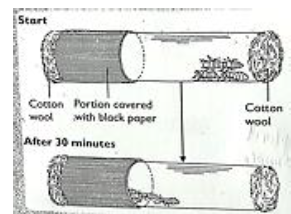 a) What were the results at the end of the experiment?
b) Name the type of response exhibited by the termites.
c) Give one survival value of the response.
a) What were the results at the end of the experiment?
b) Name the type of response exhibited by the termites.
c) Give one survival value of the response.
Date posted:
September 25, 2019
-
The Scientific name of confused beetle is TRIBOLIUM CONFUSAM. Identify any three mistakes made in writing the name.
Date posted:
September 25, 2019
-
In an experiment to investigate the action of pepsin on egg albumen, equal amount of pepsin were added to equal amount of egg albumen in different test tube. The test tubes were placed in water bath at different temperature. The graph below shows the time taken for the enzymes to digest protein at each temperature.
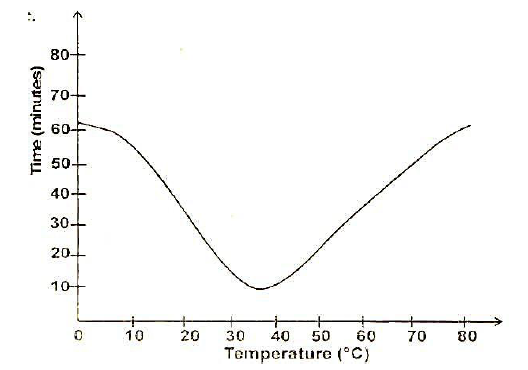 a) What is the optimum temperature for enzymes?
b) Account for the time taken to digest egg albumen at 600C.
c) With reason name the form in which the enzymes pepsin is secreted.
d) State three other factors that affect enzyme controlled reactions.
a) What is the optimum temperature for enzymes?
b) Account for the time taken to digest egg albumen at 600C.
c) With reason name the form in which the enzymes pepsin is secreted.
d) State three other factors that affect enzyme controlled reactions.
Date posted:
September 19, 2019
-
The flow chart below, illustrates blood circulation in certain organs in humans.
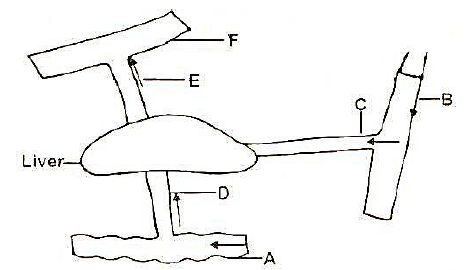 a) Name the organ labeled A.
b) Name the blood vessel labeled B and F.
c) State how the consumption of blood in vessel E differs from that in vessel.
d) Name two hormones whose target is the liver when there is variation in simple carbohydrates concentration in blood.
a) Name the organ labeled A.
b) Name the blood vessel labeled B and F.
c) State how the consumption of blood in vessel E differs from that in vessel.
d) Name two hormones whose target is the liver when there is variation in simple carbohydrates concentration in blood.
Date posted:
September 19, 2019
-
The figure below shows part of a food web for the South Atlantic ocean.
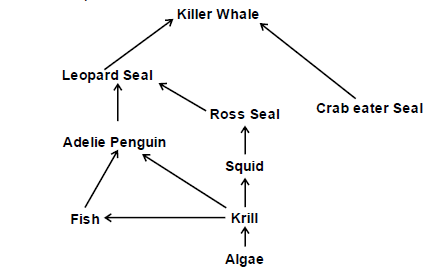 a) i) Name the producer in this food web.
ii) Name the top carnivore in this food web.
b) construct a food chain in which leopard seal is a tertiary consumer.
c) In the future, the extraction of mineral resources in the Antarctic might occur on a large scale. This could destroy the breeding-grounds of the Ross seal.
i) State and explain the effects this might have on the population of leopard seal.
ii) List two human activities that can affect the population of organisms in the ecosystem represented by food web.
d) Name the organism with the highest number of predators.
a) i) Name the producer in this food web.
ii) Name the top carnivore in this food web.
b) construct a food chain in which leopard seal is a tertiary consumer.
c) In the future, the extraction of mineral resources in the Antarctic might occur on a large scale. This could destroy the breeding-grounds of the Ross seal.
i) State and explain the effects this might have on the population of leopard seal.
ii) List two human activities that can affect the population of organisms in the ecosystem represented by food web.
d) Name the organism with the highest number of predators.
Date posted:
September 19, 2019
-
The diagram below illustrates the behaviour of red blood cells when placed in two different solutions X and Y.
 i) Name the process represented by letter A and B.
ii) Identify the type of solution that would prevent processes A and B from taking place when the cells are placed in it.
iii) Draw a diagram to illustrate how a plant cell would appear if placed in solution Y.
i) Name the process represented by letter A and B.
ii) Identify the type of solution that would prevent processes A and B from taking place when the cells are placed in it.
iii) Draw a diagram to illustrate how a plant cell would appear if placed in solution Y.
Date posted:
September 19, 2019
-
Name a chemical reagent that can be used to preserve specimens.
Date posted:
September 19, 2019
-
During a Practical study students made measurements on a fish and found out that its body length from the tip of the mouth to the tail tip was 30cm and the length from the tail tip to the anus was 12cm. Use this information to calculate the tail power of the fish.
Date posted:
September 18, 2019
-
What is meant by tail power ?
Date posted:
September 18, 2019
-
The diagram below shows a cross-section through a pistil.
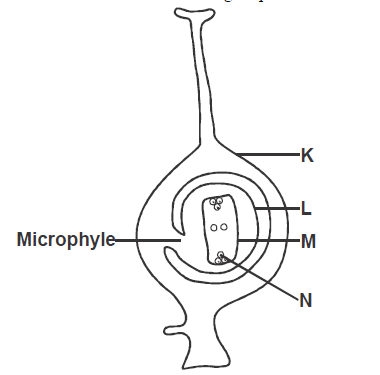 a) Name the structures labelled K, L and M
b) What do the following parts develop into after fertilization.
i) Part M
ii) Part L
iii) Part N
a) Name the structures labelled K, L and M
b) What do the following parts develop into after fertilization.
i) Part M
ii) Part L
iii) Part N
Date posted:
September 18, 2019
-
An experiment was set up as shown below.
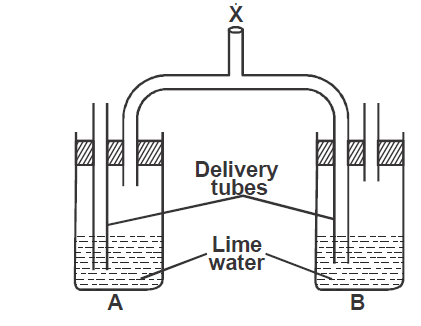 a) A student blew air in and out through point X. Using arrows, indicate on the diagram how air gets in and out of the setup.
b) i) In which of the test tube would lime water forms white precipitate first.
ii) Give a reason
a) A student blew air in and out through point X. Using arrows, indicate on the diagram how air gets in and out of the setup.
b) i) In which of the test tube would lime water forms white precipitate first.
ii) Give a reason
Date posted:
September 18, 2019
-
Identify the type of muscle in human being where formation and effect of lactic acid is not felt.
Date posted:
September 18, 2019
-
In an experiment to investigate a product of photosynthesis, the set up was as shown in the diagram below. The apparatus was placed in the sun.
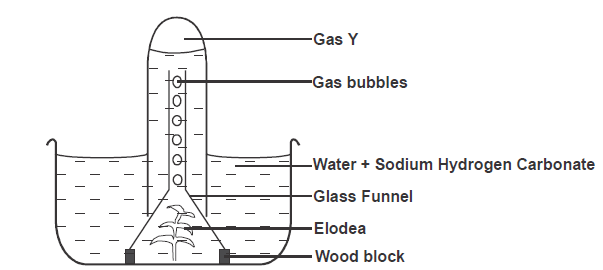 a) State the confirmation test for gas Y
b) Explain why Elodea is the most suitable plant for this experiment.
c) State the functions of the sodium hydrogen carbonate in the experiment.
a) State the confirmation test for gas Y
b) Explain why Elodea is the most suitable plant for this experiment.
c) State the functions of the sodium hydrogen carbonate in the experiment.
Date posted:
September 18, 2019
-
A student added equal amounts of blood to equal volumes of salt of different concentrations. She observed and counted the red blood cells at the beginning of the experiment and at end of the experiment. The results were as shown :
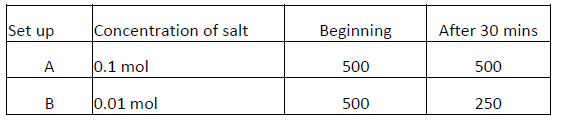 Account for the results in :
a) Set up A
b) Set up B
Account for the results in :
a) Set up A
b) Set up B
Date posted:
September 18, 2019