-
The diagram below represents a bone obtained from a mammal.
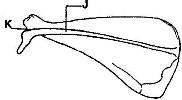 (a) Name the bone
(b) Name the: (i) Bone which articulate with the bone named (a) above at the cavity labeled K.
(ii) Joint formed by the two bones.
(c) State the function of the part labeled J.
(a) Name the bone
(b) Name the: (i) Bone which articulate with the bone named (a) above at the cavity labeled K.
(ii) Joint formed by the two bones.
(c) State the function of the part labeled J.
Date posted:
May 25, 2017
-
Why is movement necessary in animals?
Date posted:
May 25, 2017
-
The diagram below represents a tissue obtained from an animal
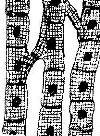 (a) Identify the tissue.
(b) State the functions of the tissue named in (a) above
(a) Identify the tissue.
(b) State the functions of the tissue named in (a) above
Date posted:
May 25, 2017
-
State two advantages of having an exoskeleton.
Date posted:
May 25, 2017
-
State the functions of synovial fluid.
Date posted:
May 25, 2017
-
State the difference between ball and socket and hinge joint
Date posted:
May 25, 2017
-
Name the three type of muscles found in mammals
Date posted:
May 25, 2017
-
State a characteristic that is common to all cervical verterbrae.
Date posted:
May 25, 2017
-
The diagram below represents a bones at a joint found in the hind limb of a mammal.
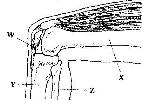 (a) Name the bones labeled X, Y and Z.
(b) Name the substance found in the place labeled W.
(c) Name the structure that joins the bones together at the joint.
(a) Name the bones labeled X, Y and Z.
(b) Name the substance found in the place labeled W.
(c) Name the structure that joins the bones together at the joint.
Date posted:
May 25, 2017
-
A bone obtained from a mammals is represented by the diagram below.
 (a) Name the bone.
(b) Which bones articulate with the bone shown in the diagram at the notch?
(a) Name the bone.
(b) Which bones articulate with the bone shown in the diagram at the notch?
Date posted:
May 25, 2017
-
Name three types of skeletons found in multicellular animals.
Date posted:
May 25, 2017
-
Give a reason why lumbar vertebrate have long and broad transerse process.
Date posted:
May 25, 2017
-
The diagram below represents a mammalian bone.
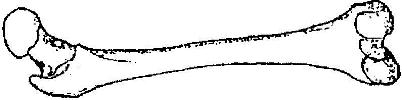 (a) Name the bone
(b) Name the type of the joint formed by the bone at its anterior end with the adjacent bone
(a) Name the bone
(b) Name the type of the joint formed by the bone at its anterior end with the adjacent bone
Date posted:
May 25, 2017
-
State three structural differences between biceps and muscles of the gut.
Date posted:
May 24, 2017
-
State three ways in which support is brought about in a leaf.
Date posted:
May 24, 2017
-
State four characteristics of apical meristem cells.
Date posted:
May 24, 2017
-
Name the strengthening materials found in the following support tissues:
(a) Collenchymas;
(b) Xylem
Date posted:
May 24, 2017
-
(a) What happens when a wilting young plants is well watered.
(b) Name a support tissue in plants thickened with (i) Cellulose
(c) Lignin
Date posted:
May 24, 2017
-
Name a support tissue in plants that is thickened with lignin
Date posted:
May 24, 2017
-
Name two tissues in plants that provide mechanical support.
Date posted:
May 24, 2017
-
(a) Name two tissues in plants which are thickened with lignin.
(b) How is support attained herbaceous plants?
Date posted:
May 24, 2017
-
How are the xylem vessels adapted for support?
Date posted:
May 24, 2017
-
State three ways by which plants compensate for lack of ability to move from one place to another.
Date posted:
May 24, 2017
-
What makes young herbaceous plant remain upright?
Date posted:
May 24, 2017
-
State the importance of tactic response among some members of kingdom protista.
Date posted:
May 24, 2017
-
Below are components of a simple reflex pathway:
- Interneurone
- Muscle;
- Motor neurone;
- Sensory neurone;
- pain receptor
- Central nervous system
List the components in their proper sequence during transmission of a nerve impluse.
Date posted:
May 24, 2017
-
The diagram below represents the transverse section of the spinal cord.
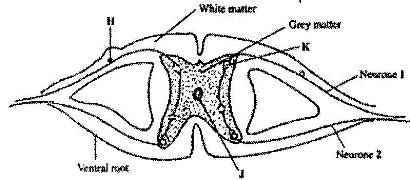 (a) Name the part labelled H.
(b) State two functions of the fluid found in the parts labelled J.
(c) Give a reason for the colour of white matter.
(a) Name the part labelled H.
(b) State two functions of the fluid found in the parts labelled J.
(c) Give a reason for the colour of white matter.
Date posted:
May 24, 2017
-
Give a reason why the image is not formed when light is focused on the blind spot.
Date posted:
May 24, 2017
-
The diagram illustrates a nerve cell.
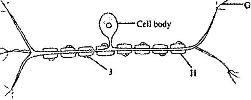 (a) Name the type of nerve cell illustrated.
(b) Give a reason for your answer in (a) above
(c) Identify the part labelled J
(a) Name the type of nerve cell illustrated.
(b) Give a reason for your answer in (a) above
(c) Identify the part labelled J
Date posted:
May 24, 2017
-
State one function of each of the following parts of mammalian eye:
(a) eye lashes
(b) Lachrymal glands
Date posted:
May 24, 2017