-
Figure 1 shows a vernier calipers being used to measure the internal diameter of a tube
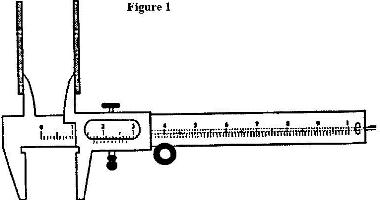 Record the diameter of the tube
Date posted:
April 18, 2017
-
Figure 3 shows part of an experimental set up for estimating the diameter of an oil molecule.
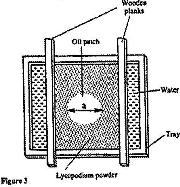 i) Describe how the oil patch is formed.
ii) Describe one method of determining the diameter of the oil drop
i) Describe how the oil patch is formed.
ii) Describe one method of determining the diameter of the oil drop
Date posted:
April 18, 2017
-
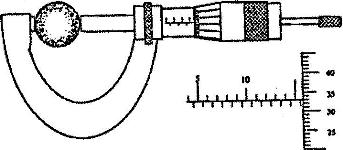
Figure 1 shows a micrometer screw gauge being used to measure the diameter of a ball bearing. A magnified portion of the scale is shown
Date posted:
April 18, 2017
-
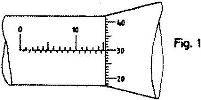
Figure 1 shows a micrometer screw gauge being used to measure the diameter of a metal rod. The thimble scale has 50 divisions
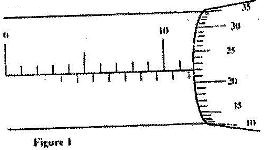 What is the reading shown?
Date posted:
April 18, 2017
-
The micrometer screw gauge represented by Fig.1 has thimble scale of 50 divisions. What is the reading shown?
Date posted:
April 18, 2017
-
Figure 2 shows a soft iron bar AB placed in a coil near a freely suspended magnet.
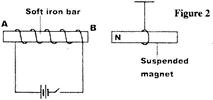 Explain the observation made when the switch is closed.
Date posted:
April 18, 2017
-
Figure 2 shows a horse – shoe magnet whose poles are labeled and two other magnets near it. Iron nails are attracted to the lower ends of the magnets as shown.
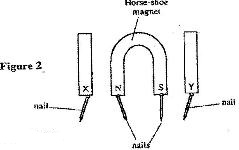 Identify the poles marked X and Y
Date posted:
April 18, 2017
-
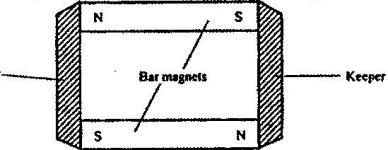
Figure 7 shows how magnets are stored in pairs with keepers at the ends. Explain how this method of storing helps in retaining magnetic longer
Date posted:
April 18, 2017
-
In an experiment to magnetize two substances p and Q using electric currents, two curves (graphs) were obtained as shown in fig. 1
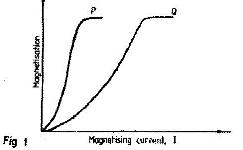 Using this information in Fig. 1 explain the difference between the substances P and Q with reference to the domain theory
Date posted:
April 18, 2017
-
Figure 4 shows the cross-section of a dry cell. Use the information on the figure to answer question a) and b)
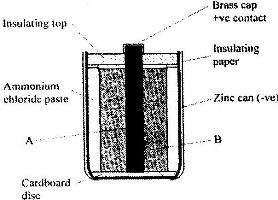 a) Name the parts labeled A and B
b) State the use of manganese (IV) oxide in the cell.
a) Name the parts labeled A and B
b) State the use of manganese (IV) oxide in the cell.
Date posted:
April 18, 2017
-
Figure 12, shows an electrical circuit including three switches, S1, S2, S3 and three identical lamps L1, L2, L3. A constant potential difference is applied across X and Y.
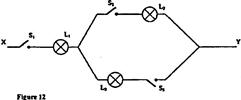 i) Other than L1, state the lamp that will light when S1 and S2 are closed.
ii) How does the brightness in L1 in (i) above compare with its brightness when all the switches are closed?
iii) Explain the observation in (ii) above
i) Other than L1, state the lamp that will light when S1 and S2 are closed.
ii) How does the brightness in L1 in (i) above compare with its brightness when all the switches are closed?
iii) Explain the observation in (ii) above
Date posted:
April 18, 2017
-
Figure 7 shows the features of a dry cell (Leclanche’s). Use the information in the figure to answer the questions a and b
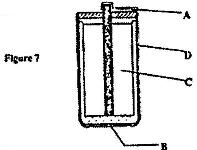 a) State the polarities of the parts labeled A and B.
b) Name the chemical substance in the parts labeled C and D
a) State the polarities of the parts labeled A and B.
b) Name the chemical substance in the parts labeled C and D
Date posted:
April 18, 2017
-
Figure 7 shows a highly negatively charged rod being brought slowly near the cap of a positively charged leaf electroscope. If is observed that the leaf initially falls and then rises
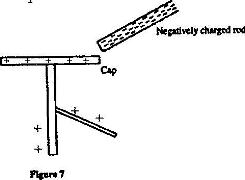 Explain this observation.
Date posted:
April 17, 2017
-
Figure 4 shows a source of heat placed at equal distances from two identical flasks X and Y containing air. The surface of X is painted black while Y is clear.
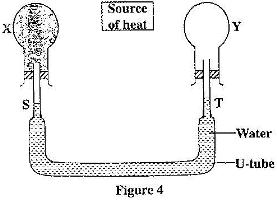 X and Y are linked by a U-tube filled with whose levels S and T are initially the same. It is later observed that S falls while T rises. Explain this observation.
Date posted:
April 17, 2017
-
A paper windmill in a horizontal axis was placed above a candle as shown in Figure 2. When the candle was lit the paper windmill begun to rotate. Explain this observation
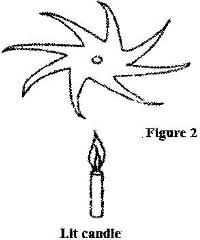
Date posted:
April 17, 2017
-
Figure 3 shows a hot water bath with metal rods inserted through one of its side. Some wax is fixed at the end of each rod. Use this information to answer questions
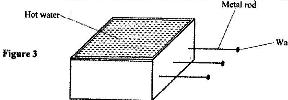 a) What property of metals could be tested using this set-up?
b) Besides the length of the rods that is kept constant, what else should be kept constant when comparing the property for the different metal rods?
a) What property of metals could be tested using this set-up?
b) Besides the length of the rods that is kept constant, what else should be kept constant when comparing the property for the different metal rods?
Date posted:
April 17, 2017
-
When a Bunsen burner is lit below wire guaze, it is noted that the flame initially burns below the guaze as shown in Figure 5 (i). After sometimes, the flame burns below as well as above the gauze in figure 5 (5) (ii)
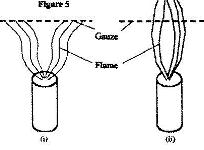 Explain this observation.
Date posted:
April 17, 2017
-
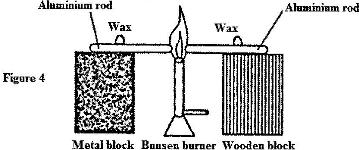
Two identical aluminium rods are shown in Figure 4. One rests on metal block and the other on a wooden block. The protruding ends are heated on a Bunsen burner as shown.
Date posted:
April 17, 2017
-
In the set up shown in Fig. 3, water near the top of the boiling tube boils while at the bottom it remains cold.
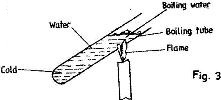 Give a reason for the observation
Date posted:
April 15, 2017
-
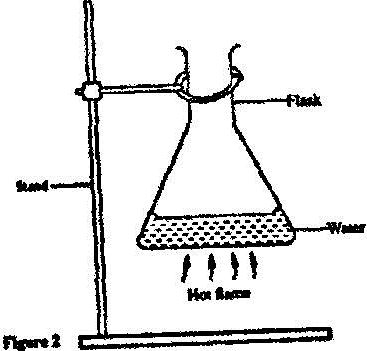
Figure 2 shows a flat bottomed flask containing some water. It is heated directly with a very hot flame. Explain why the flask is likely to crack
Date posted:
April 15, 2017
-
Figure 3 shows an aluminium tube tightly stuck in a steel tube.
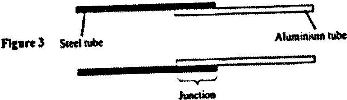 Explain how the two tubes can be separated by applying a temperature change at the same junction given that aluminium expands more than steel for the same temperature rise.
Date posted:
April 15, 2017
-
Figure 2 shows a flask filled with water. The flask is fitted with a cork through which a tube is inserted. When the flask is cooled, the water level rises slightly, and then falls steadily.
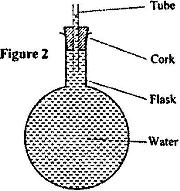 Explain this observation.
Date posted:
April 15, 2017
-
In the set up shown in figure 4, it is observed that the level of the water initially drops before starting to rise.
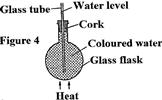 Explain the observation.
Date posted:
April 15, 2017
-
In the laboratory, small quantities of nitric (V) acid can be generated using the following set up. Study it and answer the questions that follow
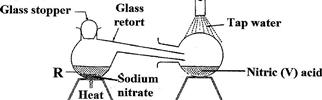 i) Give the name of substance R.
ii) Name one other substance that can be used in place of sodium nitrate.
iii) What is the purpose of using tap water in the set up above?
i) Give the name of substance R.
ii) Name one other substance that can be used in place of sodium nitrate.
iii) What is the purpose of using tap water in the set up above?
Date posted:
April 15, 2017
-
Study the flow chart below and answer the questions that follow.
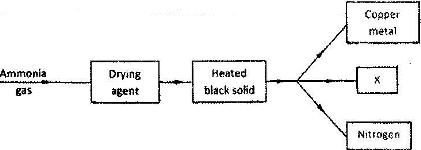 a) name the suitable drying agent for ammonia
b) Describe one chemical test for ammonia
c) Name X.
a) name the suitable drying agent for ammonia
b) Describe one chemical test for ammonia
c) Name X.
Date posted:
April 15, 2017
-
The set up below shows how nitrogen gas is prepared in the laboratory.
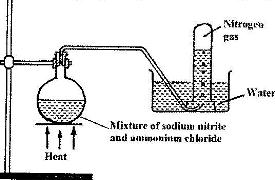 a) describe how nitrogen gas is formed in the flask.
b) Nitrogen is inert. State one use of the gas based on this property.
a) describe how nitrogen gas is formed in the flask.
b) Nitrogen is inert. State one use of the gas based on this property.
Date posted:
April 15, 2017
-
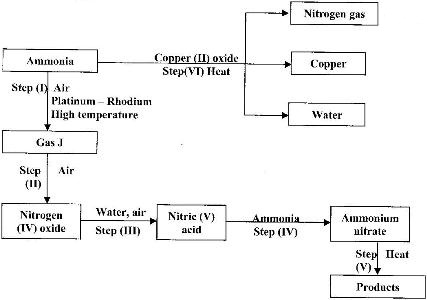
When magnesium was burnt in air, a solid mixture was formed. On addition of water to the mixture a gas which turned moist red litmus paper blue was evolved. Explain these observations.
Date posted:
April 15, 2017
-
The diagram below shows a set-up that was used to prepare and collect a sample of nitric (V) acid.
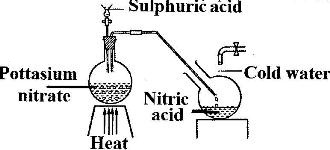 i) Give a reason why it is possible to separate nitric (V) acid from sulphuric (VI) acid in the set-up
ii) Name another substance that can be used instead of potassium nitrate.
iii) Give one use of nitric (V) acid
i) Give a reason why it is possible to separate nitric (V) acid from sulphuric (VI) acid in the set-up
ii) Name another substance that can be used instead of potassium nitrate.
iii) Give one use of nitric (V) acid
Date posted:
April 15, 2017
-
The flow chart below shows some reactions starting with lead (II) nitrate. Study it and answer the questions that follow.
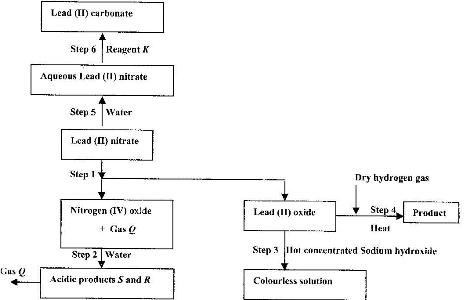 i) State the condition necessary in step 1.
ii) Identify:
I. Reagent K.
II. Gas Q.
III. Acidic products S and R.
i) State the condition necessary in step 1.
ii) Identify:
I. Reagent K.
II. Gas Q.
III. Acidic products S and R.
Date posted:
April 15, 2017
-
Ammonium nitrate was heated as shown in the set-up below.
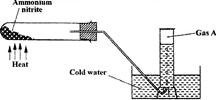 a) Identify gas A
b) State and explain a precaution that must be taken before heating is stopped.
a) Identify gas A
b) State and explain a precaution that must be taken before heating is stopped.
Date posted:
April 15, 2017