-
Choose the correct option from those given in brackets.
i) I'm sure he wouldn't mind if we ___________ early.
(arrive/arrived)
ii) If she ______ (comes/came) late again, she'll lose her job.
iii) ______ (we will/we would) call you if we had time.
iv) If I had seen the thief, I ______ (will tell/would told/would) have told the police
Date posted:
April 2, 2019
-
Rewrite the following sentences as instructed.
i) Someone is following us. (Rewrite in the passive voice)
ii) The victim and the neighbors did not speak to the reporters. (Being; Neither ..........)
iii) We light fire in the kitchen (Rewrite in past tense)
iv) Okoyo will not win the elections if he does not clear himself of the corruption charges. (Begin: unless ..........)
Date posted:
April 2, 2019
-
i) The choir entertained the visitors. begin: The visitors _______
ii) If we do not keep the environment clean, the health officer will close our cafe (Rewrite using 'unless')
iii) The patient could not stand without support. She also could not sit straight. (Rewrite as one sentence using: 'neither ___ nor').
iv) The school team would not have won the game if it had not been for the captain's quick action. (Begin: Had __________)
v) Jomo Kenyatta the first president of Kenya was a great orator.
(Punctuate the sentence)
vi) We learn from the legend that Me Katilili was a powerful leader.
(Begin: The legend ________)
Date posted:
April 2, 2019
-
Rewrite the following sentences to remove gender bias. (3 marks)
i) A professor should give his students opportunities to develop their skills.
ii) My sister was appointed chairman of the water project committee.
iii) The firemen took a long time to arrive at the scene of the accident
Date posted:
April 2, 2019
-
Give one difference between limiting and dynamic forces of friction
Date posted:
April 2, 2019
-
Read the following oral poem and answer the questions that follow.
After a brief struggle I got myself a job;
My food was meat and banana flour.
A hundred ants a month and soon I had some
Money
Soon after wards I bought myself a beautiful girl.
My heart was telling time this was a fortune,
So heart you were deceiving me and I believed you.
On a Saturday morning I was leaving work;
I was thinking I was being awaited at home.
But on arrival! couldn't find my bride.
Nor was she in her parents' home
I run fast to a river valley;
What I saw gave me a shock –
There was my wife conversing
With her lovers.
I sat and silently wept;
I realized there was no lack
In this world
People are not trustworthy and
will never be
Girls are not trustworthy and
will never be!
1. Place this song in its appropriate genre
2. State and illustrate two functions of this song.
3. What evidence is there to show that this is an oral poem? Give two illustrated features.
4. If you were to do a solo performance of this oral poetry what elements would you emphasize on?
5. What is the singer’s attitude towards his subject(s) in this song?
6. Give two character traits of the singers.
7. Give this oral poem an appropriate title.
Date posted:
April 2, 2019
-
Explain why it is easier to ride a bicycle round a bend on a road if the surface is dry than
when it is wet
Date posted:
April 2, 2019
-
Read the following passage and answer the questions that follow: (20 marks)
It is a great fortune to belong to that generation that grew up feeding on tales of Kaka Sungura na wenzake instead of the cartoon network fare. I am sure, in many ways we are better people for it.
But the thing that used to get to me about Kaka Sungura was this; although he was brighter, spiffier, humorous and certainly more interesting than all the other animals he pitted himself against in all his food' hardy acts, he always lost the race, the woman, the maize con or even his life!
The great African moral of the story was that it didn't pay to be too smart for your boots, so while the tortoise won the race through perseverance and some measure of deceit, the cocksure rabbit slept against a tree and got to finish the line only to realize the joke was on him.
Yet we loved those stones even though we had heard them a million times before, even though we knew the outcome. For you Sere, in great tradition of oral folklore, the story teller always varied his rendition for each different audience. He or she also knew when to throw a song, dance or mime.
Their expressions animated, the story although with predictable endings (the rabbit always lost, duh!) never failed to come alive with new twists and turns each time. But the really interesting part came when we retold the Kaka Sungura stories to our peers. We added in characters - like superman and wonder-woman- you see that was way before the time of Batman.
Sometimes we even gave kaka Sungura Superpowers himself. And when we told the story out of the ear shot of the grownups, we occasionally allowed Kaka Sungura to win! So what if he was trickster and too cocksure, we liked the guy! If only we could conjure up that childlike imagination to change our real life situations as easily as that.
Too often we grow up believing that our dreams and desires will unfold for us. When that fails to happen, we may get bitter at worst or resign ourselves to the present drams as it unfolds at best. We may even rationalize that we are too old, too female, too poor and whatever else to significantly steer our lives in another direction.
But then again, why can't we? Why can't we add some drama every now and them to a story that is getting boring? Heck, while we are at it, why can't we just change the ending of the story? Today, during a conversation with a friend, we began to reminisce about our lives and the paths we had chosen at critical moments in life which had led us to our present situations. These included choice of a partner, friends an whether or not to have children. This also in part included choice of a partner, friends and whether or not the have children. This also in part includes choice of-type of education and whether to pursue it further. This even included choice of career and jobs.
The tragedy is that some of us then choose to stay in unpleasant situations because the naysayers insist that one must never change the ending. No matter what happens in between, the rabbit is always supposed to lose
Yet, as Oprah would say, I now know for sure that we can retell our life story. As a matter of fact, if we are very unhappy with our current state of affairs; we can rewrite the script. The courageous in our midst do it every day. It is the woman who at mid life opts for a career change that makes her wake up with a zing. It is the man who unhappy with his health decides to prepare for a marathon, climbs a mountain or changes his lifestyle. It is the woman who walks out of an abusive and demanding relationship. It is the man who changes his outlook and takes a kinder perspective toward life. Yet in all these scenarios, the critical question hinges on whether or not one is committed to remaining where they are and their old story or to moving to where they want to be and rewriting that story. It is certainly much easier than it sounds, and I am sure each of the courageous souls above will tell us that it took some gut, blood and tears. But the good new is that it is possible. Now that is what I call a happy ending to a hare story!
(Adopted from Daily Nation Sunday August 21, 2005)
a) Which aspects made Africa folklore a great narration? (2 marks)
b) Sometimes we even gave Kaka Sungura super powers himself, (write the above statement in the passive (1 mark)
c) What remedies does the writer suggest to reduce boredom of story telling?
(2 marks).
d) Identify parenthesis in the paragraph beginning; Their expression....
(1 mark)
e) Which factors in the passage made Kaka Sungura likeable? (3 marks)
f) State any four factors that can facilitate the destiny of a person in life
(4 marks)
g) Give another word with similar pronunciation as the following words.
(2 marks)
i) Won ________
ii) Too ________
h) Explain the meanings of the following words and expressions as used in the passage. (5 marks)
i) Pitted himself against
ii) We can rewrite the script
- Demeaning relationship
iv) Reminisce
v) Animated
Date posted:
April 2, 2019
-
Outline ways in which mountains influence climate in Kenya.
Date posted:
April 2, 2019
-
Give the electronic components of a microcomputer system.
Date posted:
April 2, 2019
-
The figure below shows a block of mass 25g and density 200kg/m3 submerged beam by means of a thread. A mass of 2g if suspended form the beam as shown in the figure below.
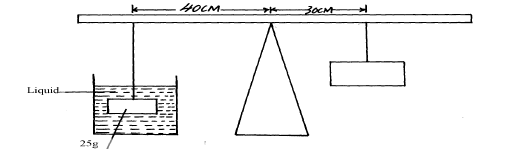 (i) Determine the up thrust force acting on the block.
(ii) Calculate the density of the liquid.
(i) Determine the up thrust force acting on the block.
(ii) Calculate the density of the liquid.
Date posted:
April 2, 2019
-
Read the comprehension below and then answer the questions that follow
The death penalty has been abolished in many countries. But there are still many other countries in the world which punish offenders against certain laws by putting them to death. The debate about the suitability of death as punishment has been raging all over the world for quite a long time. It is still going on today. Unfortunately, many arguments either for or against death as a punishment are emotional, based on mere feelings, with little regard to facts or simple logic. Let us look at a few of the pros and cons of this matter of life and death and see how rational debate can be developed around them.
The death penalty is most frequently meted out to murderers, people who have deliberately killed others. Supporters of the penalty this offence argue that a murderer commits the ultimate violation of human life and society. His or her offence is so serious that the only commensurate punishment is death. "Let him or her die, just as the victim die", the approach to punishment is called retribution. In other words, pay the offenders back in his or her own coins.
This position, however, is rather untenable. As the famous Indian statesman Mahatma Gandhi put it, an eye-for-an eye policy would just leave the world with a lot of blind people. Hanging, electrocuting or shooting a murderer does not do the murdered victim any good. It only means the destruction and waste of yet another life. Instead of concentrating on retribution as a purpose of punishment, it may be better to emphasize reform. Offenders are subjected to sanctions, like life imprisonment, but they are also given a chance to repent and mend there is not much possibility of giving him or her a chance to reform, is there?
Closely related to retribution, 'justice' or satisfaction is also advocated by supporters of death penalty. They say that society as a whole, and the relatives of the victim of a crime like murder in particular, need to feel that their grievance is recognized and assuaged through the severe punishment given to offender. Thus justice is done and seen to be done, as they say in law, indeed, no society should compromise on the administration of justice. Any aggrieved person who approaches the seat of justice to demand satisfaction should be adequately served by the state. Indeed, this may be one reason why criminal offences, like murder, are prosecuted in the name of the state rather than in the name of the victims or their relatives. A criminal act is an offence against the whole society and should be adequately punished.
The problem with the death sentence, however, is that it is not always a satisfaction of justice. The taking of a person's life is violation of the most fundamental human violation of the most fundamental human right. It cannot be justified on the pretext that the presumed murderer also violated the victim's right. Moreover, two wrongs do not make a right. Moreover, because of its finality, the execution of a convict cannot be revised or rescinded one it has been carried out. Yet, since we are all human and we can
make mistakes, it is quite possible for a court to convict an innocence person by mistake. Cases have been known where a supposed murder victim reappeared, alive and well, long after his or her presumed 'murderer' had been convicted and executed!
Another common argument advanced in favour of the death penalty is that it acts as a deterrent. Supporters of this position believe that the certainty that those who commit crimes like murder, rape, treason or drug trafficking will be condemned to death deters or scares would-be offenders. In other words, the death penalty is a kind of preventive measure. People will avoid these offences, so the argument goes, because of fear of death. This argument appears to carry some weight, since the self-preservation instinct is strong in all of us. However its only acceptable proof would have to be based on statistical evidence.
Unfortunately, there is no known body of statistics which proves conclusively that murder and other capital offences are more prevalent in societies without the death penalty than in those which have it. But even if such statistics were available, we would be left with the practical difficulty of ascertaining the reasons why certain crimes were not committed. Thus it may be more productive to concentrated on educating members of society on non-violate life. Styles and effective conflict resolution than on tarrying them and brutalizing them through barbaric measures like the death penalty.
Indeed, the cruelty and trauma of execution affect not only those put to death but everyone involved in the process, like the executioners themselves, the clergymen who have to counsel and pray for the convicts in their last moments and the doctors who certify that the hanged, electrocuted or poison-injected person is really dead. Hangmen particularly often give testimonies of how they are haunted and disturbed by the executions they have to carry out. It is fair to subject these innocent people to such mental and psychological torture in the name of a dubious 'just' punishment?
1. What is the opinion of the writer about many arguments for or against the
death penalty?
2. Define retribution
3. Identify another phrase in the passage that means the same as 'an eye for an eye'
4. Paraphrase the author's objections to retribution.
5. In three sentences, explain in what ways the death penalty is a violation of justice.
6. According to the passage, how would we know whether the death penalty is an effective deterrent?
7. What methods of execution does the passage mention?
8. 'Two wrongs do not make a right? Add a question tag to this sentence.
9. In about 45 words, summarize the author's argument against the death penalty.
10. Explain the meaning of each of the following words according to the way it is used in the passage.
(a) Commensurate
(b) Untenable
(c) Assuaged
(d) Rescinded
(e) Haunted
Date posted:
April 2, 2019
-
List the limitations of Speech Input devices.
Date posted:
April 2, 2019
-
Read the poem below and answer the questions that follow.
The road not taken
Two roads diverged in a yellow wood,
And sorry I could not travel both .
And be on traveler, long I stood
And looked down one as far as I could
To where it bent in the undergrowth;
Then took the other, as just as fair,
And having perhaps the better claim,
Because it was grassy and wanted wear,
Though as for that the passing there
Had worn them really about the same.
And both that morning equally lay,
In leaves no step had trodden black,
Oh, I kept the first for another day!
Yet knowing how way leads on to way
I doubted if I should ever come back.
I shall be telling this with a sigh,
Somewhere ages and ages hence:
Two roads diverged in a wood and I
I took the one less traveled by
And that has made all the difference.
(Robert Frost)
(a) What is the poem about? (4 marks)
(b) Identify and explain any two used in the poem. (4 marks)
(c) Explain the meaning of the following lines (6 marks
i) Because it was grassy and wanted wear',
ii) Oh, I kept the first for another day!'
iii) 'And that has made all the difference'
d) The title, of the poem can be interpreted in two different ways. Give the two possible illustrations. (4 marks)
Date posted:
April 2, 2019
-
Explain the problems related to scanners.
Date posted:
April 2, 2019
-
Give the uses of Optical Character Recognition devices.
Date posted:
April 2, 2019
-
Love
Love is madness
Hard brutal madness
Love is fire
Hot blazing
Love is a chameleon
a camouflaged dangerous chameleon
Hot fiery Love
I beg you ------------
Put out your blazing flame,
Because I desire to feel you.
Hard remorseless love
Please change your stance.
Before the fire of my youth
is quenched.
(From the African saga by Susan N. Kigali)
a) Explain in your own words what the poem says about love. (4 mks)
b) Identify and explain the image used to describe love (6 mks)
c) What effect does the persona create by addressing (apostrophizing?) love directly in the last stanza? (4 mks)
d) Explain the irony of the last two lines: Before the fire of my youth is quenched (3 mks)
e) Explain the meaning of the following
i) brutal
ii) Camouflaged
iii) Remorseless
Date posted:
April 2, 2019
-
Give the Disadvantages of OCR.
Date posted:
April 2, 2019
-
Read the following poem and answer the questions that follow.
DEATH, BE NOT PROUD
By John Doune
Death; be not proud, though some have called thee
Mighty and dreadful, thou are not so; for those whom thou think'st thou dost overthrow.
Die not, poor Death, nor yet canst thou kill me.
From rest and sleep, which but thy pictures be, much pleasure - then from three much more must flow;
And soonest our best men with thee do go,
Rest of their bones and soul's delivery.
Thou art slave to fate, chance, kings and desperate men,
And dost with poison, war, and sickness dwell; And poppy or charm's can make us sleep well,
And better than they stroke. Why swell'st thou then?
One short sleep past, we wake eternally,
And death shall be no more, Death, thou shalt die.
(a) The argument of this poem is based on certain religious beliefs. Identify and explain these beliefs. (4 marks)
b) Each set of four lines in this poem (up to live 12) represent an aspect of argument. Summarize the three aspects (6 marks)
c) Pick out any three features of style in this poem and their functions
(6 marks)
d) Explain the meaning of the following line Thou art slave to fate, chance, kings and desperate men. (2 marks)
e) What is the significance of the last two lines? (2 marks)
Date posted:
April 2, 2019
-
A crane lifts a load 500kg through a vertical distance of 4m in 8 seconds. Determine:
(i) Work done by the crane
(ii) Power developed by the crane
(iii) Efficiency of the crane given that it is operated by an electric motor rated 2.8Kw
Date posted:
April 2, 2019
-
Give the advantages of using devices, which can read data directly from source documents.
Date posted:
April 2, 2019
-
Read the poem below and answer the questions that follow:
White child meets Black man
She caught me outside a London
Suburban shop, I like a giraffe
and she a mouse. I tried to go
but felt she stood
Lovely as light on my back.
I turned with hello
And waited. Her eyes got
wider but not her lips
Hello 1 Smiled again and watched.
She stepped around me
Slowly, in a kind of a dance,
her wide eyes searching
inch by inch up and down:
no fur no scales no feathers-curiously
no shell. Just a live silhouette,
wild and strange
and compulsive
till mother came horrified
"Mummy is his tummy black?"
Mother grasped her and swung
towards the crowd. She tangled
Mother's legs looking back at me
As I watched them birds were singing.
(James Berry (Jamaica)
a) Briefly explain what the poem is about (3 mks)
b) What does the reaction of the white child make the persona feel? Illustrate/your answer (4 mks)
c) Compare and contrast the reactions of mother and daughter to the black man (6 mks)
d.) Identify and explain any two uses of figurative language (4 mks)
e.) What is the significance of the last line of the poem? (3 mks)
Date posted:
April 2, 2019
-
A bicycle has wheels 66 cm in diameter. Its crank wheel has 44 teeth and the rear sprocket 16 teeth. The crank radius is 16.5 cm.
(i) Determine the radius of the rear sprocket.
(ii) The bicycle moves when the rear sprocket is made to move. Hence determine the
velocity ratio.
Date posted:
April 2, 2019
-
A wheel and axle are used to raise a load of 280N by a force 40N applied to the rim of the
wheel. If the radii of the rim and axle are 70cm and 5cm respectively, calculate:
(i) The mechanical advantage
(ii) The velocity ratio
(iii) The efficiency
Date posted:
April 2, 2019
-
State and explain two parameters used in classifying microprocessors.
Date posted:
April 2, 2019
-
Read the following poem and answer the questions that follow.
Crazy Peter Prattles
So what is the mountain deal
About the minister's ailing son
That he makes boiling news?
How come it was not whispered
When Tina's hospital bed crawled with maggots
And her eyes oozed pus
Because the doctors lacked gloves?
What about Kasajja's only child
Who died because the man with the key
To the oxygen room was on leave?
I have seen queues
of emaciated mothers clinging to
babies with translucent skins
faint in line
and the lioness of a nurse
Commanding tersely
"Get up or leave the line".
Didn't I hear it rumoured that
the man with the white mane
and black robes
whose mouth stores the justice of the land
ushered a rape case out of court
because the seven year old
failed to testify?
Anyway, I only remember these things
when I drink
they are indeed tipsy explosions.
["Crazy Peter Prattles" by Susan Nalugwa Kiguli in Echoes Across the valley: Ed. Auther I. Luvai and Kwamchetsi Makokha]
a) What problems are highlighted in the poem about the state of health care?
(2 mks)
b) What is the significance of the rhetorical question in the first stanza?
(3 mks)
c) Pick out any two images in this poem and explain their significance.
(4 mks)
d) i) Identify the problem that the fifth stanza deals with (2 mks)
ii) How does this connect with the problems in the previous stanzas?
(3 mks)
e) Explain the meaning of the following words a they are used in the poem
(3 mks)
(i) oozed
(ii) emaciated
(iii) translucent
f) What is the significance of the last stanza (3 mks)
Date posted:
April 2, 2019
-
List the factors that affect the performance of a Processor.
Date posted:
April 2, 2019
-
Read the following poem and answer the questions that follow.
My little sister likes to try my shoes,
to strut in them
admire her spindle- thin twelve- year old legs
In this season's styles.
She says they fit perfectly,
But wobbles
On their high heels, they're
hard to balance
I like to watch my little sister
playing hopscotch, admire the
neat hops-and -skips of her,
their quick peck,
never missing their mark, not
over-stepping the line
She is competent at peever.
I try to warn my little sister
about unsuitable shoes,
Point out my own distorted feet, the callouses,
Odd patches of hard skin.
I should not like to see her
In my shoes
I wish she would stay
Sure footed
Sensible shod
(By Liz Lochhead in poem 1, ed. Celeste flower. Singapore: Longman, 1995.)
a) Why does the little sister try the persona's shoes? (3 mks)
b) How do we know from the first stanza that the shoes don't fit? (1 mk)
c) Why does the persona like watching her younger sister play hopscotch?
(4 mks)
d) In the third stanza, the persona gives us new reasons why her little sister should not wear her shoes. What are these reasons? (2 mks)
e) What is the message of this poem? (5 mks)
f) Describe the tone of the poem? (3 mks)
g) Explain the meaning of the following lines; I should not like to see her in my shoes (2 mks)
Date posted:
April 2, 2019
-
Read the following poem and answer the questions that follow.
Touch by High Lewin.
When I get out
I'm going to ask someone
To touch me
Very gently please
And slowly
Touch me
I want
To learn again
How life feels.
I've not been touched
For seven years
for seven years
I've been untouched
out of touch
and I've learnt
to know now
the meaning of
untouchable.
Untouched - not quite
I can count the things
that have touched me.
One: fists
At the beginning
fierce mad fists
beating beating
till I remember
screaming
don't touch me
please don't touch me.
Two: paws
The first four years of paws
everyday
patting paws, searching
- arms up, shoes off
legs apart
prodding paws, systematic
heavy, indifferent
probing away
all privacy.
I don't want fists and paws
I want
to want to be touched
again
and to touch
I want feel alive
again
I want to say
when I get out
Here I am
please touch me.
(From poets to the people, edited by Barry Feinberg)
a) Where do you think the persona is? Briefly explain your answer (3mks)
b) What do you think the persona means by "touch"? (3 marks)
c) Using two illustrations, describe the persona’s experience during the seven years. (4 marks)
d) What is the significance of the word "paws"? (2 marks)
e) Which device does the poet use to reinforce the theme? (2 marks)
f) Explain the meaning of the following words as they are used in the poem:
(2 marks)
g) What does the poem reveal about human need? (4 marks)
Date posted:
April 2, 2019
-
The diagram below shows a charcoal refrigerator.
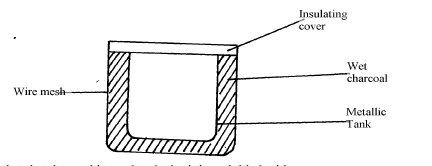 (i) Explain why charcoal is used and why it is sprinkled with water
(ii) What is the role of the metallic tank and the wire mesh
(i) Explain why charcoal is used and why it is sprinkled with water
(ii) What is the role of the metallic tank and the wire mesh
Date posted:
April 2, 2019