-
In a physiological experiment, starch, protein, diastase and sodium chloride (common salt) were added
to water and put inside a visking tubing. The visking tubing was then placed in a water bath maintained at a temperature between 350C and 400C. The set-up was as shown in the diagram below.
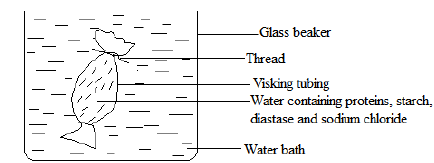 The following observations were made after the procedures indicated.
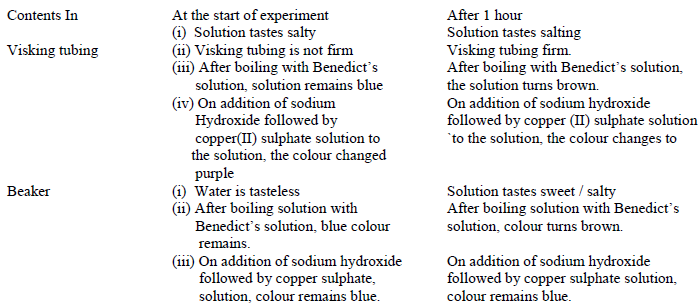 (a) Name the process by which salt moved into the water in the beaker from the visking tubing.
(b) (i) Name the food substance responsible for the brown colour observed after one hour both in the beaker and visking tubing when solutions were boiled with Benedict’s solution.
(ii) Account for the observation in b(i) above.
(c) (i) Name the food substance tested with sodium hydroxide followed by copper sulphate solutions.
(ii) Account for the absence of the food substance named in c(i) above in the beaker after1 hour.
(d) After one hour, the visking tubing was firm. State the term used to describe this state.
(a) Name the process by which salt moved into the water in the beaker from the visking tubing.
(b) (i) Name the food substance responsible for the brown colour observed after one hour both in the beaker and visking tubing when solutions were boiled with Benedict’s solution.
(ii) Account for the observation in b(i) above.
(c) (i) Name the food substance tested with sodium hydroxide followed by copper sulphate solutions.
(ii) Account for the absence of the food substance named in c(i) above in the beaker after1 hour.
(d) After one hour, the visking tubing was firm. State the term used to describe this state.
Date posted:
May 29, 2019
-
The figure below shows a germinating seedling.
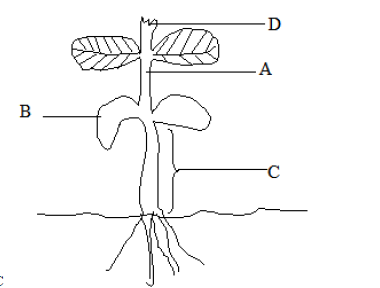 (a) Name the parts labelled. A,B C
(b) Give three important environmental conditions that are necessary for seed germination and state why they are important.
(c) The part labelled D was removed from the above seedling three months later. After a few days the plant became bushy with several lateral branches.
(i) What is this phenomenon called?
(ii) Why did the removal of the stem tip result in a shorter plant with bushy growth?
(a) Name the parts labelled. A,B C
(b) Give three important environmental conditions that are necessary for seed germination and state why they are important.
(c) The part labelled D was removed from the above seedling three months later. After a few days the plant became bushy with several lateral branches.
(i) What is this phenomenon called?
(ii) Why did the removal of the stem tip result in a shorter plant with bushy growth?
Date posted:
May 29, 2019
-
The diagram below shows part of a food relationship in an ecosystem.
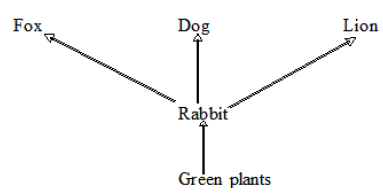 (a) Name the food relationship above.
(b) How many trophic levels are shown in the diagram above.
(c) Name one primary consumer in the food relationship above.
(d) State the main source of energy in the ecosystem.
(a) Name the food relationship above.
(b) How many trophic levels are shown in the diagram above.
(c) Name one primary consumer in the food relationship above.
(d) State the main source of energy in the ecosystem.
Date posted:
May 29, 2019
-
Explain the absence of fibrinogen in urine yet it is present in blood plasma.
Date posted:
May 29, 2019
-
The graph below shows the relationship between environmental temperature and the body temperature in two different animals A and B.
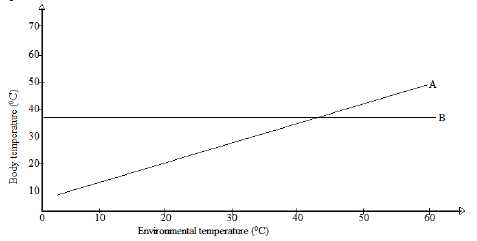 (a) State the relationship between the body temperature of animal A and external environmental temperature.
(b) Give the term used to describe;
(i) Animals of type shown by graph A.
(ii) Animals of type represented by graph B.
(a) State the relationship between the body temperature of animal A and external environmental temperature.
(b) Give the term used to describe;
(i) Animals of type shown by graph A.
(ii) Animals of type represented by graph B.
Date posted:
May 29, 2019
-
Below is a diagrammatic summary of the main biochemical events in photosynthesis. Study it
carefully and answer the questions that follow.
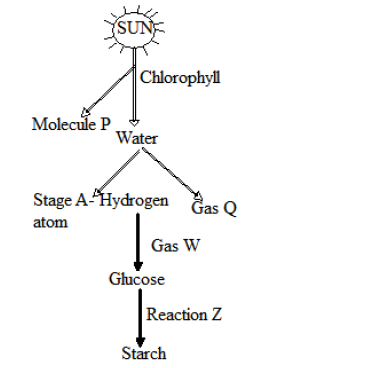 (a) Suggest the identity of molecule P.
(b) Name the gas represented by letter W.
(c) Name the specific site for the reactions in stage A.
(d) Name reaction Z.
(a) Suggest the identity of molecule P.
(b) Name the gas represented by letter W.
(c) Name the specific site for the reactions in stage A.
(d) Name reaction Z.
Date posted:
May 29, 2019
-
Work out a cross between a haemophilic man married to a carrier woman for haemophilia.
Date posted:
May 29, 2019
-
What is the importance of a pooter to an ecologist?
Date posted:
May 29, 2019
-
Explain why it is genetically unwise for sisters to marry brothers or father to marry their daughters.
Date posted:
May 29, 2019
-
A certain organ K was surgically removed from a rat. It was later found that there was a drastic increase in glucose level in the
blood. When substance Q was injected into the animal the glucose in the blood went back to normal. Identify
i) Organ K
ii) Substance Q.
Date posted:
May 29, 2019
-
Explain the biological disadvantage of growing some aesthetic plants in the living rooms.
Date posted:
May 29, 2019
-
In a family with four children three were found to have normal skin pigmentation while one was an albino. Using letter A to represent gene for normal skin pigmentation and a to represent the gene for albinism.
(a) What are the possible genotypes of the parents?
(b) Work out the genotypic ratio of their children.
(c) Apart from albinism, name two disorders that are genetically inherited in human beings.
Date posted:
May 29, 2019
-
A student collected a bone from the school garden. The bone was measuring 45 cm. He drew the bone in his book and his diagram was 9 cm long.Calculate the magnification of his drawing.
Date posted:
May 29, 2019
-
In an ecological study a grass hopper population and that of crows was estimated in a certain grass land area over a period of
one year. The results are as shown in the table below.
 a) i) What is the relationship between the rainfall and grasshoppers population?
ii) Account for the relationship stated in a (i) above
b) Explain the relationship between the grasshopper and the crows population.
c) If the data was used in the construction of pyramid of numbers, what would be the trophic level of:
i) Grasshopper
ii) Crows
iii) The grass in the study area
d) If the area studied was on a square kilometer, state
i) One method that could have been used to estimate the grasshopper population.
ii) One method that could have been used to estimate the crows population.
e) Suggest what would happen if a predator for grasshoppers entered the study area.
a) i) What is the relationship between the rainfall and grasshoppers population?
ii) Account for the relationship stated in a (i) above
b) Explain the relationship between the grasshopper and the crows population.
c) If the data was used in the construction of pyramid of numbers, what would be the trophic level of:
i) Grasshopper
ii) Crows
iii) The grass in the study area
d) If the area studied was on a square kilometer, state
i) One method that could have been used to estimate the grasshopper population.
ii) One method that could have been used to estimate the crows population.
e) Suggest what would happen if a predator for grasshoppers entered the study area.
Date posted:
May 29, 2019
-
The diagram below represents a set-up to investigate a certain physiological process.
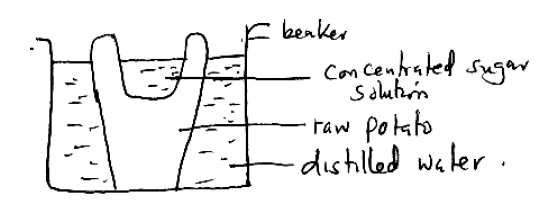 After some time the level of sugar solution was observed to have risen.
a) What physiological process was being investigated.
b) Account for the rise in the level of sugar solution.
c) Suggest the result that would be observed if the experiment was repeated using a piece of boiled potato.
After some time the level of sugar solution was observed to have risen.
a) What physiological process was being investigated.
b) Account for the rise in the level of sugar solution.
c) Suggest the result that would be observed if the experiment was repeated using a piece of boiled potato.
Date posted:
May 29, 2019
-
The diagram below represents a gill of a bony fish . Study it and answer the questions that follow.
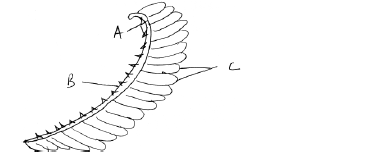 Give the function of each of the lablled parts A, B and C
Date posted:
May 29, 2019
-
a)Construct a dichotomous key to key out the following organisms using the following steps
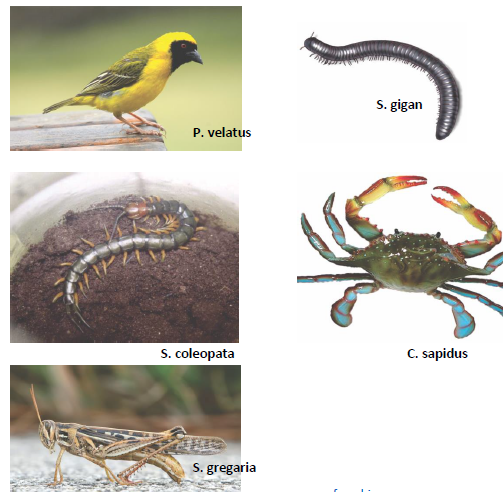 Step 1: Body covering
Step 2: Animal with 3pairs of walking limbs or more
Step 3: Animals with four pairs of legs
Step 4 : Number of walking limbs per segment.
b) With reasons state the class to which the organisms belong.
i) S. gregaria
ii) S. coleopata
Step 1: Body covering
Step 2: Animal with 3pairs of walking limbs or more
Step 3: Animals with four pairs of legs
Step 4 : Number of walking limbs per segment.
b) With reasons state the class to which the organisms belong.
i) S. gregaria
ii) S. coleopata
Date posted:
May 28, 2019
-
a)A student from Kegonga used a microscope with X40 objective lens and X5 eye piece lens which had 2mm radius and
counted 5 cells. Calculate the area of the field of view in micrometers.
b) What is the average size of the cell in micrometers?
Date posted:
May 28, 2019
-
In an ecological study a certain insect population and that of predators was estimated in a certain grassland over a period of 1 year (one year).
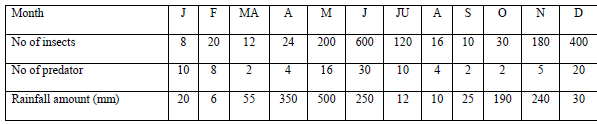 (a) Using the information above plot on the same axis the graph of number of insects and number of predators against time in months.
(b) Suggest what happens to the insect’s population during dry months.
(c) Explain the relationship between the insect population and that of predators.
(d) Suggest what happens to the predator’s population during dry month.
(e) Name the trophic level occupied by:-
(i) Predator
(ii) Insects
(iii) Grass
(f) Name the method used to estimate population of:
(i) Predator
(ii) Insects
(iii) Grass
(a) Using the information above plot on the same axis the graph of number of insects and number of predators against time in months.
(b) Suggest what happens to the insect’s population during dry months.
(c) Explain the relationship between the insect population and that of predators.
(d) Suggest what happens to the predator’s population during dry month.
(e) Name the trophic level occupied by:-
(i) Predator
(ii) Insects
(iii) Grass
(f) Name the method used to estimate population of:
(i) Predator
(ii) Insects
(iii) Grass
Date posted:
May 28, 2019
-
In fruit flies (Drosophila melanongaster) inheritance of eye colour is sex linked. The gene for red eye is dominant.
Across was made between homozygous red eyed female and white eyed male. Work out the phenotypic ratio of F1
generation. (Use R to represent gene for red eyes).
Date posted:
May 28, 2019
-
Give a reason why it is difficult to calculate Respiratory Quotient (RQ) in plants.
Date posted:
May 28, 2019
-
The following set up was used in an experiment
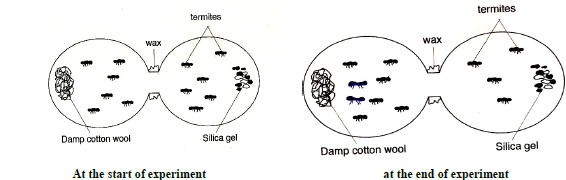 (a) State the function of the following in the set –up.
i). damp cotton wool
ii) Silica gel.
iii) Wax.
b) Deduce the condition that must be present in a termite habitat
(a) State the function of the following in the set –up.
i). damp cotton wool
ii) Silica gel.
iii) Wax.
b) Deduce the condition that must be present in a termite habitat
Date posted:
May 28, 2019
-
The graph below show the rate of an enzyme controlled reaction against temperature (OC)
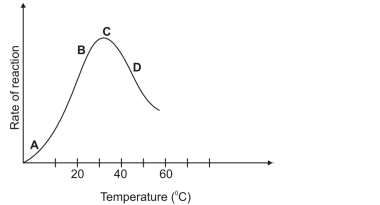 Explain the shape of the curve:
(i) Between A and B
(ii) At Point C
(iii) Between C and D
(iv) Other than temperature, state two factors that affect the above reaction
Explain the shape of the curve:
(i) Between A and B
(ii) At Point C
(iii) Between C and D
(iv) Other than temperature, state two factors that affect the above reaction
Date posted:
May 28, 2019
-
A student in form 3 caught an organism which had the following characteristics.
(i) Body divided into two parts
(ii) Simple eyes
(iii) Eight legs
Classify the organism up to the class level
Date posted:
May 28, 2019
-
Explain each of the following:
(a) A mature plant cell does not lose its shape even after losing water
(b) Xylem vessels do not collapse even when they are not conducting water
Date posted:
May 28, 2019
-
(i)Identify the mode of feeding of the animal whose dental formula is shown below
 (ii) Give reasons for your answer in (i) above
Date posted:
May 28, 2019
-
The diagram below represents a cell as seen under an electron microscope.
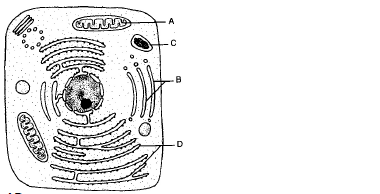 a) Identify the parts labeled A and D.
b) State the function of the structures found on the part labeled D.
a) Identify the parts labeled A and D.
b) State the function of the structures found on the part labeled D.
Date posted:
May 28, 2019
-
An experiment was carried out to investigate transpiration and absorption of water in sunflower plants in their natural environment with adequate supply of water. The amount of water was determined in two hour intervals. The results are shown in the table below.
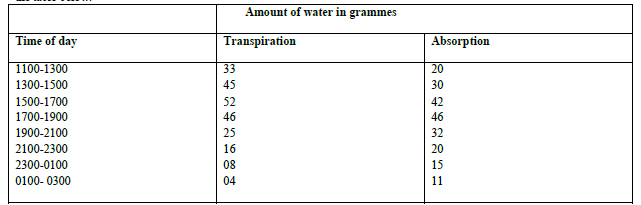 (a) Using the same axes, plot graphs to show transpiration and absorption of water in grammes against time of the day.
(b) At what time of the day was the amount of water the same for transpiration and absorption.
(c) Account for the shape of the graph of
(i) Transpiration
(ii) Absorption
(d) What would happen to transpiration and absorption of water if the experiment was continued till 0050 hours.
(e) Name two factors that may affect transpiration and absorption at any given time.
(f) Explain how the factors you named in (e) above affect transpiration.
(a) Using the same axes, plot graphs to show transpiration and absorption of water in grammes against time of the day.
(b) At what time of the day was the amount of water the same for transpiration and absorption.
(c) Account for the shape of the graph of
(i) Transpiration
(ii) Absorption
(d) What would happen to transpiration and absorption of water if the experiment was continued till 0050 hours.
(e) Name two factors that may affect transpiration and absorption at any given time.
(f) Explain how the factors you named in (e) above affect transpiration.
Date posted:
May 28, 2019
-
A portion of a nucleic acid is shown below;
 a) Name the nucleic acid to which the portion belongs. Give a reason.
b) Write down the sequence of bases of a complimentary strand to the one above.
a) Name the nucleic acid to which the portion belongs. Give a reason.
b) Write down the sequence of bases of a complimentary strand to the one above.
Date posted:
May 28, 2019
-
The diagram below illustrate an experiment to demonstrate some aspects of respiration in a potted plant.
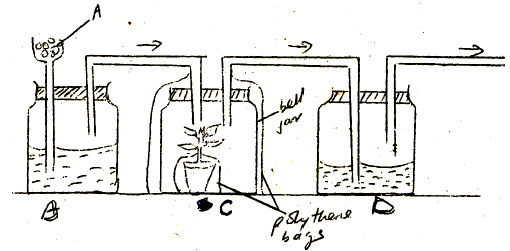 (a) Name and state the role of the chemical compound labeled A
Chemical compound
Role played
(b) What aspect of respiration is being demonstrated?
(c) Name the reagents in set up B and D.
(d) What would be the results in set up B and D after the experiment has run for some time.
Set up B
Set up D
(e) State the importance of covering the bell jar in set up C with a black polythene bag.
(f) Why was it necessary to enclose the pot with a polythene bag.
(a) Name and state the role of the chemical compound labeled A
Chemical compound
Role played
(b) What aspect of respiration is being demonstrated?
(c) Name the reagents in set up B and D.
(d) What would be the results in set up B and D after the experiment has run for some time.
Set up B
Set up D
(e) State the importance of covering the bell jar in set up C with a black polythene bag.
(f) Why was it necessary to enclose the pot with a polythene bag.
Date posted:
May 27, 2019