-
Study the flow chart below and answer the questions that follow.
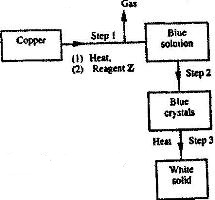 a) Name reagent Z.
b) Describe the process which takes place in step 2
c) Identify the white solid
a) Name reagent Z.
b) Describe the process which takes place in step 2
c) Identify the white solid
Date posted:
April 20, 2017
-
Dilute hydrochloric acid and solid sodium sulphite were reacted as shown in the set-up below
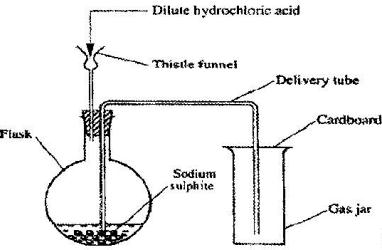 a) Name the gas produced in the flask
b) give two reasons why no gas was collected in the gas jar
a) Name the gas produced in the flask
b) give two reasons why no gas was collected in the gas jar
Date posted:
April 20, 2017
-
The aparatus shown below was set to prepare and collect hydrogen sulphide gas
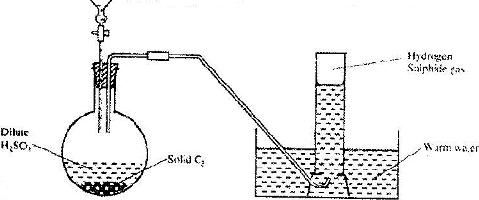 a) Name solid C2
b) Give a reason why warm water is used.
c) What observation would be made if hydrogen sulphide gas was bubbled into a solution of lead (II) nitrate?
a) Name solid C2
b) Give a reason why warm water is used.
c) What observation would be made if hydrogen sulphide gas was bubbled into a solution of lead (II) nitrate?
Date posted:
April 20, 2017
-
A sample of air contaminated with carbon (II) oxide and sulphur (IV) oxide was passed through the apparatus shown in the diagram below.
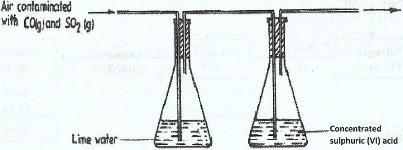 Which contaminant was removed by passing the contaminated air through the apparatus Explain
Date posted:
April 20, 2017
-
The diagram below represents the extraction of sulphur by Frasch process
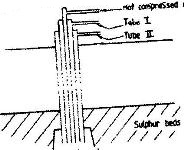 a) Name the substance that passes through tube;
I.
II.
b) What is the purpose of hot compressed air in the process?
a) Name the substance that passes through tube;
I.
II.
b) What is the purpose of hot compressed air in the process?
Date posted:
April 20, 2017
-
The table below shows the observations made when aqueous ammonia was added to cations of elements E, F and G until in excess.
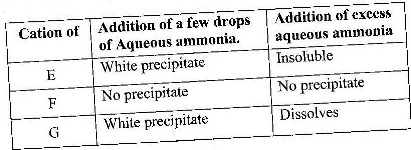 i) Select the cation that is likely to be Zn2+
ii) Given that the formula of the cation of element E is E2+, write the ionic equation for the reaction between E2+ (aq) and aqueous ammonia.
i) Select the cation that is likely to be Zn2+
ii) Given that the formula of the cation of element E is E2+, write the ionic equation for the reaction between E2+ (aq) and aqueous ammonia.
Date posted:
April 20, 2017
-
Study the flow chart below and answer the questions that follow
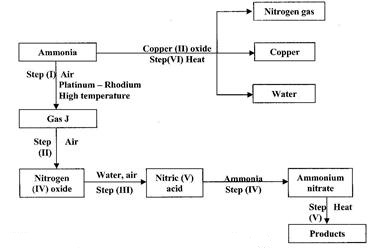 i) Identify gas J.
ii) Using oxidation number, show that ammonia is the reducing agent in step (VI)
iii) Write the equation for the reaction that occurs in step (V)
i) Identify gas J.
ii) Using oxidation number, show that ammonia is the reducing agent in step (VI)
iii) Write the equation for the reaction that occurs in step (V)
Date posted:
April 20, 2017
-
Dry ammonia and dry oxygen were reacted as shown in the diagram below
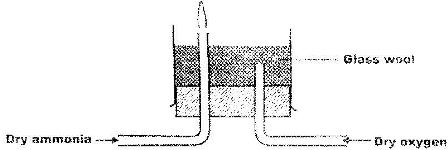 a) what is the purpose of the glass wool?
b) What products would be formed if red hot platinum was introduced into a mixture of ammonia and oxygen
a) what is the purpose of the glass wool?
b) What products would be formed if red hot platinum was introduced into a mixture of ammonia and oxygen
Date posted:
April 20, 2017
-
A student used the set up below to prepare a sample of nitrogen gas
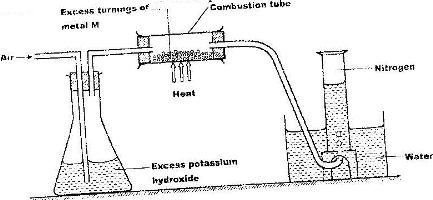 a) State the function of potassium hydroxide in the set up
b) Give a suitable metal M for use in the combustion tube
c) Give a reason why the nitrogen gas obtained is not pure
a) State the function of potassium hydroxide in the set up
b) Give a suitable metal M for use in the combustion tube
c) Give a reason why the nitrogen gas obtained is not pure
Date posted:
April 20, 2017
-
Study the set-up below and answer the questions that follow.
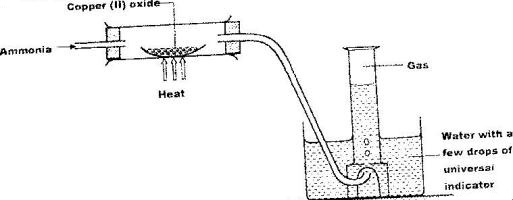 a) Write an equation for the reaction between ammonia and copper (II) oxide
b) During the experiment, the colour of the contents in the water trough changed. State the colour change observed and give an explanation.
a) Write an equation for the reaction between ammonia and copper (II) oxide
b) During the experiment, the colour of the contents in the water trough changed. State the colour change observed and give an explanation.
Date posted:
April 20, 2017
-
Dry ammonia gas was passed over heated lead (II) oxide and the products passed over anhydrous copper (II) sulphate as shown in the diagram below.
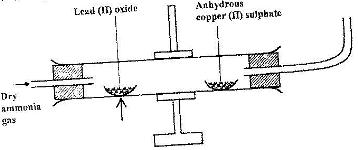 State:
a) Two observations made in the combustion tube
b) The property of ammonia gas in this experiment.
State:
a) Two observations made in the combustion tube
b) The property of ammonia gas in this experiment.
Date posted:
April 20, 2017
-
Figure 12 shows a displacement - time graph for a progressive wave
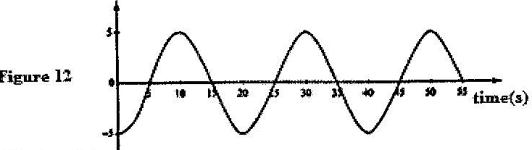 i) State the amplitude of the wave
ii) Determine the frequency of the wave.
i) State the amplitude of the wave
ii) Determine the frequency of the wave.
Date posted:
April 19, 2017
-
The three springs shown in figure 7 are identical and have negligible weight. The extension produced on the system of springs is 20 cm.
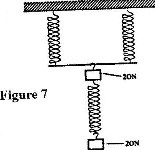 Determine the constant of each spring.
Date posted:
April 19, 2017
-
Figure 2 shows a spring balance. Its spring constant is 125Nm-1. The scale spreads over a distance of 20 cm.
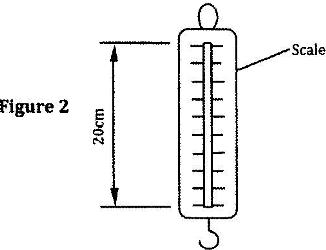 Determine the maximum weight that can be measured using the spring.
Date posted:
April 19, 2017
-
The three springs shown in Figure 5 are identical and have negligible weight. The extension produced on the system of springs is 20 cm.
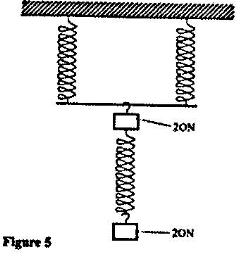 Determine the constant of each spring
Date posted:
April 19, 2017
-
The spiral spring shown in Figure 4 are identical. Each spring has a spring constant k = 300 N/m
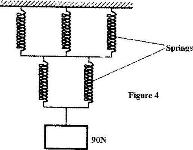 Determine the total extension caused by the 90 N weight. (Ignore the weight of the springs and connecting rods)
Date posted:
April 19, 2017
-
Figure 7 shows a simple electric bell circuit
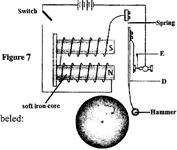 i) Name the parts labeled:
I) D
II) E
ii) When the switch is closed, the hammer hits the gong repeatedly. Explain why?
I) The hammer hits the gong.
II) The hammer hits the gong repeatedly
i) Name the parts labeled:
I) D
II) E
ii) When the switch is closed, the hammer hits the gong repeatedly. Explain why?
I) The hammer hits the gong.
II) The hammer hits the gong repeatedly
Date posted:
April 19, 2017
-
Figure 8 shows two parallel thick copper conductors connected to a d.c. power supply. A rider made from a thin copper wire is placed on the conductors
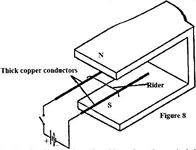 State and explain what is observed on the rider when the switch is closed.
Date posted:
April 19, 2017
-
In the set up in Fig. 5, the suspended metre rule in equilibrium balanced by the magnet and the weight shown. The iron core is fixed to the bench.
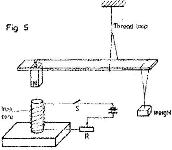 i) State and explain the effect on the metre rule when the switch S, is closed.
ii) What would be the effect of reversing the battery terminals?
iii) Suggest how the set up in figure 5 can be adapted to measure the current flowing in the current circuit.
i) State and explain the effect on the metre rule when the switch S, is closed.
ii) What would be the effect of reversing the battery terminals?
iii) Suggest how the set up in figure 5 can be adapted to measure the current flowing in the current circuit.
Date posted:
April 19, 2017
-
Figure 6 shows an athlete lifting weights while standing with the feet apart
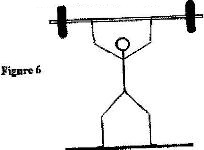 Explain why standing with the feet apart improves the athlete’s stability.
Date posted:
April 19, 2017
-
Figure 3 shows a uniform metre rule pivoted at the 30 cm mark. It is balanced by a weight of 2 N suspended at the 5 cm mark.
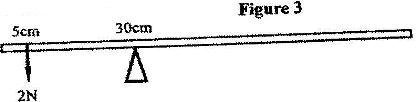 Determine the weight of the metre rule
Date posted:
April 19, 2017
-
Figure 5 shows a uniform bar of length 1.0 m pivoted near one end. The bar is kept in equilibrium by a spring balance as shown.
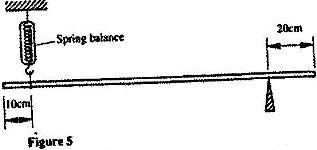 Given that the reading of the spring balance is 0.6 N, determine the weight of the bar
Date posted:
April 19, 2017
-
Figure 3 shows a rectangular block of wood with a hollow section (inside) at the position shown. The block is resting on a Horizontal bench
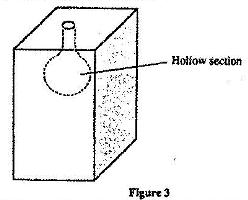 i) State the effect on the stability of the block when the hollow section is filled with water
ii) Explain your answer in (i) above.
i) State the effect on the stability of the block when the hollow section is filled with water
ii) Explain your answer in (i) above.
Date posted:
April 19, 2017
-
Figure 3 shows two identical trolleys with loads A and B. The loads are identical in shape and size
 Given that the density of A is greater than that of B, explain why the trolley in Figure 3 (ii) is more stable
Date posted:
April 19, 2017
-
Figure 3 shows two identical hollow spheres. Sphere A is completely filled with the liquid while B is partially filled with identical liquid.
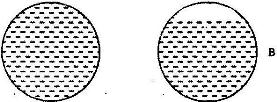 When the two spheres are rolled gently on a horizontal surface, it is observed that the sphere B stops earlier that the sphere A. Explain this observation.
Date posted:
April 18, 2017
-
Figure 2 shows a beaker placed on a bench. A block of ice is placed in the beaker as shown
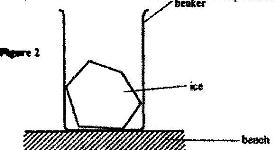 State and explain the change in the stability of the beaker when the ice melts
Date posted:
April 18, 2017
-
Figure 4 shows a uniform metal rod balanced at its centre by different forces.
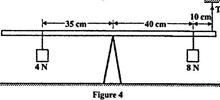 Determine the value of T.
Date posted:
April 18, 2017
-
Figure 5 shows a uniform rod 4 m and of mass 2 kg. It is pivoted 1 m from one end and balanced horizontally by a string attached near the other end
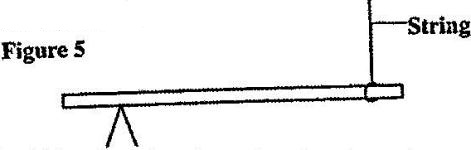 Determine the position where a mass of 5 kg should be placed on the rod so that the rod remains horizontally by a string attached near the other end.
Date posted:
April 18, 2017
-
Figure 9 shows a uniform bar in equilibrium under the action of two forces.
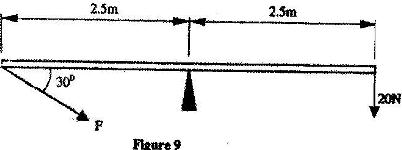 Determine the value of F.
Date posted:
April 18, 2017
-
Figure 4 shows a uniform metre rule of weight I N with two weights of 0.18 N and 0.12 N suspended from its ends.
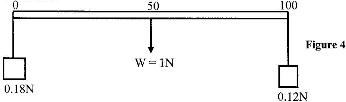 Determine how far from the 0.18 N weight a pivot should be placed in order to balance the meter rule
Date posted:
April 18, 2017