-
List the stages involved in bottling as a method of preservation.
Date posted:
September 12, 2019
-
Use the thermo chemical equations below to answer the questions that follow.
 (i) Name two types of heat changes represent by
  (ii) Draw an energy level diagram for the reaction represented by equation 1.
(iii) Calculate the standard enthalpy of formation of ethane.
(ii) Draw an energy level diagram for the reaction represented by equation 1.
(iii) Calculate the standard enthalpy of formation of ethane.
Date posted:
September 12, 2019
-
The table below shows the marks scored by eighty Form 4 students in a mathematics test.
 a) Calculate
i) Mean mark.
ii) Lower quartile
b) On the grid provided draw the cumulative frequency curve to represent the above
distribution
c) From the graph estimate the
i) 4th decile
ii) Range of marks of the middle 70% of the students.
a) Calculate
i) Mean mark.
ii) Lower quartile
b) On the grid provided draw the cumulative frequency curve to represent the above
distribution
c) From the graph estimate the
i) 4th decile
ii) Range of marks of the middle 70% of the students.
Date posted:
September 12, 2019
-
Study the following part of periodic table chart and use it to answer the question that follow. The letters are of the actual symbols of the elements.
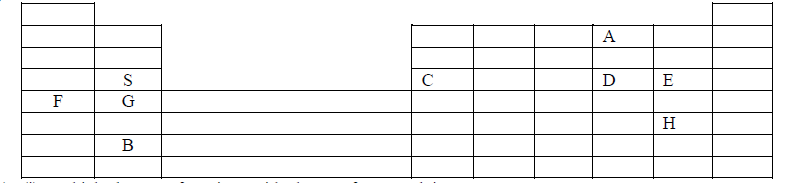 (i) Which elements form ions with charge of -2. Explain.
(ii) Compare the ionic radius of C and E. Explain.
(iii) Write the formular of the compound formed between element G and H.
(iv) In terms of structure of bonding, explain why the oxides of D has a lower melting point than that of G.
(v) Write an equation to show the action of heat on nitrates of F and G.
(i) Which elements form ions with charge of -2. Explain.
(ii) Compare the ionic radius of C and E. Explain.
(iii) Write the formular of the compound formed between element G and H.
(iv) In terms of structure of bonding, explain why the oxides of D has a lower melting point than that of G.
(v) Write an equation to show the action of heat on nitrates of F and G.
Date posted:
September 12, 2019
-
The table below shows income Tax rates
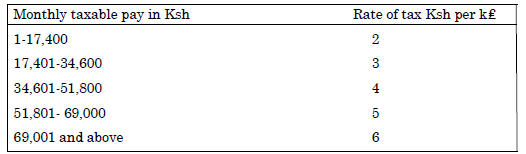 Faith earns a monthly basic salary of Ksh 45,000 and she is also given taxable allowances amounting to Ksh 20480 per month.
a) Calculate Faiths’ gross income tax per month.
b) Faith is entitled to a personal tax relief of Ksh 1162. Determine her net income per month.
c) Faith received 50% increase in her total income; calculate the corresponding percentage increase on the net income tax.
Faith earns a monthly basic salary of Ksh 45,000 and she is also given taxable allowances amounting to Ksh 20480 per month.
a) Calculate Faiths’ gross income tax per month.
b) Faith is entitled to a personal tax relief of Ksh 1162. Determine her net income per month.
c) Faith received 50% increase in her total income; calculate the corresponding percentage increase on the net income tax.
Date posted:
September 12, 2019
-
Read the poem below and answer the questions that follow.
I wonder by the edge
Of this desolate lake
Where wind cries in the sledge
Until the axle break
That keeps the stars in their round
And hands hurt in the deep
The banners of east and west
And the girdle of light is unbound,
Your breast will not lie by the breast
Of your beloved in sleep
(i) Describe the rhyme scheme of the poem.
(ii) Identify and illustrate any two sound pattern used in the poem.
(iii) How would you say the last two lines of the poem?
(iv) Give homophones for the following words used in the poem (2mks)
Wonder –
Break-
Date posted:
September 12, 2019
-
Replace the underlined words with phrasal verbs formed from the words in brackets
1. Lucy asked Julius not to involve himself with her personal matters. (keep)
2. My mother accidentally met me along Jamhuri highway in the town (run)
Date posted:
September 12, 2019
-
Rewrite the following sentences to correct the errors.
1. Of the two books, the first is longest
2. The quarter of the three girls sleeps earlier.
3. I did not find any fellow colleagues in class when I arrived late.
Date posted:
September 12, 2019
-
The reaction between Lead (II) Nitrate and concentrated sulphuric (VI) acid starts but stops immediately.Explain.
Date posted:
September 12, 2019
-
Rewrite the following sentences according to the instructions given after each. Do not change the meaning.
1. The children welcomed the teachers.
(Begin with: The teachers)
2. John does not take Lunch. His sister does not take Lunch.
(Begin with: Neither)
3. Gatwiri asked, "Can we meet here tomorrow morning?"
(Rewrite in direct speech)
4. This novel is far better than the one I bought last week.
(Rewrite using the word ‘superior’)
5. It is not necessary to collect the garbage today.
(Rewrite being: You do not )
Date posted:
September 12, 2019
-
Read the narrative below and then answer the questions that follow.
Once upon a time, all animals in the jungle were of the same plain colour but when they were invited by king lion for his son’s wedding, they decided to decorate themselves for the occasion. The tortoise was given the task of making the dye to be used. Though he was slow, he was the most intelligent.
The big day was fast approaching but the tortoise had only managed to make one big pot of black dye. He called a meeting and they all decided to use the available dye to make various patterns in their skins.
The leopard was allocated the job of painting the rest of the animals. The zebra was the first on queue followed by the giraffe, then the donkey and all the other animals were to follow. The giraffe and the zebra were painted and they looked very beautiful.
Then the donkey’s turn came but he was undecided on the pattern to choose. The leopard decided to paint him like a zebra and got down to work. He had a long line along the donkey’s spine from head towards the tail. On reaching the tail, the donkey started giggling. The leopard continued and the donkey jumped and threw him his hind legs saying the brush was tickling and he could not contain himself any longer.
He had thrown his hind legs so hard that he hit the pot containing the dye. The dye spattered all over the animals on the queue. The cheetah got speckles all over his body, the leopard got spotted and the crow who happened to be passing by with an urgent letter for the king hanging on its neck was splashed by the dye which covered him the whole body apart from the neck where the letter was. On seeing this, the hyena started laughing but got a large splotch on his mouth.
All the animals rushed to the stream to try and wash out the dye but it was already dried and had become permanent. Nobody could get off the spots, streaks, speckles and splotches. And that is how the donkey was responsible for the various patterns we see on animal’s bodies today.
a) Classify the narrative above.
b) Identify and illustrate any two social aspects of society from which this narrative is taken.
c) Identify and illustrate any three features peculiar to oral narratives evident in this narrative.
d) Identify and illustrate any two character traits of the Leopard.
e) Who would be the target audience of such a narrative
f) If you were to collect this narrative from the field, what preparations would you make before the actual field work
Date posted:
September 12, 2019
-
The table below gives the solubilities of potassium nitrate at different temperatures.
 (i) Plot a graph of the solubility of potassium nitrate (vertical axis) against temperature.
(ii) Using the graph:
I. Determine the solubility of potassium nitrate at 150C.
II. Determine the mass of potassium nitrate that remained undissolved given that 80g of potassium nitrate were added to 100cm3 of water and warmed to 400C. (2mks)
(iii) Determine the molar concentration of potassium nitrate at 1500C. (Assume there is no change in density of water at this
temperature) (K = 39.0; N = 14.0; O = 16.0)
(i) Plot a graph of the solubility of potassium nitrate (vertical axis) against temperature.
(ii) Using the graph:
I. Determine the solubility of potassium nitrate at 150C.
II. Determine the mass of potassium nitrate that remained undissolved given that 80g of potassium nitrate were added to 100cm3 of water and warmed to 400C. (2mks)
(iii) Determine the molar concentration of potassium nitrate at 1500C. (Assume there is no change in density of water at this
temperature) (K = 39.0; N = 14.0; O = 16.0)
Date posted:
September 12, 2019
-
Read the following excerpt and answer the questions that follow.
Nora: (jumping up and going to him) oh, dear, nice Doctor Rank, I never meant that at all. But surely you can understand that being with Torvald is a little like being with Papa –
(enter MAID from the hall)
Maid: if you please, ma’am. (Whispers and hands her a card)
Nora: (glancing at the card) oh! (Puts it into her pocket)
Rank: is there anything wrong?
Nora: No, no, not in the least. It is only something – it is my new dress –
Rank: what? Your dress is lying there.
Nora: Oh, yes, that one: but this is another. I ordered it. Torvald mustn’t know about it –
Rank: Oho! Then was the great secret.
Nora: Of course. Just go in to him: he is sitting in the inner room. Keep him as long as –
Rank: Make our mind easy; I won’t let him escape (goes into HELMER’S room)
Nora: (to the MAID) And he is standing waiting in the kitchen?
Maid: Yes; he came up the back stairs.
Nora: But didn’t you tell him no one was in?
Maid: Yes, but it was no good.
Nora: He won’t go away?
Maid: No; he says he won’t until he has seen you, ma’am.
Nora: Well, let him come in – but quietly. Helen you mustn’t say anything about it to anyone. It is a surprise for my husband.
Maid: Yes, ma’am, I quite understand. (exit)
Nora: This dreadful thing is going to happen! It will happen in spite of me! No, no, no, it can’t happen – it shan’t happen!
a) Place this excerpt in its immediate context
b) Indentify and illustrate the character trait of the following characters
i)Rank
ii)Nora
c) Who is in the kitchen and why has he come?
d) Identify and illustrate the dominant theme in the excerpt.
e)'............. being with Torvald is a little like being with papa' what does Nora mean by this statement?
f) Explain an incidence of dramatic irony from the excerpt.
g) Why is Nora quick to usher Dr. Rank out of the room?
h) "This dreadful thing is going to happen." Rewrite in reported speech.
i) Explain the dreadful thing that Nora fears might happen?
j) Explain the meaning of the following expressions as used in the excerpt.
i) Make your mind easy
ii) I won’t let him escape
iii) It was no good
iv) Dreadful
Date posted:
September 12, 2019
-
Read the passage below and answer the questions that follow .
Cities and towns are experiencing massive population growth the world over receiving huge numbers of migrants ever year.
In 1950, urban population accounted for only 29 percent of the world population, according to the United Nations Educational Scientific and Cultural Organization (UNESCO). At the turn of the century, the figure had risen to 45 percent. This was enough to declare the Twentieth Century the century of urbanization and city life. Now the figure is projected to hit 70 percent by 2025.
In Africa, urbanization is most intense in Algeria, Tunisia and South Africa, which have more than 50 percent of their population living in urban areas. Generally, cities in the developing world are growing at a rate of 3.5 per cent per annum.
These figures indicate that there is a continuous massive movement of people from rural to urban areas worldwide. Driven by the desire for better living conditions, they flock to cities in droves in search of greener pastures. But, slowly the illusion disappears, and is replaced by harsh realities of urbanism: unemployment or underemployment, crime, poverty, hunger and life in the slums.
To cope with this fast – moving wave of rural flight requires new strategies for urban planning and the use of urban spaces. Thus urban planners, policymakers and governments seek pragmatic and timely ways of addressing this challenge. The process of urbanization transforms land use and farming systems, patterns of labour force participation, infrastructural requirements, and natural resource systems. When cities grow, their population expands, putting a strain on food production.
As a way of easing the food shortage, many urban households, particularly the poor, have taken to growing food on small plots. Today, if you take a walk through some of the residential estates in Nairobi such as Ngara, Eastleigh and Buru Buru, you might be forgiven for thinking that a green revolution is under way. And on the outskirts of the city, green – houses and ponds compete for space with small gardens planted with flowers, vegetables and fruits. Banana plants and palm trees dwarf wrought – iron gates, their green dotting the skyline, Kale, cabbage and maize gardens sprout in the middle of urban squalor. In this unusual rare blend, urban features and rural agrarian patterns are combined in a new form of settlement and one might call ‘garden cities.’
Although it is often not given much attention, urban agriculture is steadily increasing. The practice involves cultivating, processing and distributing food in and around a town or city. It also encompasses an array of activities including horticulture, aquaculture, animal husbandry and bee keeping
a) What are the challenges facing major cities and towns
b) What does the mention of 70% by 2025 reveal?
c) What do we learn about urbanization in Africa from the passage
d) Mention the reason for rural to urban migration
e) How are urban households easing the problems of food shortage?
f) What is meant by the term ‘garden city?’
g) In note form, list the influences of urbanization
h) Urban populations accounted for only 29% of the world population
(Rewrite the statement adding a question tag)
i) Explain the meaning of the following words as used in the passage
i) Illusion
ii) Pragmatic
iii) Squalor
Date posted:
September 12, 2019
-
David Mulwa, inheritance
"Pretenders are worse than murderers." Write an easy to show the truthfulness of this statement basing your answer on the inheritance by David Mulwa.
Date posted:
September 12, 2019
-
Draw the structural formula of Butyne
Date posted:
September 12, 2019
-
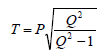
Make Q the subject of the formula
Date posted:
September 12, 2019
-
"People who do bad deeds to others never go unrepaid"
Show the validity of this statement with reference to Henry Ole Kulet’s novel. Blossoms of the savannah'
Date posted:
September 12, 2019
-
A point P divides AB in the ratio 7: -5 where A (2,-3, 4) and B (-4, 7,-2). Find the coordinates of P.
Date posted:
September 12, 2019
-
Explain the difference in meaning between these two sentences.
a)The hawker was selling ten day- old chicks.
b)The hawker was selling ten- day old chicks.
Date posted:
September 12, 2019
-
Use the correct form of the word in brackets to fill in the blanks.
a)There was enough............... (prove) that examination had leaked.
b)The student gave a very good............. ( describe) of the party.
c)The painting................. (steal) from the museum
Date posted:
September 12, 2019
-
Rewrite the following sentences as instructed. Do not change the meaning of the sentences.
a) Marylyn Monroe was the most beautiful woman in Hollywood in the sixties( Begin:No............)
b) I did not know that there was trouble ahead ( Begin; Little..............)
c) All except Maina went for games. Rewrite using 'save for'
Date posted:
September 12, 2019
-
Read the song below and answer questions that follow.
LISTEN DEAR BRIDE
Oh my sister, listen
From this day, you won’t go dancing,
From this day, you won’t go to the dance,
From this day, you won’t go dancing
You’ll dance only on the path to the river.
My sister, will you listen?
From this day, you won’t go chatting,
From this day, you won’t sit to chat,
From this day, you won’t sit chatting,
You’ll only chat on the path to the farm.
Daughter of my mother, listen!
From this day, you won’t enjoy teasing,
From this day, you won’t enjoy to tease,
From this day, you won’t enjoy teasing,
You’ll only tease the baby on your lap.
Listen, my dear sister!
You’ll only dance on the path to the river,
You’ll only chat on the path to the farm,
You’ll only tease the baby on your lap,
From this day, life will change.
Have you heard daughter of my mother?
You’ll not go dancing, dance today.
You’ll not go sit chatting, chat today.
You’ll not enjoy teasing, tease today.
From this day, life will change.
1. With explanation, classify the above item
2. Who do you think are the singers in this song? Give reasons
3. Identify two features which qualify this text as a song.
4. Briefly explain what the society expects of a married woman as brought out in the song.
5. Giving illustrations, give two functions of this song.
6. According to the song, how do you think the bride will behave when this song is sung?
7. Explain the relationship between stanza 4 and the first three stanzas.
8. Explain the effect/impact of the phrase “daughter of my mother' instead of my sister'
9. Add an appropriate question tag to the statement below.
a) Listen, my sister
b) You’ll only dance on the way to the river
Date posted:
September 12, 2019
-
The diagram below shows heating curve of water in the laboratory.
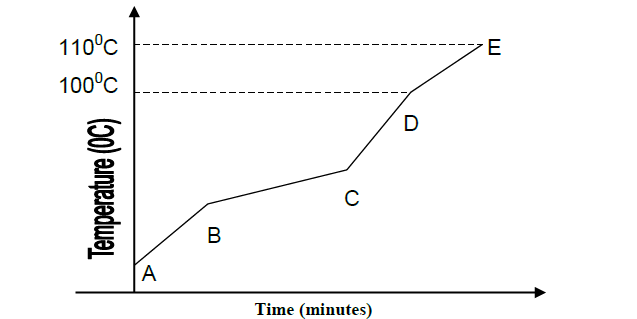 (i) At what temperature does the water boil?
(ii) Giving reason(s) is this pure or impure water?
(iii) State the effect of impurities on the boiling point of water?
(i) At what temperature does the water boil?
(ii) Giving reason(s) is this pure or impure water?
(iii) State the effect of impurities on the boiling point of water?
Date posted:
September 12, 2019
-
Read the passage below and then answer the questions that follow.
Happiness arises largely from the mental qualities of contentment, confidence, serenity and active good-will. It includes the pain of losing as well as the pleasure of finding. It thrives best in a crowded life. The men and women who are recorded in history and biography as the most happy were with always somewhat to do than they could possibly do. Every waking hour of their lives was occupied with ambitious projects, literature, love, politics, science, friendship, commerce, professions, trades, their religious faith, and a thousand other matters. The secret of happiness may be found by making each of these interests count to its utmost as part of the fabric of life.
We need to avoid the extremes of sluggish placidity and feverish activity. we are not going to be satisfied with felicity which resembles that of a stone, unfeeling and unmoving, but will look back from future ears with sorrow and regret if we run to and fro, giving it what Socrates called ‘the itch’.
Happiness obviously includes two sorts of behavior: active and passive. We may say the active consists in searching and sharing, while the passive part is made up security and possession. Neither part is complete in itself, nor does neither yield full satisfaction if it is over-emphasized. Philosophers from the ancient Greeks to present day have been extolling a balanced life as the most happy life,and many unhappy people can, when they face the issue, trace their discontent to imbalance.
The recipe for happiness cannot be given in any single word, because its many virtues have to be combined in their proper quantities, at the proper times for proper purposes.
It is legitimate to seek happiness. We cannot help observing that while followers of some schools of thought are telling us to avoid seeking happiness; they intimate that if we do so we shall be happy.
The search requires a plan. We need to know what sort of happiness we seek, what the ingredients are, what our strongest wants are, and what we have to start with. We should train ourselves to keep the program me simple, and free from complications and side trips, to pay attention to little things to deflate quickly after being praised and to bounce back quickly after disappointment, to seize to create opportunities to put our special abilities to work, to seek excellence in everything we do, to remain modest and to review and revise periodically.
Most of us do not really have to seek far and wide. Happiness grows at our fireside, if we cultivate it.
a) According to the writer, what is the source of happiness?
b) What two sorts of behavior does happiness include?
c) What does the writer mean when he talks about a balanced life?
d) In a paragraph of about 30 words, summarize the things we must know as we search for happiness?
e) Explain the writers point in the last paragraph of the passage. (2mks)
f) The recipe for happiness cannot be given in any single word.
(Rewrite the sentence beginning: No single word....)
g)Identify and comment on the figures of speech used in the following:
(i) It (Happiness) thrives best in a crowded life.
(ii) ... as part of the fabric life.
h)Describe the tone of this passage.
i)Explain the meaning of the following words as used in the passage.
(i) Extolling-
(ii) Intimate-
(iii) Felicity-
(iv) Legitimate-
Date posted:
September 12, 2019
-
The curves below represent the volume of carbon (IV) oxide gas evolved when 1M concentrated hydrochloric acid and 60g of calcium carbonate and also 0.5M concentrated hydrochloric acid was reacted with the same quantity of the carbonate.
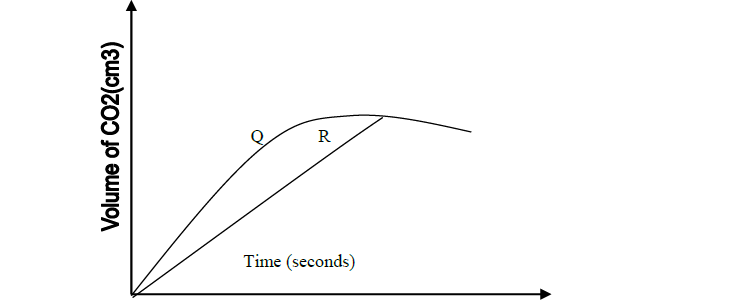 (a) Which of the curves represent the reaction of 1M concentrated hydrochloric acid with powdered calcium carbonate.
Explain.
(b) Explain why the curves flatters at the same level of production of carbon (IV) oxide.
(a) Which of the curves represent the reaction of 1M concentrated hydrochloric acid with powdered calcium carbonate.
Explain.
(b) Explain why the curves flatters at the same level of production of carbon (IV) oxide.
Date posted:
September 12, 2019
-
State the fluids that provide cushion in the following organs
(a) Lungs
(b) Heart
(c) Knee
(d) Eye ball
Date posted:
September 11, 2019
-
The diagram below illustrates a physiological process that occurs in the alimentary canal of man.
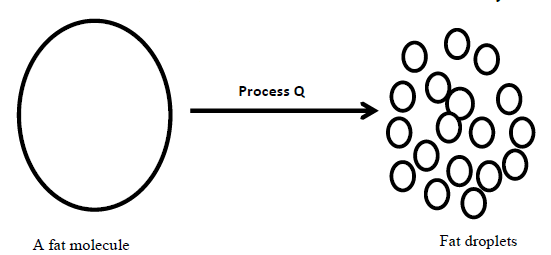 a) Name the process Q above
b) Explain the biological importance of the above process.
c) Name the substance that helps the process named (a) above.
a) Name the process Q above
b) Explain the biological importance of the above process.
c) Name the substance that helps the process named (a) above.
Date posted:
September 11, 2019
-
The figure below shows a match stick floating on the surface of water in a basin.
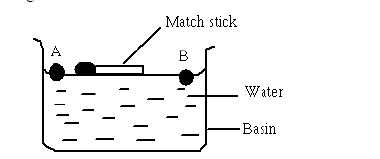 When a drop of soap solution was carefully added to the water at A, the match stick is observed to move in a certain direction. State the direction of this match using A and B and explain this observation.
Date posted:
September 11, 2019
-
A heating element rated 2.5 KW is used to raise the temperature of 3.0 kg of water through 500C. Calculate the time required to effect this. (Specific heat capacity of water is 4200 J/kgK)
Date posted:
September 11, 2019