-
Metal S removes oxygen combined with P. Q reacts with an oxide of R and not with an oxide of P. P reacts with cold water
but Q does not.
a) Which is the most reactive metal ?
b) Which is the least reactive metal ?
c) Arrange the metals in order of reactivity starting with most reactive to the least reactive.
Date posted:
May 24, 2019
-
Describe the way by which terrestrial plants are adapted to living in arid and semi-arid ecosystems.
Date posted:
May 24, 2019
-
Describe the adaptations of wind pollinated flowers.
Date posted:
May 24, 2019
-
Rewrite the following sentences as instructed.
(i) (a) The photographs will be taken at the venue of the wedding. The photographs will
be taken in a reputable studio. (Combine into once sentence using ‘either …..or,,,,’)
(b) Neither the children nor the peasant ………allowed to go to the hall yesterday.
(Rewrite filling the blank with an appropriate auxiliary verb).
(ii) (a) The principal noticed serious laxity among the students. He warned them against such
behaviour. (Combine the sentence using present participle. )
(b) The farmer’s cow gives twenty-five kilos of milk everyday. He feeds and waters it very well. (Combine using
the present participle).
(iii) Underline the gerund in the following sentence.
Kibet is studying but swimming is his hobby.
(iv) Replace the underlined word with a phrasal verb.
(a) It is not good to despise other people.
(b) I am currently living with my brother in Karen
(c) The principal was annoyed with the three boys.
Date posted:
May 24, 2019
-
The diagram below represent a seedling.
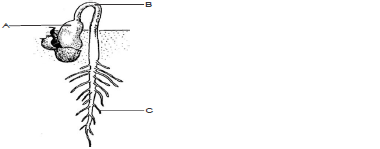 a) Name the structure labelled B
b) State the functions of the parts labelled A and C
c) Name the type of germination exhibited by the seedling.
d) State three conditions within the seed necessary for germination.
e) What is the importance of optimum temperature in seed germination ?
a) Name the structure labelled B
b) State the functions of the parts labelled A and C
c) Name the type of germination exhibited by the seedling.
d) State three conditions within the seed necessary for germination.
e) What is the importance of optimum temperature in seed germination ?
Date posted:
May 24, 2019
-
Read the following passage and answer the questions that follow.
The Man, His Son and The Squirrel
There was a certain town whose only occupation was catching squirrels (ground squirrels). There was a man in
this town who excelled at catching squirrels. One squirrel was so smart that it eluded everyone in town. It was said
that only this man said to his son, “Come, let’s go to catch the squirrel.” They took an axe; they found the squirrel
near its hole. Then the squirrel ran and entered its hole. They searched out all the holes, then they stopped them
up. Then the man said to his son, “Don’t let the quirrel get out of its hole.” He answered, “Okay.” But one hole
wasn’t stopped up, and the squirrel escaped. When it escaped, the father came to his son and said to him, “Why
did you let it escape? If I go home now, I will be ashmed.” He grabbed the axe and struck his son. Then he went
on his way and left his son unconscious. Ants began to fill his eyeballs an his ears; vultures were circling above
him.
In the afternnon, the headman of a rich caravan arrived at the spot. When he arrived, he setp up camp. Then he got
up and went for a stroll and saw the boy. He called his slaves to take him and have him washed and shaved. The
boy recovered. The headman had no offspring. When he took the boy, he decided that he would make him his son.
He sent a message to the chief of the town, telling him that he had an offspring, that he was happy he had become
a complete man, and that he would now receive the gifts due to him.
The chief said, “This is a lie. He is not his son. If he is his son, then let him come that I can see.” Then the
headman arrived in town. The chief gave his sons horses worth ten pounds. He said, “Go and join the son of the
headman. Have a race. When you finish give these horses away” (forcing him to do the same). They did it and
they returned. the next day, the chief again gave them horses worth ten pounds. They did as the day before. They
did it five times. They ran out of horses. Then the chief said, “Indeed, it is his son I have run out of horses. If it
weren’t his son, he wouldn’t agree to let him give his own horses away to match the presents.” Then the chief
summoned his daughter. The Gralladima brought his to help. The Madaki also gave, and the Makama gave.
Altogether, four wives. The chief gave a big house. The headman came and brought twenty concubines and gave
to his son. There was continuous feasting.
Then one day the son saw his father, the one who had knocked him down with the axe because of the squirrels.
The father came to the house of his son and said, “Throw away your gown and start catching squirrels.” The
slaves of the headman said, “This is a crazy man, let us all strike him.” The boy said to him, “This is my father,
the one who sired me.” The headman said, “I have already lied to the chief. Let us keep that secret. I will give
your father wealth. Let him go home. Should he want to see you, let him come to visit you. If you want to see him,
then you can go and visit him.” The real father said he did not agree. Then the headman said, “Well then, let us go
out in the countryside.” They went. The headman unsheathed his sword. He handed it to the son, and said, “Kill
one of the two of us.” Here ends the story
Questions
(a) (i) Classify the above narrative.
(ii) What are the characteristics of the above classification?
(iii)What is the function of this narrative?
(b) Identify and illustrate any three features of oral narrative evident in the story.
(c) Give one economic activity that is undertaken by the community referred to in this narrative.
(d) Describe the character of the following:
(i) The young man
(ii) his father
(e) Whom do your think would be the most appropriate audience of this story.
(f) What is the moral lesson of this narrative?
Date posted:
May 24, 2019
-
Below are PH values of some solutions.
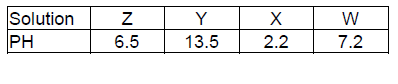 i) Which solution is likely to be
I. acidic rain
II. Potassium hydroxide
ii) A basic substance V reacted with both solutions Y and X. What is the nature of V.
iii) Identify two substances that show these characteristics in question (ii) above.
i) Which solution is likely to be
I. acidic rain
II. Potassium hydroxide
ii) A basic substance V reacted with both solutions Y and X. What is the nature of V.
iii) Identify two substances that show these characteristics in question (ii) above.
Date posted:
May 24, 2019
-
The diagram below represents a transverse section of a young stem.
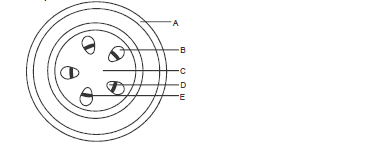 a) Name the parts labelled A and C on the diagram.
b) State the functions of the parts labelled B, D and E
c) List three differences between the section shown above and one that would be obtained from the
root of the same plant.
a) Name the parts labelled A and C on the diagram.
b) State the functions of the parts labelled B, D and E
c) List three differences between the section shown above and one that would be obtained from the
root of the same plant.
Date posted:
May 24, 2019
-
The diagram below is a cross section through a part of human ileum.
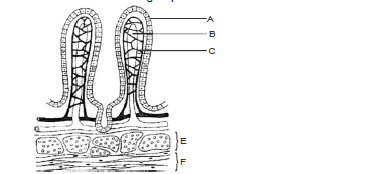 a) i) Identify the structure drawn above.
ii) State the significance of the structure shown above.
b) Name the parts labelled A, B and C
c) Give the functions of the part labelled B and C.
a) i) Identify the structure drawn above.
ii) State the significance of the structure shown above.
b) Name the parts labelled A, B and C
c) Give the functions of the part labelled B and C.
Date posted:
May 24, 2019
-
Read the following passage and then answer the questions that follow.
Unscrupulous as he was, Kwame Asante had a qualm as he looked at the woman sitting on the
African stool near the bed. He had called her and yet when she came he did not quite know how to begin the
conversation.
“Akosua, how would you like fifty pounds to start a small business of your own – selling cloths or
perfume and powder?” The woman smiled nervously. Ten years of married life had made her wary of her
husband’s fits of generosity.
She was as black as ebony, with the fine features peculiar to the girls of the Akwapim hills; graceful
in her brown and red design cloth and the lovely silk head-tie wrapped round her head. Her feet were shod in
‘spitfire’ sandals and on her tiny ears she had the popular golden ear-rings named ‘Abongo’.
The slender woman on the stool was the mother of three children though she still looked a girl.
Married under the native customary law, she had served her lord and master with zeal and zest. It is a law
which as some other law in the Gold Coast, needs disinfecting for though it aids the man to gain his desire
when it is at its fiercest, it in no way safeguards the position of the woman when the man’s passion abates.
“Would you like fifty pounds?” asked Kwame again. “Could make it a hundred. You have been a
very good wife to me, Akosua.” Did the truth begin to dawn on the woman’s consciousness? No. She thrust
the thought away from her. ‘He could not do it’.
Kwame cleared his throat – after all he might as well get it off his chest: hadn’t she noticed that the
whole relationship had become impossible? A cloth woman was all right when one was young and struggling.
She could be so useful – a general servant, and yet a wife. Akosua was so gentle, and even quite refined, but a
man needs a change. He had just completed his two-storied building and he had been made a committee
member of an important club. The other day his academy had conferred on him an associateship and his
university had given him a coveted degree. He had at last achieved his ambition and had become an important
man in the community. He was thinking seriously of entering the town council.
Fancy being addressed councilor Kwame Asante, O.B.A…. A.S.S. He smiled inanely to himself.
Akosua looked at him in wonder.
“Er….. er…. Akosua…., I want to tell you I am going to marry a lady; you will be paid off with a hundred
pounds. A…. frock….. lady….um…..er …. of course you can read and write Ga and Twi but my friends will
call you an illiterate woman.”
“Did you consult your friends before you married me ten years ago?” The voice was cold and calm,
yet the words cut like a whip.
“If you are going to be impertinent, I shall not discuss the matter further.” He got up and walked up
and down the room. “How many men in the Gold Coast will pay a woman off with one hundred pounds? You
are only entitled to twenty-five pounds and here I am out of kindness offering you a hundred. Show some
gratitude, Akosua.” Akosua looked at him. Stark misery was in her eyes.
“I shall send the children to Achimota College.” There was a whining note in his voice. “I am only
doing this because of my position in society. You see I may be called to Government House and other
important places……. say something Akosua.
“I say you can keep your twenty five pounds, fifty pounds or a hundred pounds. I will have nothing to
do with it. I will not be paid off.
“What! What! Come! Come! Don’t do anything rush!”
“If you dare touch me I shall strike your face.”
“Strike your master, your husband! Are you mad?”
“I shall leave this house.”
“If you dare to disgrace me by leaving the house before I am ready for you to go, there will be trouble.
I do not intend to put up with a willful woman. What is my sin after all? I only want to become a decent and
respectable member of society. If you leave this house without my knowledge and permission, I shall claim
every penny I have spent on you since I married and lived with you these ten years; and not only that but I
shall claim all the presents I have given to your parents and other relatives. You know our native customary
law.”
“Yes, I know your native customary law. It is a grave to bury women alive whilst you men dance to
the tom-tom on top of the mound of earth.'
Questions
i) Why does Akosua smile nervously when Kwame offers her fifty pounds to start a small business of her own?
ii) Explain the effect of Akosua’s silence on Kwame?
iii) In not more than 60 words, summarize the reasons for Kwame’s intention to marry another wife.
v) Identify a statement from the passage which proves that Kwame was ashamed of the action he was about to
take.
vi) What is Kwame Asante’s burning ambition?
vii) Rewrite the following sentence in reported speech
‘Did you consult your friends before you married me ten years ago?’ Akosua asked Kwame.
viii) Give an instance of irony in the passage.
ix) ‘It is a grave to bury women alive whilst you men dance to the tom-tom on top of the grave.’
Explain the meaning of this statement.
x) What is Kwame’s attitude towards women?
xi) Explain the meaning of the following words and phrases as used in the passage.
a) Disinfecting …………………………………………………………………………………..
b) The words cut like a whip ………………………………………………................................
c) Impertinent ………………………………………………………………………………….
Date posted:
May 24, 2019
-
Read the oral poem below and respond to the questions that follow.
A BAREFOOT BOY
A barefoot boy! I mark him at his play…
For May is here once more, and so is he,…
His dusty trousers, rolled half to the knee,
And his bare ankles grimy, too, as they:
Cross- hatchings of the nettle, in array
Of feverish stripes, hint vividly to me
Of woody pathways winding endlessly
Along the creek, where even yesterday
He plunged his shrinking body – gasped and shook
Yet called the water ‘warm’ with never lack
Of joy. And so, half enviously I look
Upon this graceless barefoot and his track,…
His toe stubbed…, his big toe-nail knocked back
Like unto the clasp of an old pocketbook.
i) Identify and illustrate two devices that make the poem musical.
ii) How would you effectively recite line 13 of this poem?
iii) Which word would you stress in line 12? Give a reason
Date posted:
May 24, 2019
-
Short Stories, When the sun Goes Down and other stories.
The reason that makes people want to leave home and go abroad is that their mother country pushes them away. Using illustrations from leaving by Moyez G, Vassanji, show the validity of this statement.
Date posted:
May 24, 2019
-
The diagram below is a section of a model of the structure of element T.
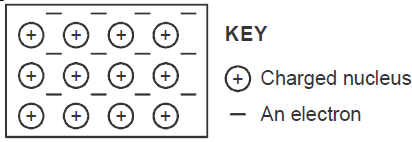 a) State the type of bonding that exist in T.
b) In which group of the periodic table does element T belong ? Give a reason.
a) State the type of bonding that exist in T.
b) In which group of the periodic table does element T belong ? Give a reason.
Date posted:
May 24, 2019
-
Imaginative Composition (Compulsory).
Either
(a) Write a story ending with the following words:
….’The experience left a permanent scar in my heart.’
Or
(b) Write a composition justifying or refuting this statement:
'The Government is justified in its plan to provide laptops to pupils in class one'
Date posted:
May 24, 2019
-
20cm3 of an unknown gas Q takes 12.6 seconds to pass through small orifice. 10cm3 of oxygen gas takes 11.2 seconds to
diffuse through the same orifice under the same conditions of temperature and pressure. Calculate the molecular mass of
unknown gas. (O = 16)
Date posted:
May 24, 2019
-
Read the excerpt below and answer the questions that follow.
Read the excerpt below and answer the questions that follow: (25mks)
INKEEPER: Your worship, it’s a question of the family honour. I wish to bring an action on behalf of
my son, who’s away on business on the other side of the mountain. This is the offending
stable man, and here is my daughter in law.
(Enter the Daughter in law, a voluptuous wench. She is veiled)
AZDAK: (Sitting down): I accept (sighing, the Inkeeper hands him some money). Good. Now the
formalities are disposed of. This is a case of rape?
INKEEPER: Your honour, I caught the fellow in the act. Ludovica was in the straw on the stable
floor.
AZDAK: Quite right, the stable. Lovely horses! I especially liked the little roan.
INKEEPER: The first thing I did, of course, was to question Ludovica. On my son’s behalf.
AZDAK: (Seriously) I said I specially liked the little roan.
INKEEPER: (Coldly): Really? Ludovica confessed the stableman took her against her will.
AZDAK: Take your veil off: Ludovica (she does) Ludovica, you please tell the court. Tell us what
happened.
LUDOVICA: (Well schooled). When I entered the stable to see the new foal the stableman said to
me on his own accord, “It’s hot today!” and laid his hand on my left breast. I said to him,
“Don’t do that!” But he continued to handle me indecently, which provoked my anger.
Before I realized his sinful intentions, he got much closer. It was all over when my father-inlaw entered and accidentally trod on me.
INKEEPER: (explaining) On my son’s behalf.
AZDAK: (to the stableman). You admit you started it?
STABLEMAN: Yes
AZDAK: Ludovica, you like to eat sweet things?
LUDOVICA: Yes, sunflower seeds.
AZDAK: You like to lie a long time in the bathtub?
LUDOVICA: Half an hour or so.
Questions
(a) Explain what happens before this excerpt.
(b) 'I accept.' Explain what is implied by this statement.
(c) 'Your honour, I caught the fellow in the act.' Identify and explain one theme that can be deduced from the
statement.
(d) '(Sighing, the innkeeper hands him some money.) Good now the formalities are disposed of.' What turns out to
be ironic about this statement?
(e) Who is the public prosecutor in this case?
(f) Why do you think Azdak asks Ludovica to remove her veil?
(g) Describe any other three cases adjudicated by Azdak.
(h) Basing your answer on the excerpt, identify and illustrate any two character traits of Ludovica.
(i) Identify an instance of humour used in the except.
(j) Give the meaning of the following words as used in the excerpt.
(i) Roan:…………………………………………………………………………………………
(ii) Stable:…………………………………………………………………………………………
Date posted:
May 24, 2019
-
Read the following comprehension passage and then answer the questions that follow.
Aristotle, the father of Western critical thought, Leonardo da Vinci, Oprah Winfrey, Marie Curie, Albert
Einstein, Ronald Reagan, Bill Clinton, Fidel Castro, George Bush, Julius Caesar, Alexander the Great, Napoleon
Bonaparte, Bill Gates, Barack Obama and Uhuru Kenyatta all have one thing in common. Not that they are great
men and a woman, but because all of them are left-handed!
Is there something special about being left handed? It is a question that has given rise to many myths about
left handed people.
Interestingly, in a majority of cultures the world over, left-handed people are a stigmatised minority. Left is
associated with femininity while right in linked to masculinity.In many of our cultures, when giving direction, we
talk about the female side and male side of the road. Patriarchal structures have ways of twisting the truth to
preserve masculine hegemony.
In some cultures of Africa, people view left-handedness as a sign of evil, while in Japan it can be enough
reason for divorce. Many myths in our cultures in Africa regard left-handedness as something unacceptable and
evil. Languages have ways of carrying these beliefs about left-handedness. In Latin, the word left is synonymous
with “sinister”, while in Spanish the word for left is linked with “malicious”. The French word for left is
synonymous with “awkward”. In English, the word left comes from the Anglo-Saxon word ‘luft’, which means
weak or broken.
The holy books have not been left out in stigmatising left-handedness. The Bible, specifically the book of
Judges, associates left-handedness with war-like tendencies.
We also know of many sayings that are negative in reference to left handedness, for instance left wing and a lefthanded compliment.
It is, therefore, possible to argue that left handed people are a minority that deserves attention. They suffer at
the hands of right handed people who do not recognise their special needs
Some insensitive teachers are known to punish left handed children and force them to write using their right
hands. It is, however, notable that in Western cultures, the discrimination of left-handed people is almost over due
to the enlightenment of the society.
But what brings about left handedness? Experts remain unsure of how handedness emerges in children.
However, a number of reasons have been advanced to explain why majority of people in all societies are righthanded. In terms percentage, less than 10 percent of the world population is left handed and majority of them are males.
Evolutionary theory attempts to explain this phenomenon by suggesting that during the early ages, primitive
hunters needed to protect their most vital organ of the body — the heart — and their left hand was used to hold the
shield. The right hand was used to hold the sword or knife and because of this it acquired greater agility, which
was passed down through the generations.
This theory, therefore, explains why more men would be right-handed than women. Other studies have also
revealed that the left-handedness of children is an inherited trait. It is common if one parent is left-handed and
more common if both parents are left handed.
An equally useful theory that tries to explain this phenomenon is the brain hemisphere theory. It postulates
that the preference of using one side of the body more than the other in performing special tasks depends on which
brain hemisphere is dominant. In most people, the left hemisphere controls speaking and handy work and that is
why right-handedness is common. It further argues that left-handed people are controlled by the right hemisphere
of the brain.
Some researchers claim that left-handed people are more intelligent and eloquent than the right-handed
people. It is argued that there are more left-handed people with IQs of over 140 than right-handed people.
Captivatingly, other studies reveal that left-handed people are more unlikely to suffer from disorders of the
immune system.
In view of the fact that studies have found that this group of individuals comprise of intelligent and creative
people, we need to revisit our curriculum in order for it to take care of their unique potentialities. We have to put
in place structures that will create a learner-friendly environment for left handed children. Desks should also be
designed to cater for their unique needs. Special pens and writing materials should be provided specifically for this
group of children. More importantly, we should re-train teachers to appreciate the fact that pupils are gifted in
different ways, and it is their duty to help pupils to put to use these gifts.
Adapted from Saturday Nation 28/02/2015 Pg. 39
By Prof. Egara Kabaji and Dr Misigo Lushya.
Questions
(a) Why do the writers give a long list of people who were / are left-handed?
(b) How are the left-handed people discriminated against in the society they live in?
(c) What makes left-handed people unique?
(d) According to the passage, why do we have fewer females being left-handed than males?
(e) Distinguish the functioning of the left-handed people from the right-handed ones?
f) Make notes on the various ways left-handed individuals can be accommodated by the learning institutions.
(g) Rewrite the following sentence as instructed.
Desks should also be designed to cater for their unique needs.
Begin: Their unique needs:
(h) Explain the meaning of the following words as used in the passage.
(i) Agility:…………………………………………………………………………………………………
(ii) Hemisphere:……………………………………………………………………………………………
(iii) Postulates:………………………………………………………………………………………………..
Date posted:
May 24, 2019
-
Consider the following dialogue and describe the shortcomings of Orgon’s listening skills.
ORGON: Ah, good morning, brother.
CLEANTE: I was just going. I’m glad to see you back again. There isn’t much life in the
countryside just now.
ORGON: Dorine – (to Cleante) a moment brother, please – excuse me if I ask the news of
the family first and set my mind at rest. (To Dorine).
Has everything gone well the few days I’ve been away? What have you been doing? How is everyone?
DORINE: The day before yesterday, the mistress was feverish all day. She had a dreadful
headache.
ORGON: And Tartuffe?
DORINE: Tartuffe? He’s very well: hale and hearty: in the pink.
ORGON: Poor fellow!
DORINE: In the evening she felt faint and couldn’t touch anything, her headache was so
bad.
ORGON: And Tartuffe?
DORINE: He supped with her. She ate nothing but he very devoutly devoured a couple of
partridges and half a hashed leg of mutton.
ORGON: And Tartuffe?
DORINE: Feeling pleasantly drowsy he went straight to his room, jumped into a nice warm
bed, and slept like a top until morning.
ORGON: Poor fellow!
DORINE: Eventually she yielded to our persuasions, allowed herself to be bled, and soon felt
much relieved?
ORGON: And Tartuffe?
DORINE: He dutifully kept up his spirits and took three or four good swigs of wine at
breakfast to fortify himself against the worst that might happen and to make up for the blood the
mistress had lost.
ORGON: Poor fellow!
DORINE: They are both well again now so I’ll go ahead and tell the mistress how glad you
are to hear that she’s better.
(From the Misanthrope and other Plays by Moliere)
Date posted:
May 24, 2019
-
Read the poem below and answer questions that follow.
The sweetest thing by Ibid.
The sweetest thing by Ibid.
There is in this world something
That surpasses all other things
In sweetness.
It is sweeter than honey
It is sweeter than salt
It is sweeter than sugar
It is sweeter than all
Existing things.
This thing is sleep
When you are conquered by sleep
Nothing can prevent you
Nothing can stop you from sleeping
When you are conquered by sleep
And numerous millions arrive
Millions will find you asleep
(i) Identify and illustrate two sound patterns used in the poem.
(ii) Write down words from the poems that have the following sounds;
/ i: / …………………………………………
/ S / …………………………………………
/ D / ………………………………………..
Date posted:
May 24, 2019
-
When one mole of lithium has completely reacted what volume of hydrogen would be produced at room temperature? (MGV = 24dm³, Li=7)
Date posted:
May 24, 2019
-
The diagram below represents phloem tissue from the stem of a plant.
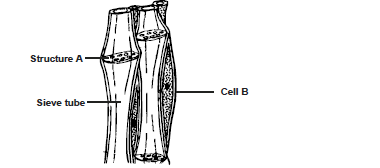 i) Name the structure labelled A.
ii) State TWO substances transported in the phloem.
iii) Give the function of cell B.
i) Name the structure labelled A.
ii) State TWO substances transported in the phloem.
iii) Give the function of cell B.
Date posted:
May 24, 2019
-
Read the passage below and fill in the gaps using the most appropriate words.
The classification (1) _________ any material refers to (2) _________ division of such materials into specific
classes according to established (3) _____. The categories developed should (4) ____ be able to accommodate all
manner of material considered. We can then talk of literary classification as a (5) __________ of categorizing,
characterizing, describing, typifying, labeling etc. In literature (6) _________, classification is done according to
the content or (7) ________ of the material. Content refers to the subjects, ideas, people, objects and situations
presented in the work. The latter refers to the how, the shapes, patterns, appearances, dimensions and textures.
Written literature comes to us in the form of novels, short stories, poems (8) __________ plays. They are in a
graphic form. But oral literature comes (9) __________ the form of narratives, poetry, riddles and proverbs.
They are transmitted by (10) ___________ of mouth and therefore have an oral form.
Date posted:
May 24, 2019
-
Write synopsis of the adapted play from Margaret Ogola’s The River and The Source paying particular attention to events that affect the character of Akoko, Chief Owuor Kembo and Otieno Kembo.
Date posted:
May 24, 2019
-
The diagram below represents recycling of nutrients in a certain ecosystem.
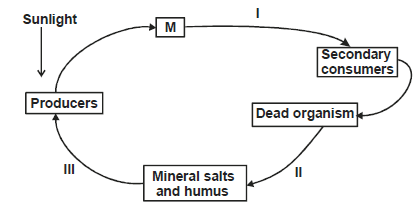 a) Name the trophic level represented by M.
b) Name the processes represented by. I,II,III
c) Name the organisms involved in process II.
d) What would happen within the ecosystem if all secondary consumers were eliminated?
a) Name the trophic level represented by M.
b) Name the processes represented by. I,II,III
c) Name the organisms involved in process II.
d) What would happen within the ecosystem if all secondary consumers were eliminated?
Date posted:
May 24, 2019
-
. Imaginative composition
Either
a) Write a story ending with:
…. I walked home feeling sad about what had happened during the day.
Or
b) ‘The ranking of schools during the release of the national examinations should continue.’ Write a composition in
support or against this statement
Date posted:
May 24, 2019
-
Explain the meaning of the following sentences.
i. Lydia found the empty room.
ii. Lydia found the room empty.
Date posted:
May 24, 2019
-
Supply correct question tags to the following.
i. Let us go home.........................................
ii. I am pleased with you................................
Date posted:
May 24, 2019
-
Use the correct form of the word in brackets in the sentences that follow.
i. She ...........................the teachers advice in everything she did. (seek)
ii. He has ......................... across the muddy river. (swim)
iii. They............................. in amazement. (spin)
iv. The senator was popular for his....................... .........character. (conscience)
Date posted:
May 24, 2019
-
Rewrite the following sentences as instructed.
(i) No one likes to be sick. (change the infinitive into a gerund)
(ii) Many students do not benefit if they read late into the night. (Rewrite using present simple)
(iii) My examination results were released only after I had cleared the fee balance.
(Begin: Not until......)
(iv) The teacher was annoyed by the students. He punished them severely. (rewrite using past participle)
Date posted:
May 24, 2019
-
Read the poem bellow and answer the question that follows
My grandmother
by Elizabeth Jennings
She kept an antique shop-or it kept her.
Among Apostle spoons and Bristol glasses,
The faded silks, the heavy furniture,
She watched her own reflection in the brass
Salvers and silver bowls, as if to prove
Polish was all, there was no need for love.
And I remember how I once refused
To go out with her, since I was afraid.
It was perhaps a wish not to be used
Like antique objects .Though she never said
That she was hurt, I still could feel the guilt
Of that refusal, guessing how she felt.
Later, too frail to keep a shop, she put
All her best things in one long, narrow room.
The place smelt old, of things too long kept shut,
The smell of absences where shadows come
That can’t be polished. There was nothing then
To give her own reflection back again.
And when she died I felt no grief at all,
Only the guilt of what I once refused.
I walked into her room among the tall
Sideboards and cupboards-things she never used
But needed: and no finger-marks were there,
Only the new dust falling through the air.
a) Identify the persona in the above poem.
b) In note form, summarize what each stanza is talking about
c) Identify and briefly explain the use of any two images in the poem
d) What does the persona feel towards the subject matter?
e) What do the following lines mean in the poem?
'too frail to keep a shop'
'Only the new dust falling through the air'
f) Describe the tone the persona uses in the poem above
g) Explain the paradox in the line:
-things she never used
But needed
h) Explain the persona’s sense of guilt?
Date posted:
May 24, 2019