-
An ion of oxygen is larger than oxygen atom. Explain
Date posted:
October 14, 2019
-
Read the passage below and then answer the questions that follow.
Moving to a new country can be exciting, even exhilarating experience. In a new environment, you somehow feel more alive: seeing new sights, eating new food, hearing the foreign sounds of a new language, and feeling a different climate against your skin stimulate your senses as never before. Soon, however, this sensory bombardment becomes sensory overload. Suddenly, new experiences seem stressful rather than stimulating, and delight turns into discomfort. This is the phenomenon known as culture shock. Culture shock is more than jet lag or homesickness, and it affects nearly everyone who enters a new culture – tourists, business travelers, diplomats and students alike. Although not everyone experiences culture shock in exactly the same way, many experts agree that it has roughly five stages.
In the first stage, you are excited by your new environment. You experience some simple difficulties such as trying to use the telephone or public transportation, but you consider these small challenges that you can
quickly overcome. Your feelings about the new culture are positive, so you are eager to make contact with people and to try new foods.
Sooner or later, differences in behavior and customs become more noticeable to you. This is the second stage of culture shock. Because you do not know the social customs of the new culture, you may find it difficult to make friends. For instance, you do not understand how to make “small talk,” so they overhear a conversation. You understand all the words, but you do not understand the meaning. Why is everyone laughing? Are they laughing at you or at some joke that you did not understand?
Also, you aren’t always sure how to act while shopping. Is this store self-service or should you wait for a clerk to assist you? If you buy a sweater the wrong size, can you exchange it? These are not minor challenges; they are major frustrations.
In the third stage you no longer have positive feelings about the new culture. You feel that you have made a mistake in coming here. Making friends hasn’t been easy, so you begin to feel lonely and isolated. Now you want to be with familiar people and eat similar food. You begin to spend most your free time with students from your home country, and you eat in restaurants that serve your native food. In fact, food becomes an obsession, and you spend a lot of time planning, shopping for, and cooking food from home.
You know that you are in the fourth stage of culture shock when you have negative feelings about almost everything. In this stage you actively reject the new culture. You become critical, suspicious, and irritable. You believe that people are unfriendly, that your landlord is trying to cheat you, that your teachers do not like you, and that the food is making you sick. In fact, you may actually develop stomachaches, headaches, sleeplessness, lethargy, or other physical symptoms.
Finally, you reach the fifth stage. As your language skills improve, you begin to have some success in meeting people and in negotiating situations. You are able to exchange the sweater that was too small, and you can successfully chat about the weather with a stranger on the bus. Your self-confidence grows. After realizing that you cannot change your surroundings, you begin to accept the differences and tolerate them. For instance the food will never be as tasty as the food in your home country, but you are now able to eat and sometimes even enjoy many dishes. You may not like the way some people in your host country dress or behave in public, but you do not regard their clothes and behavior as wrong – just different. In conclusion, nearly everyone moving to a new country feels some decree of culture shock.
Symptoms may vary, and not all people experience all five stages. Newcomers with a strong support group may feel at home immediately in the new culture, while others take months to feel comfortable. Staying in touch with friends and family, keeping a positive attitude, and above all, learning the language as soon as possible is ways to overcome the difficulties and frustrations of adapting to life in a new land.
From: Writing Academic English, Alice Oshima and Ann Hogue, Pearson Education, Longman (2006)
(a) According to the passage, what is the meaning of culture shock?
(b) Identify any three factors that can cause culture shock?
(c) What evidence does the author give to show "you understand all the words, but you do not understand the meaning"?
(d) Give any three features that characterize a person in the worst state of culture shock.
(e) In note form, give the difficulties experienced in the second stage of culture shock
(f) Why is making friends helpful in overcoming culture shock?
(g) Explain the meaning of the following words as used in the passage.
i. Alive –
ii. Obsession –
iii. Negotiation –
(h) Staying in touch with friends and family, keeping a positive attitude, and, above all, learning the language as soon as possible are ways to overcome the difficulties and frustrations of adapting to life in a new land.
(Rewrite the sentence above without changing the meaning. Begin: You.....)
Date posted:
October 14, 2019
-
Read the following narrative and answer the questions that follow.
The Ndebele tell their children that long ago, there were three friends: the beautiful leopard, the jackal and the hyena. They went everywhere together. Whenever Leopard killed an animal, he would always leave part of it for his friends so that they could have a good feed too.
One day it happened that leopard was ill, and so he could not hunt. "Jackal," he said, "please catch some food for us, for I am not well."
But lazy Jackal said, "No, I am too weary. Ask Hyena."
So Leopard said, "Hyena, please hunt for us today, for I am not well enough to do so.”
But Hyena, too, made an excuse: "No, I have a sore foot."
So leopard roared in anger. "I thought you were my friends, but you are a no-good, lazy pair. Never again will I leave you meat when I make my kill. From this day on, I will make sure of it. I shall take what is left and hang it in a tree, when I have eaten all I want. Then neither of you will be able to get at it."
Leopard was true to his word – for since that day he has never left any meat for his selfish friends. Up into a tree it goes, high out of reach of jackals and hyenas. They have become scavengers now instead, and they eat the scraps that other animals leave behind. It was a sad day for them when they lost Leopard’s friendship.
(when Hippo was Hairy and Other Tales from Africa, Letterworth Press, 1990)
a) Giving a reason for your answer, say what kind of narrative this is.
b) What character can you give the leopard?
c) Identify the features of oral narratives that have been used in this story.
d) What lessons do we learn from this story?
e) What function is played by an opening formula and a closing formula in an oral narrative?
Date posted:
October 14, 2019
-
The table below gives information about the ions T+ and Z2-
 (a) How many protons are there in the nucleus of ?
(i) Element T?
(ii) Element Z?
(b) Determine the relative formula mass of the compound formed between T and Z
(c) State two conditions under which the compound would conduct electricity
(a) How many protons are there in the nucleus of ?
(i) Element T?
(ii) Element Z?
(b) Determine the relative formula mass of the compound formed between T and Z
(c) State two conditions under which the compound would conduct electricity
Date posted:
October 14, 2019
-
Read the following story and then answer the questions that follow.
Once upon a time, the pot and the drum got into an argument. They were sitting idly in a house when the pot suddenly said to the drum, 'You know, I’m tougher and stronger than you.'
'Oh!'Exclaimed the drum. 'Are you now? How’s that?”
'Well, just look at me,' said the pot. 'Isn’t it obvious?'
The drum took a long and hard look. The pot was a huge round thing, all made of clay and black with soot from years and years of cooking over hot, smoky fires.
'I sit over fires day in, day out,' continued the pot after a while. 'The more they burn me, the stronger I get. Could you, drum, sit over a fire for even half a minute? Why, you would be burnt to ashes.'
The drum could not dispute that. He certainly would not dare sit over a blazing fire. He was made of wood, you see, a hollowed-out trunk, spread with a skin at both ends. So he said to the pot, 'I agree with you. I couldn’t stand a fire even for a brief moment. But how about you facing my drummer with his drumsticks? I would love to see you stand up to the kind of pummeling he gives me day in, day out.'
The pot was scared stiff at the thought of being struck with drumsticks. He immediately suggested that they drop the argument, and they did.
Questions:
i) Identify and illustrate three characteristics of narratives present in this story.
ii) What two features of oral performance would you employ in the effective delivery of the story?
iii) List down the reason why the pot feels he is stronger than the drum and vice versa.
iv) How does the drum hit back at the pot?
v) Who won the argument and why?
vi) How would you classify the above narrative? Give a reason
vii) Give a suitable title for the above narrative.
Date posted:
October 14, 2019
-
An oxide of element G has the formula as G2O3
(a) State the valency of element G
(b) In which group of the periodic table is element G?
Date posted:
October 14, 2019
-
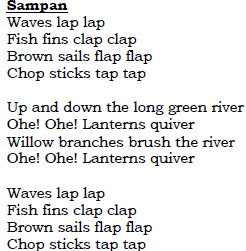
Read the poem below and answer the questions that follow.
 Questions:
1. Describe the rhyme scheme of the above poem.
2. Identify and illustrate any sound devices used in the poem.
3. Provide another word that is pronounced the same way as the ones provided below.
i) Key –
ii) One –
iii) Passed –
iv) Come –
v) Read
Questions:
1. Describe the rhyme scheme of the above poem.
2. Identify and illustrate any sound devices used in the poem.
3. Provide another word that is pronounced the same way as the ones provided below.
i) Key –
ii) One –
iii) Passed –
iv) Come –
v) Read
Date posted:
October 14, 2019
-
An element M has two isotopes M and M . The relative atomic mass of the naturally occurring is 63.55. Calculate the percentage of each isotope
Date posted:
October 14, 2019
-
The following refers to element Y
 Given that isotope C contains 31 neutrons in its nucleus,find the number of protons in isotope B
Date posted:
October 14, 2019
-
Element V has two isotopes. Two thirds of V and one third of V . What is the relative atomic mass of element V?
Date posted:
October 14, 2019
-
"Greed and Materialism can lead to grave consequences." In reference to the story "How Much Land Does Man a Need by Leo Toistoy," write an essay to illustrate the truth of this statement.
Date posted:
October 14, 2019
-
Element A has atomic mass 23 and element B has atomic mass 7 and also have 12 neutrons and 4 neutrons respectively.
(a) Write the electronic arrangement of A and B
(b) Which element has higher ionization energy? Explain
Date posted:
October 14, 2019
-
"Greed leads to evil." Write a composition to show the truth of this statement using illustrations from John Steinbeck’s The Pearl
Date posted:
October 14, 2019
-
In an experiment an unknown mass of anhydrous sodium carbonate was dissolved in water and the solution made up to 250cm3. 25cm3 of this solution neutralized 20cm3 of 0.25M nitric acid.
(Na = 23.0 C = 12.0 O = 16.0)
Calculate:
(a) Moles of Nitric acid used
(b) Moles of sodium carbonate in 25cm of the solution
(c) Mass of unknown sodium carbonate used
Date posted:
October 14, 2019
-
Read the poem below and answer the questions that follow.
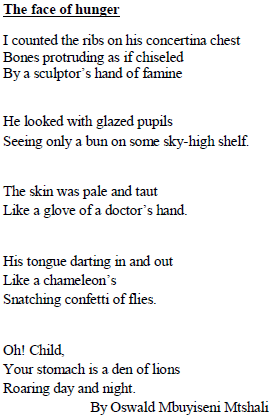 a) Who is the persona in the poem.
b) Identify the imagery used and show its effectiveness.
c) Explain the meaning of the following sentences:-
1) Seeing only a bun on some sky-high shelf.
2) Your stomach is a den of lions
Roaring day and night
d) What is the attitude of the persona towards the boy?
e) What is the meaning of the following words?
1) Chiseled
2) Glazed
3) Taut
4) Confetti
f) What is the mood of the poem?
a) Who is the persona in the poem.
b) Identify the imagery used and show its effectiveness.
c) Explain the meaning of the following sentences:-
1) Seeing only a bun on some sky-high shelf.
2) Your stomach is a den of lions
Roaring day and night
d) What is the attitude of the persona towards the boy?
e) What is the meaning of the following words?
1) Chiseled
2) Glazed
3) Taut
4) Confetti
f) What is the mood of the poem?
Date posted:
October 14, 2019
-
Read the excerpt below and answer the questions that follow.
'No Joseph' she said in an infantile whimper. “I can’t bear that we can’t express the love that we have for one another because of some primitive culture. If by loving you, I offend the sensibilities of Nasila then let me offend and face the consequences of doing so!"
"I also love you very much," Joseph Permute responded finally. "I loved you the moment I saw you during your father’s homecoming ceremony. But then the clan matter came to separate us. It is true we have no blood relation. But Nasila culture dictates who are related and who are not. We are slotted among those who cannot marry."
"No, it can’t be, I cannot accept its verdict," she said petulantly her words agonized. "No way, never" She stopped, confused and angry with herself at her inarticulate outburst. She took several long steadying breaths and then said, "I cannot accept that a culture that does not feed, clothe or house me comes to control my life. Our lives belong to us, Joseph. The destiny of our lives is in our own hands. We should guard it jealously."At last they drew a little a part .His eyes were open, honest and steady upon her face.
1. What happens before this excerpt?
2. For both Joseph and Taiyo, give and illustrate two character traits.
3. How is dialogue significant in this excerpt?
4. Explain any two thematic concerns addressed in the excerpt.
5. From elsewhere in the novel, how does Joseph sacrifice for his love for Taiyo?
6. Explain the meaning of the following vocabulary as used in the excerpt.
a) destiny
b) infantile
c) petulantly
d) primitive
7. What happens immediately after this extract?
Date posted:
October 14, 2019
-
Read the comprehension below and answer the questions that follow.
Prof Atieno Ndede-Amadi the head of the university’s school of Business at Technical University of Kenya (TUK) and associate professor of information systems and accounting, has embarked on a crusade to convince her peers of the need to introduce information systems (IS) analysis as a complete academic programme. She believes that the course would benefit young people interested in IT, as well as local enterprises that have had to rely on expatriates with the skill.
Prof Atieno’s concern arises from her own study. She established that despite a high demand for information system analysts there weren’t many Kenyans specially trained for the job.
As such, companies were hiring outsiders as local universities continued to concentrate on broad range computer science and programming courses, and failing to give much thought to IS analysis.
Information system analysts are trained to evaluate and develop technology systems to help business to run optimally. They identify user and consumer needs and translate them into technology solutions. Despite this critical function, there aren’t many people called IS analysts in the local market, and that’s because the universities here have not been keen to train in this specialization.
“A wide systems analysis skills gap exists in the country due to the absence of strong information system academic programs in local universities.” Prof Atieno states in her study report which is titled,” Information Systems Education in Kenya: Students Specialization Choice trends.” The work has been published in the International Journal of Education and Development using Information and communication Technology (IJEDICT). The study found that of all the 32 public universities and university colleges studied, none offered an information systems or management information systems degree. Only two degrees came close with four institutions offering a Bachelor of Technology (Business Information Technology) degree in varying combinations, and one university offering a Bachelor in Business Information and Management.
Prof Atieno says that if both students and university heads fully appreciated the value of information systems analysis, they would be more focused on it as an area of study. She actually established in her study that the supply gap of people with the skill is largely a result of ignorance. Globally, a majority of IS programs within universities are located in business schools, and they have names such an information systems, management information systems, computer information systems, business information systems, or business information technology. An IS degree programme combines business and computing topics, with the emphasis on technical and organizational issues varying from one programme to another, and also from one academic institution to the next. Generally, it bridges business and computer science, using the theoretical foundations of information and computation to study various business models and related algorithmic process within the computer science discipline.
According to Prof Atieno, organizations cannot effectively and efficiently do business without solid IS setups for connecting systems within as well as with its supply chain stake holders, such as vendors and distributors. Yet, many students aren’t aware of the possibility of a career in this field. In fact, the study found that only 11% of those interviewed knew about IS analysis as a possible area of specialization. “An Information system as an academic discipline seems to be largely unknown to high school students in Kenya, making it impossible for them to select it as an area of specialization in their university education,” it states. The net effect is that the level of IS education in the country has suffered, resulting in a deficiency in systems analysis and related skills.
1. What campaigns has Prof Atieno Amadi involved herself in according to paragraph one.
2. Mention the consequence Kenyans face as a result of lack of personnel in Information Systems Analysis.
3. Explain the irony evident in the passage.
4. Enumerate the functions of an Information System analyst.
5. In your own words write the message in this passage.
6. What do you think is shocking about the findings of this study.
7. What is the tone of the passage?
8. i) A wide system analysis skills gap exists in the country due to the absence of strong information systems.
Begin: As a result
ii) There weren’t many Kenyans specially trained for the job (add a question tag)
9. Explain the meaning of the following words and phrases as used in the passage
i. Globally
ii. Specialization.
iii. Supply chain stake holders
iv. Algorithmic processes
Date posted:
October 14, 2019
-
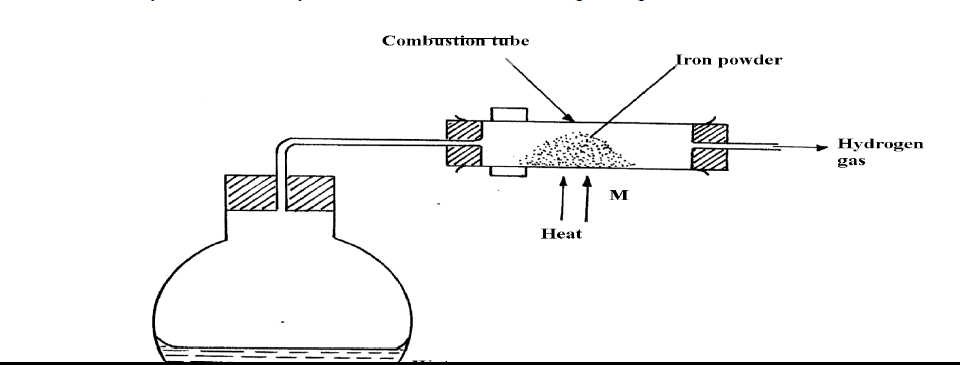
 (a) Between N and M which part should be heated first? Explain
(b) Write a chemical equation for the reaction occurring in the combustion tube.
(a) Between N and M which part should be heated first? Explain
(b) Write a chemical equation for the reaction occurring in the combustion tube.
Date posted:
October 14, 2019
-
Jane set-up the experiment as shown below to collect a gas. The wet sand was heated before heating Zinc granules.
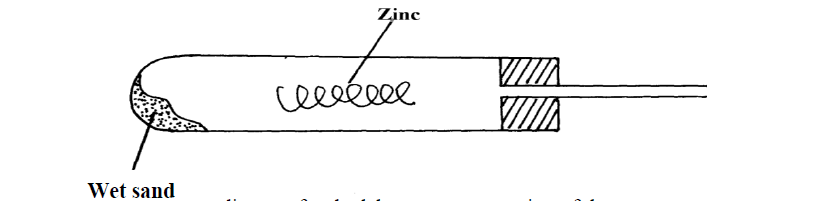 (a) Complete the diagram for the laboratory preparation of the gas
(b) Why was it necessary to heat wet sand before heating Zinc granules?
(a) Complete the diagram for the laboratory preparation of the gas
(b) Why was it necessary to heat wet sand before heating Zinc granules?
Date posted:
October 14, 2019
-
When hydrogen is burnt and the product cooled, the following results are obtained as shown in the diagram below:
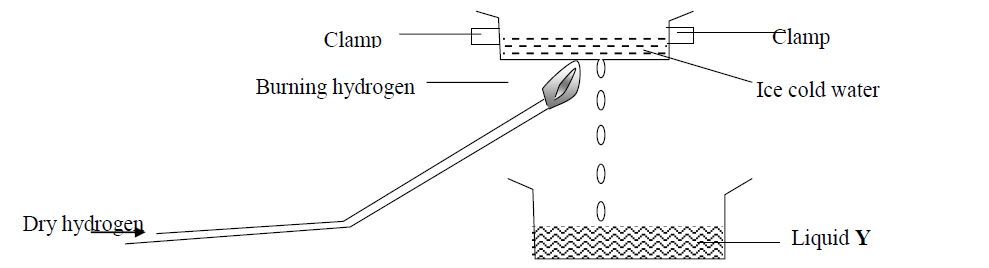 (a) Write the equation for the formation of liquid Y
(b) Give a chemical test for liquid Y
(a) Write the equation for the formation of liquid Y
(b) Give a chemical test for liquid Y
Date posted:
October 14, 2019
-
Gas P was passed over heated magnesium ribbon and hydrogen gas was collected as shown in the diagram below:
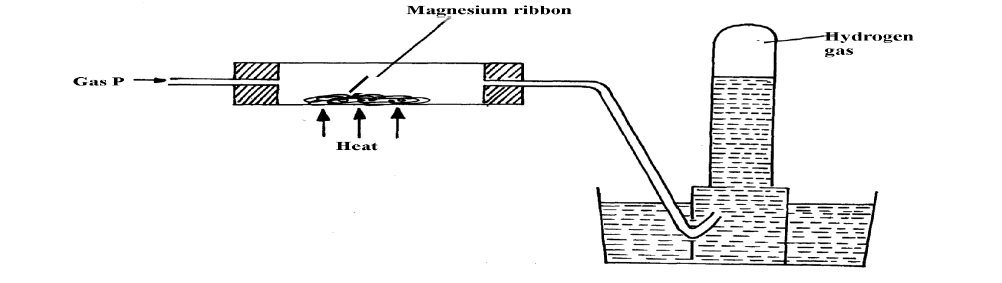 (i) Name gas P
(ii) Write an equation of the reaction that takes place in the combustion tube
(iii) State one precaution necessary at the end of this experiment
(i) Name gas P
(ii) Write an equation of the reaction that takes place in the combustion tube
(iii) State one precaution necessary at the end of this experiment
Date posted:
October 14, 2019
-
The setup below was used to investigate the reaction between metals and water.
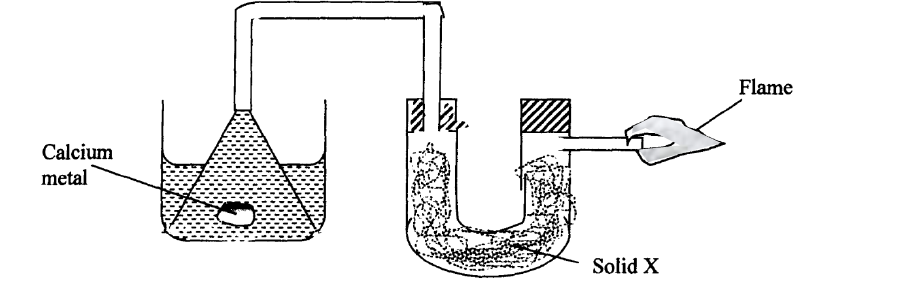 (a) Identify solid X and state its purpose
Solid X
Purpose
(b) Write a chemical equation for the reaction that produces the flame.
(a) Identify solid X and state its purpose
Solid X
Purpose
(b) Write a chemical equation for the reaction that produces the flame.
Date posted:
October 14, 2019
-
In an experiment, dry hydrogen gas was passed over hot copper (II) oxide in a combustion tube as shown in the diagram below:-
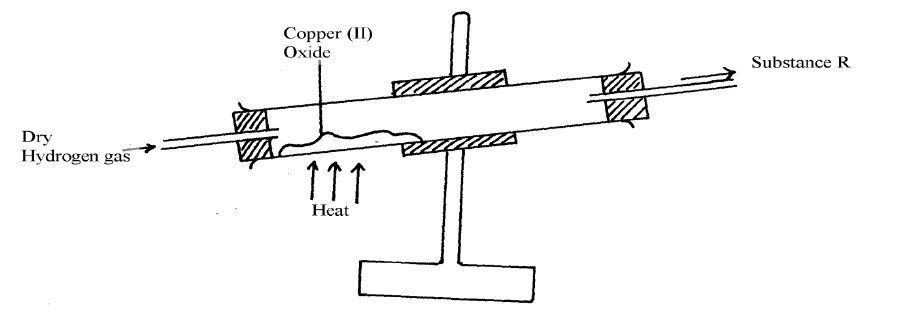 Complete the diagram to show how the other product, substance R could be collected in the laboratory.
Date posted:
October 14, 2019
-
When water reacts with potassium metal the hydrogen produced ignites explosively on the surface of water.
(i) What causes this ignition?
(ii) Write an equation to show how this ignition occurs
Date posted:
October 14, 2019
-
Hydrogen can reduce coppers Oxide but not aluminium oxide. Explain
Date posted:
October 14, 2019
-
Fe3O4 and FeO are oxides of iron which can be produced in the laboratory
(a) Write chemical equation for the reaction which can be used to produce each of the oxides
(b) Write an ionic equation for the reaction between the oxide, Fe3O4 and a dilute acid.
Date posted:
October 14, 2019
-
A piece of phosphorous was burnt in excess air. The product obtained was shaken with a small amount of hot water to make a solution
i) Write an equation for the burning of phosphorus in excess air
ii) The solution obtained above was found to have pH of 2. Give reasons for this observation
Date posted:
October 14, 2019
-
Given mass of gas T diffuses through a porous plug in 48 seconds while a similar mass of gas R diffuse in 70 seconds. Given that the density of gas T is 0.6g/cm3, find the density of gas R.
Date posted:
October 14, 2019
-
Element W has two isotopes W – 36 and W-40 which occur in the ratio x:4. Given that R.A.M of W is 37.25, find the value of x.
Date posted:
October 14, 2019
-
Few drops of hydrochloric acid were added into a test tube containing lead {II} Nitrate solution.
{a} State one observation made
{b} Write an ionic equation of the reaction that occurred in the test tube
Date posted:
October 14, 2019