-
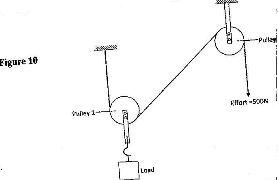
Figure 10 shows a pulley system used to raise a load by applying an effort of 500 N
 State the:
(i) Velocity ratio of the system.
(ii) Purpose of pulley 2.
(iii) Given that the machine has an efficiency of 80%, determine the maximum load that can be raised.
State the:
(i) Velocity ratio of the system.
(ii) Purpose of pulley 2.
(iii) Given that the machine has an efficiency of 80%, determine the maximum load that can be raised.
Date posted:
May 16, 2017
-
Figure 16 shows a screw jack whose screw has a pitch of 1 mm, and has a handle of 25 cm long.
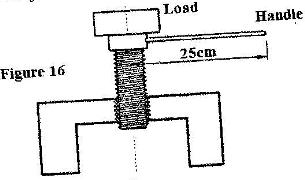 Determine the velocity ratio of the jack.
Date posted:
May 16, 2017
-
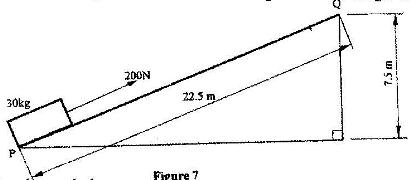
Figure 7 shows a mass of 30 kg being pulled from point P to point Q, with a force of 200 N parallel to an inclined plane. The distance between P and Q is 22.5 m. In being moved from P and Q the mass is raised through a vertical height of 7.5 m.
 Determine the work done:
(I) By the force;
(II) On the mass;
(III) To overcome friction.
Determine the work done:
(I) By the force;
(II) On the mass;
(III) To overcome friction.
Date posted:
May 16, 2017
-
Figure 5 shows two pulley systems being used to raise different loads. The pulleys are identical.
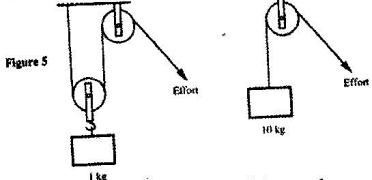 State one reason why system B may have a higher efficiency than system A.
Date posted:
May 16, 2017
-
Two identical spherical steel balls are released from the top of two tall jars containing liquids L1 and L2 respectively. Figure 3 shows the velocity-time graph of the motion of the balls.
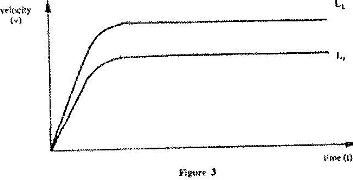 Explain the nature of the curves and state why they are different.
Date posted:
May 16, 2017
-
Figure 9 shows graph of velocity against time for a ball bearing released at the surface of viscous liquid.
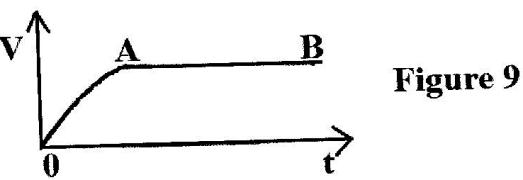 Explain the motion of the ball bearing for parts.
(i) OA
(ii) AB
Explain the motion of the ball bearing for parts.
(i) OA
(ii) AB
Date posted:
May 15, 2017
-
Figure 9 shows a velocity-time graph for the motion of a certain body.
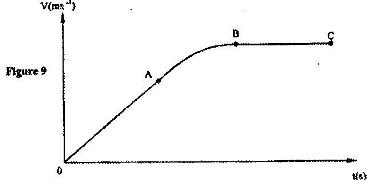 Describe the motion of the body in the region;
(i) OA; (ii) AB; (iii) BC;
Describe the motion of the body in the region;
(i) OA; (ii) AB; (iii) BC;
Date posted:
May 15, 2017
-
Figure 5 shows air flowing through a pipe of different cross-sectional areas. Two pipes A and B are dipped into water.
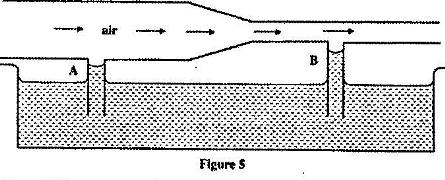 Explain the cause of the difference in the levels of water in the pipes A and B.
Date posted:
May 15, 2017
-
Figure 6 shows two inflated balloons hanging vertically on light threads.
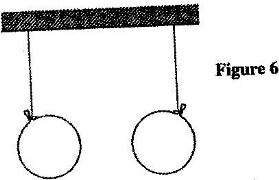 When a stream of air is blown in the space between the balloons, they are observed to move towards each other. Explain this observation
Date posted:
May 15, 2017
-
Figure 12 shows a displacement - time graph for a progressive wave
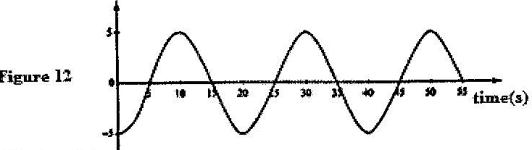 i) State the amplitude of the wave
ii) Determine the frequency of the wave.
i) State the amplitude of the wave
ii) Determine the frequency of the wave.
Date posted:
April 19, 2017
-
The three springs shown in figure 7 are identical and have negligible weight. The extension produced on the system of springs is 20 cm.
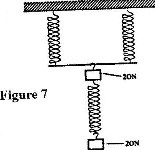 Determine the constant of each spring.
Date posted:
April 19, 2017
-
Figure 2 shows a spring balance. Its spring constant is 125Nm-1. The scale spreads over a distance of 20 cm.
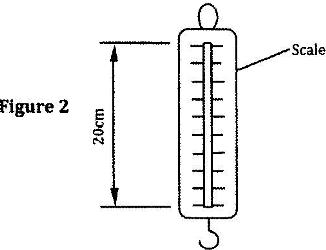 Determine the maximum weight that can be measured using the spring.
Date posted:
April 19, 2017
-
The three springs shown in Figure 5 are identical and have negligible weight. The extension produced on the system of springs is 20 cm.
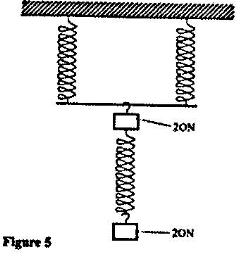 Determine the constant of each spring
Date posted:
April 19, 2017
-
The spiral spring shown in Figure 4 are identical. Each spring has a spring constant k = 300 N/m
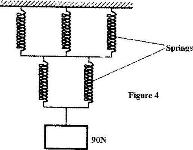 Determine the total extension caused by the 90 N weight. (Ignore the weight of the springs and connecting rods)
Date posted:
April 19, 2017
-
Figure 7 shows a simple electric bell circuit
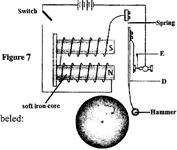 i) Name the parts labeled:
I) D
II) E
ii) When the switch is closed, the hammer hits the gong repeatedly. Explain why?
I) The hammer hits the gong.
II) The hammer hits the gong repeatedly
i) Name the parts labeled:
I) D
II) E
ii) When the switch is closed, the hammer hits the gong repeatedly. Explain why?
I) The hammer hits the gong.
II) The hammer hits the gong repeatedly
Date posted:
April 19, 2017
-
Figure 8 shows two parallel thick copper conductors connected to a d.c. power supply. A rider made from a thin copper wire is placed on the conductors
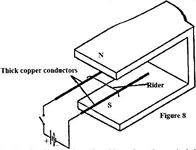 State and explain what is observed on the rider when the switch is closed.
Date posted:
April 19, 2017
-
In the set up in Fig. 5, the suspended metre rule in equilibrium balanced by the magnet and the weight shown. The iron core is fixed to the bench.
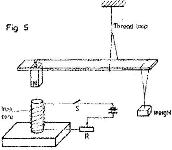 i) State and explain the effect on the metre rule when the switch S, is closed.
ii) What would be the effect of reversing the battery terminals?
iii) Suggest how the set up in figure 5 can be adapted to measure the current flowing in the current circuit.
i) State and explain the effect on the metre rule when the switch S, is closed.
ii) What would be the effect of reversing the battery terminals?
iii) Suggest how the set up in figure 5 can be adapted to measure the current flowing in the current circuit.
Date posted:
April 19, 2017
-
Figure 6 shows an athlete lifting weights while standing with the feet apart
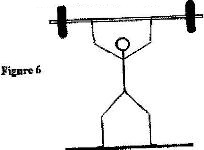 Explain why standing with the feet apart improves the athlete’s stability.
Date posted:
April 19, 2017
-
Figure 3 shows a uniform metre rule pivoted at the 30 cm mark. It is balanced by a weight of 2 N suspended at the 5 cm mark.
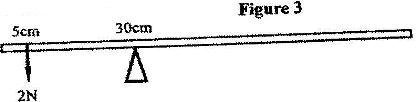 Determine the weight of the metre rule
Date posted:
April 19, 2017
-
Figure 5 shows a uniform bar of length 1.0 m pivoted near one end. The bar is kept in equilibrium by a spring balance as shown.
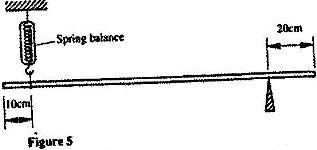 Given that the reading of the spring balance is 0.6 N, determine the weight of the bar
Date posted:
April 19, 2017
-
Figure 3 shows a rectangular block of wood with a hollow section (inside) at the position shown. The block is resting on a Horizontal bench
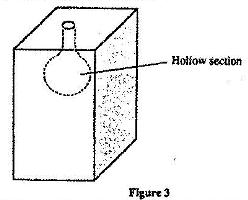 i) State the effect on the stability of the block when the hollow section is filled with water
ii) Explain your answer in (i) above.
i) State the effect on the stability of the block when the hollow section is filled with water
ii) Explain your answer in (i) above.
Date posted:
April 19, 2017
-
Figure 3 shows two identical trolleys with loads A and B. The loads are identical in shape and size
 Given that the density of A is greater than that of B, explain why the trolley in Figure 3 (ii) is more stable
Date posted:
April 19, 2017
-
Figure 3 shows two identical hollow spheres. Sphere A is completely filled with the liquid while B is partially filled with identical liquid.
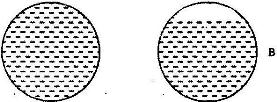 When the two spheres are rolled gently on a horizontal surface, it is observed that the sphere B stops earlier that the sphere A. Explain this observation.
Date posted:
April 18, 2017
-
Figure 2 shows a beaker placed on a bench. A block of ice is placed in the beaker as shown
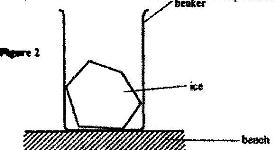 State and explain the change in the stability of the beaker when the ice melts
Date posted:
April 18, 2017
-
Figure 4 shows a uniform metal rod balanced at its centre by different forces.
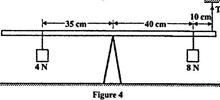 Determine the value of T.
Date posted:
April 18, 2017
-
Figure 5 shows a uniform rod 4 m and of mass 2 kg. It is pivoted 1 m from one end and balanced horizontally by a string attached near the other end
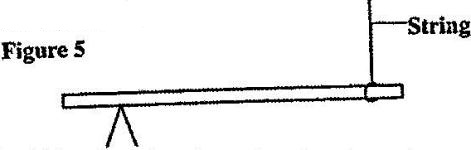 Determine the position where a mass of 5 kg should be placed on the rod so that the rod remains horizontally by a string attached near the other end.
Date posted:
April 18, 2017
-
Figure 9 shows a uniform bar in equilibrium under the action of two forces.
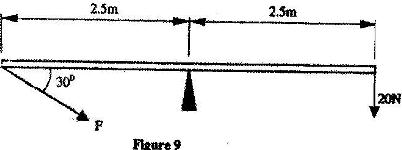 Determine the value of F.
Date posted:
April 18, 2017
-
Figure 4 shows a uniform metre rule of weight I N with two weights of 0.18 N and 0.12 N suspended from its ends.
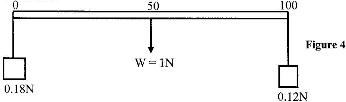 Determine how far from the 0.18 N weight a pivot should be placed in order to balance the meter rule
Date posted:
April 18, 2017
-
Figure 1 shows a vernier calipers being used to measure the internal diameter of a tube
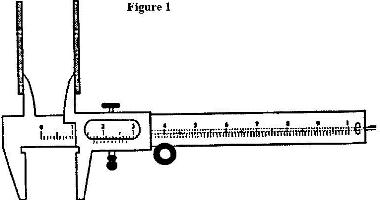 Record the diameter of the tube
Date posted:
April 18, 2017
-
Figure 3 shows part of an experimental set up for estimating the diameter of an oil molecule.
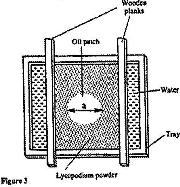 i) Describe how the oil patch is formed.
ii) Describe one method of determining the diameter of the oil drop
i) Describe how the oil patch is formed.
ii) Describe one method of determining the diameter of the oil drop
Date posted:
April 18, 2017