-
The treasurer of Watembezi Sports Club has presented the following information for the year ended 31 October 1998
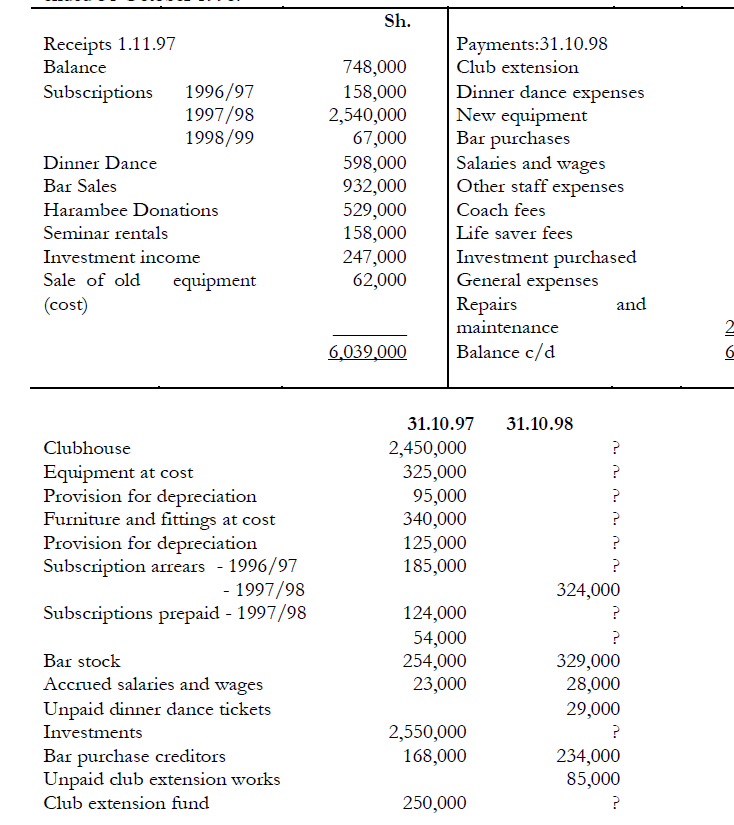 Notes:
1) The Harambee donations were for the extension of the club. The funds shall remain in this
account until the works, are completed when' the balance will be transferred to the
accumulated fund.
2) The depreciation on fixed assets is at 10% and 15% on cost on furniture and fittings; and
equipment respectively.
3) Equipment which had cost Sh.25,000 was sold on credit for Sh.14,000 to a member who
owed the club the money at the end of the year. The provision for depreciation on this
equipment was Sh.7,000. Another equipment sold for cash had an accumulated provision
for depreciation of Sh.19,000.
4) Audit fees of Sh.50,000 should be provided.
5) Subscription in arrears are written-off after 12 months.
Required:
a) Income and expenditure account for the year ended 31 October 1998
b) Balance as at 31 October 1998
Notes:
1) The Harambee donations were for the extension of the club. The funds shall remain in this
account until the works, are completed when' the balance will be transferred to the
accumulated fund.
2) The depreciation on fixed assets is at 10% and 15% on cost on furniture and fittings; and
equipment respectively.
3) Equipment which had cost Sh.25,000 was sold on credit for Sh.14,000 to a member who
owed the club the money at the end of the year. The provision for depreciation on this
equipment was Sh.7,000. Another equipment sold for cash had an accumulated provision
for depreciation of Sh.19,000.
4) Audit fees of Sh.50,000 should be provided.
5) Subscription in arrears are written-off after 12 months.
Required:
a) Income and expenditure account for the year ended 31 October 1998
b) Balance as at 31 October 1998
Date posted:
November 24, 2018
-
Reviewing the draft accounts of Uzee Ltd for the year ended 31 st December 2001 as prepared by the Chief Accountant, the Managing Director suggests that the written down value of plant is too low. To support his argument he produces the following schedule of plant on hand at 31 December 2001:
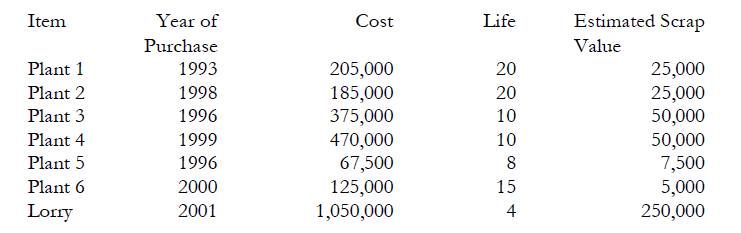 After discussing the matter the following policy is agreed:
1) Each item of plant to be depreciated on a straight line basis to its estimated scrap value over
its estimated life.
2) A full year's depreciation to be charged in the year of
purchase. On investigation you ascertain that:
There is no plant register.
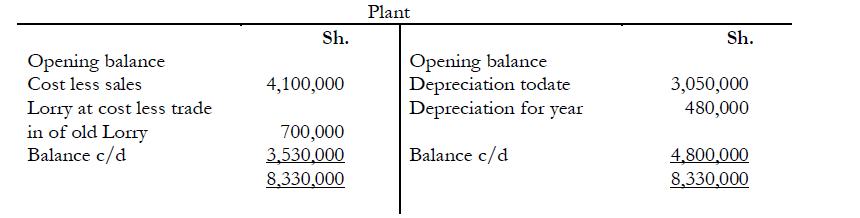
Plant which includes the lorry is shown in the accounts at cost less proceeds of sales.
3) For some years depreciation was charged at 15% on the reducing balance and then from 31st
December 1994 at 10% of cost less proceeds of sales on a straight line basis.
4) The Plant account for the year ended 31st December 2001 was:
After discussing the matter the following policy is agreed:
1) Each item of plant to be depreciated on a straight line basis to its estimated scrap value over
its estimated life.
2) A full year's depreciation to be charged in the year of
purchase. On investigation you ascertain that:
There is no plant register.
Plant which includes the lorry is shown in the accounts at cost less proceeds of sales.
3) For some years depreciation was charged at 15% on the reducing balance and then from 31st
December 1994 at 10% of cost less proceeds of sales on a straight line basis.
4) The Plant account for the year ended 31st December 2001 was:
 You are required to show, after implementing the new policy:
a) The Plant Account as it should appear in the books of the company for the year ended 31st
December 2001
b) The entries which should appear in the Balance Sheet as on 31st December 2001 and
c) A note explaining the effect on the profits on the change of depreciation policy.
You are required to show, after implementing the new policy:
a) The Plant Account as it should appear in the books of the company for the year ended 31st
December 2001
b) The entries which should appear in the Balance Sheet as on 31st December 2001 and
c) A note explaining the effect on the profits on the change of depreciation policy.
Date posted:
November 24, 2018
-
Juhudi Ltd. has two accounts "A" and "B" with different banks. On 31 March 1995 the cash
book showed a balance of Sh.200,000 in Account" A" and an overdraft of Sh. 90,000 in
account "B". However the bank statements obtained on the same day showed different
balances for the two accounts.
Further investigation reveals the following information: -
1. A deposit of Sh.60,000 made into account" A" on 1 March 1995 has been entered in
the cash book in account "B".
2. A withdrawal of Sh.20,000 from account" A" on 3 March 1995 has been debited in
the cash book in account "B".
3. Cheques of Sh.25,000 and Sh.30,000 deposited in account" A" on 9 March 1995 were
entered in the cash book in account"B". The second cheque has been dishonored by
the bankers. The entry for this dishonored cheque has been entered in the cash book
in account "B".
4. Cheques for Sh.40.000 and Sh.500.000 drawn on accounts" A" and "B" respectively
on 30 March 1995 were not paid by the banks until 5 April 1995.
5. Incidental charges of Sh.400 and Sh.1.000charged in the accounts" A" and "B"
respectively have not been entered in the cash book.
6. The bank has credited an interest of Sh.2.000 for account" A" and has debited bank
charges of Sh.1,500 to account "B". These transactions have not been entered in the
cash book.
7. Deposits of Sh.200,000 and Sh.140,000 made into the accounts" A" and "B"
respectively have not yet been credited by the bank.
8. Dividends amounting to Sh.8,000 had been paid direct to the bank in account "B".
9. A cheque for Sh.3.500 drawn on account" A" on 30 March 1995 in payment of an
electricity bill had been entered in the cash book as Sh.5,300.
Required:
i) The necessary adjustments in both cash books in order to correct the errors.
ii) Bank reconciliation statements for both cash books.
Date posted:
November 24, 2018
-
Define the term bank reconciliation statement and indicate its three main functions.
Date posted:
November 24, 2018
-
Explain four ways in which the use of historical cost accounting may cause users of financial statements to be misled when prices are rising.
Date posted:
November 24, 2018
-
Comparability is a characteristic which adds to the usefulness of financial statements.
Required:
(a) Explain what is meant by the term „comparability‟ in financial statements,
referring to two types of comparison that users of financial statements may make.
(b) Explain two ways in which the IAS (International Accounting Standards) aids the
comparability of financial information.
Date posted:
November 24, 2018
-
Explain briefly the terms prime cost and factory cost as used by manufacturing firms.
Date posted:
November 22, 2018
-
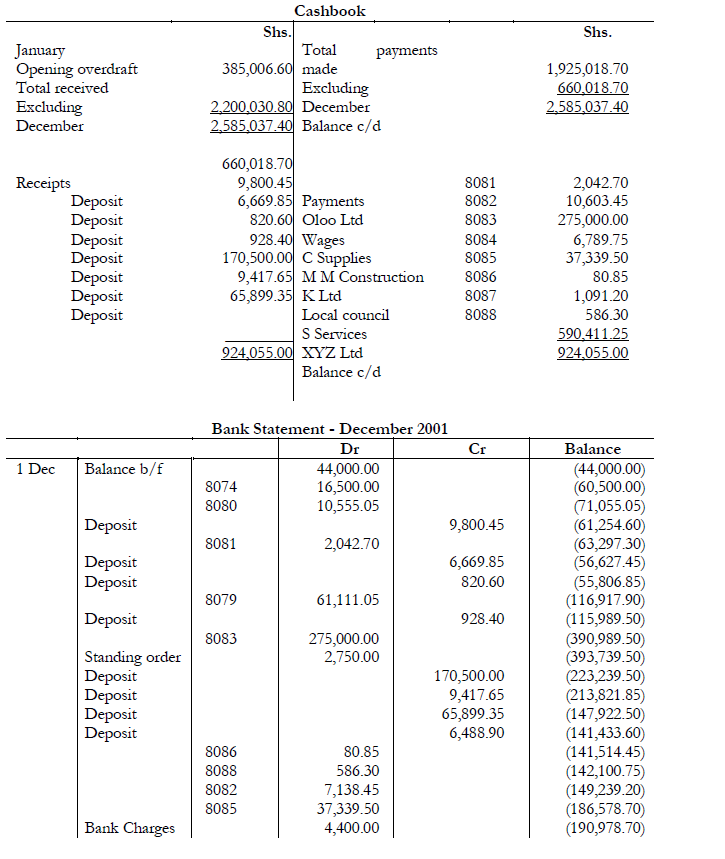
Sijui is having difficulty in preparing a bank reconciliation statement as at 31 December 2001.
He provides a summarized cashbook and a bank statement for the month of December as
shown below. Although the bank statement is correct his cashbook has several errors.
 Required:
a) Prepare a corrected cashbook
b) A bank reconciliation as at 31 December and
c) A brief explanation as to the likely cause of the remaining difference.
Required:
a) Prepare a corrected cashbook
b) A bank reconciliation as at 31 December and
c) A brief explanation as to the likely cause of the remaining difference.
Date posted:
November 21, 2018
-
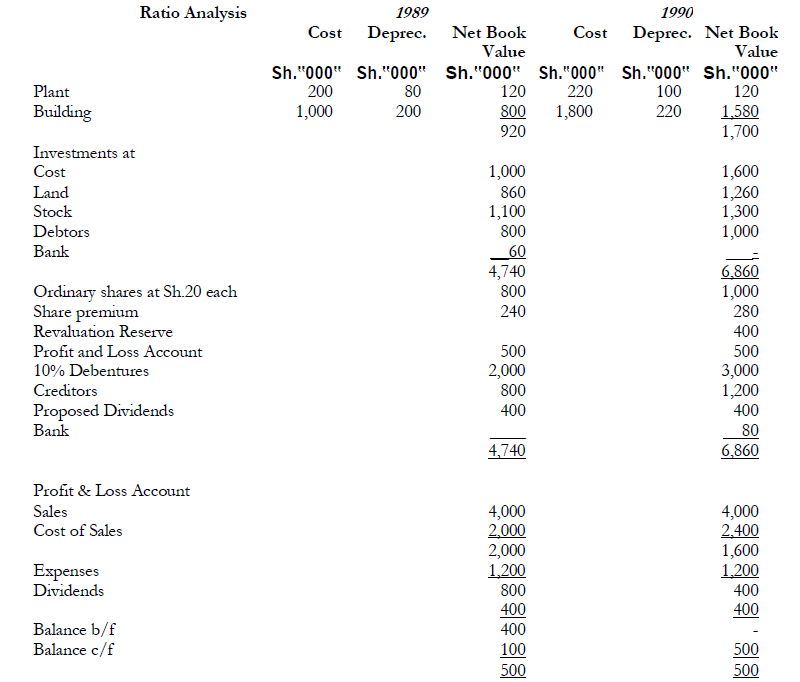 Calculate for Mvita Ltd. for 1989 and 1990 the following ratios:
Return on capital employed;
Debtors turnover;
Creditors turnover;
Current ratio;
Quick assets (acid test) ratio;
Gross profit percentage;
Net profit percentage;
Dividend cover;
Gearing ratio.
Using the summarised accounts given and ratios you have just prepared, comment on the
financial position and prospects of Mvita Ltd.
Calculate for Mvita Ltd. for 1989 and 1990 the following ratios:
Return on capital employed;
Debtors turnover;
Creditors turnover;
Current ratio;
Quick assets (acid test) ratio;
Gross profit percentage;
Net profit percentage;
Dividend cover;
Gearing ratio.
Using the summarised accounts given and ratios you have just prepared, comment on the
financial position and prospects of Mvita Ltd.
Date posted:
November 21, 2018
-
Kenya Caps Limited issued additional 100,000 ordinary shares and 50,000, 8% preference shares
on the following terms:
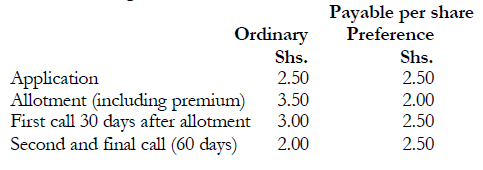 The par values were Sh.10 and Sh.9 for the ordinary and preference shares respectively. By 1
August 1993, applications had been received for 200,000 ordinary shares and 40,000 preference
shares. The directors rejected the application for 80,000 ordinary shares and refunded the
monies on 15 August 1993, and the remainder allotted five shares for every six shares applied
for. Surplus application monies were carried forward to allotment.
All allotment took place on 20 August 1993 and the due amounts were received by 31 August
1993. The first and second calls were received by the due dates except for 3,000 ordinary shares
which the directors declared forfeited on 20 November 1993. All the forfeited shares were
reissued as fully paid to another shareholder on 30 November 1993 for Sh.9 per share.
Assume that the number of shares outstanding prior to this additional issue amounted
to: Ordinary -300,000 shares of Sh.10 par
-50,000 7% preference shares of Sh.7 par
All these shares had been issued at par.
Required:
a) Journal entries including cash necessary to record the share transactions.
b) Prepare the share capital section of the Balance Sheet as at 31 December 1993.
c) What is the importance of issuing bonus shares?
The par values were Sh.10 and Sh.9 for the ordinary and preference shares respectively. By 1
August 1993, applications had been received for 200,000 ordinary shares and 40,000 preference
shares. The directors rejected the application for 80,000 ordinary shares and refunded the
monies on 15 August 1993, and the remainder allotted five shares for every six shares applied
for. Surplus application monies were carried forward to allotment.
All allotment took place on 20 August 1993 and the due amounts were received by 31 August
1993. The first and second calls were received by the due dates except for 3,000 ordinary shares
which the directors declared forfeited on 20 November 1993. All the forfeited shares were
reissued as fully paid to another shareholder on 30 November 1993 for Sh.9 per share.
Assume that the number of shares outstanding prior to this additional issue amounted
to: Ordinary -300,000 shares of Sh.10 par
-50,000 7% preference shares of Sh.7 par
All these shares had been issued at par.
Required:
a) Journal entries including cash necessary to record the share transactions.
b) Prepare the share capital section of the Balance Sheet as at 31 December 1993.
c) What is the importance of issuing bonus shares?
Date posted:
November 21, 2018
-
John and Dan are partners who run a wholesale shop. They share profits and losses equally. The accountant has provided a draft balance sheet as shown below:
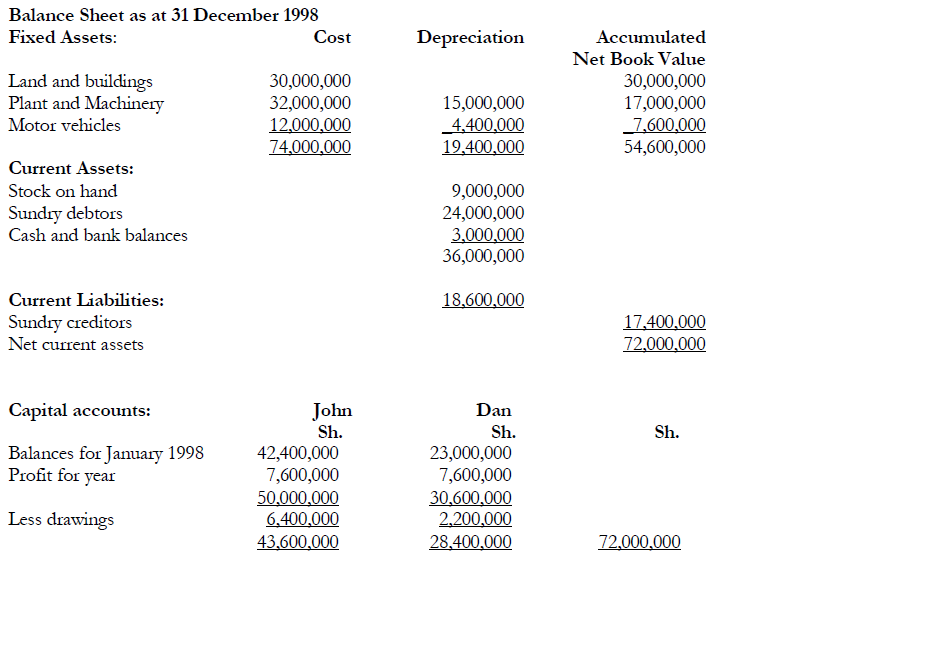 From your examination of the books, you find that adjustments to the accounts are necessary in
respect of the following:
1) Sales included goods valued at Sh.700,000 which had been taken by Dan for his own
private use and debited to him in an account opened in the sales ledger. This is to be
treated as drawings.
2) The bills for electricity amounting to Sh.446,000 had not been paid.
3) A cheque for Sh.100,000 received from a debtor on 29 December 1998 had been put in the
drawer by the cashier and forgotten.
4) The amount for sundry debtors is shown net of a provision for doubtful debts of
Sh.600,000. The provision includes a bad debt of Sh.120,000. The revised provision for
doubtful debts was agreed at Sh.560,000.
5) A stock valued at Sh.3,300,000 was considered to have a net realizable value of
Sh.3,000,000. Some items of the stock for Sh.480,000 were not included in Sh.3,300,000.
6) Trade licenses for Sh.344,000 paid during the year had been charged to the profit and loss
account yet it will not expire until 31 March 1999.
7) Plant and machinery is considered to have a written down value of Sh.16,800,000.
8) During the year a building which cost Sh.5,800,000 was sold for Sh.5,600,000 and the
amount credited to freehold premises.
A cheque for Sh.406,000 received from a debtor and paid into the bank on 13 December 1998
had been returned on 31 December 1998 marked "refer to drawer". No entries were made in
the books of account.
Required:
a) A statement showing the correct adjustments and the adjusted profit for the year ended 31
December 1998.
b) A revised balance sheet as at 31 December 1998.
From your examination of the books, you find that adjustments to the accounts are necessary in
respect of the following:
1) Sales included goods valued at Sh.700,000 which had been taken by Dan for his own
private use and debited to him in an account opened in the sales ledger. This is to be
treated as drawings.
2) The bills for electricity amounting to Sh.446,000 had not been paid.
3) A cheque for Sh.100,000 received from a debtor on 29 December 1998 had been put in the
drawer by the cashier and forgotten.
4) The amount for sundry debtors is shown net of a provision for doubtful debts of
Sh.600,000. The provision includes a bad debt of Sh.120,000. The revised provision for
doubtful debts was agreed at Sh.560,000.
5) A stock valued at Sh.3,300,000 was considered to have a net realizable value of
Sh.3,000,000. Some items of the stock for Sh.480,000 were not included in Sh.3,300,000.
6) Trade licenses for Sh.344,000 paid during the year had been charged to the profit and loss
account yet it will not expire until 31 March 1999.
7) Plant and machinery is considered to have a written down value of Sh.16,800,000.
8) During the year a building which cost Sh.5,800,000 was sold for Sh.5,600,000 and the
amount credited to freehold premises.
A cheque for Sh.406,000 received from a debtor and paid into the bank on 13 December 1998
had been returned on 31 December 1998 marked "refer to drawer". No entries were made in
the books of account.
Required:
a) A statement showing the correct adjustments and the adjusted profit for the year ended 31
December 1998.
b) A revised balance sheet as at 31 December 1998.
Date posted:
November 21, 2018
-
The term "reserves" is frequently found in company balance sheets
Required:
(i) Explain the meaning of „reserves‟ in this context;
(ii) Give two examples of reserves and explain how each of your examples comes into existence.
Date posted:
November 21, 2018
-
List and briefly explain three ways in which the use of historical cost accounting may cause financial statements to be misleading.
Date posted:
November 21, 2018
-
Otter, a limited liability company, operates a computerised accounting system for its accounts
receivable and accounts payable ledgers. The control accounts for the month of September 1999
are in balance and incorporate the following totals:
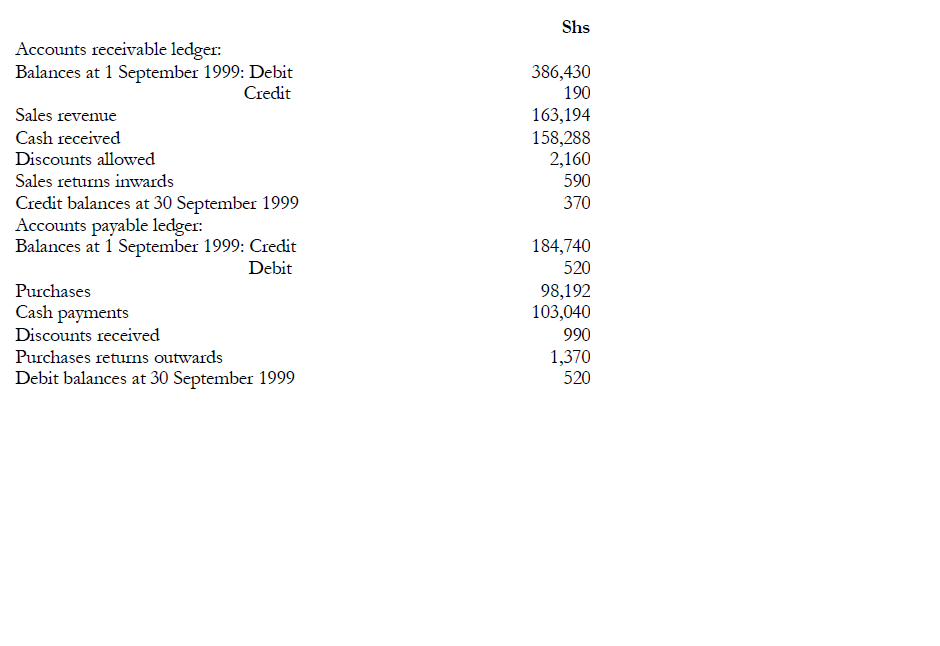 Although the control accounts agree with the underlying ledgers, a number of errors have been
found, and there are also several adjustments to be made. These errors and adjustments are
detailed below:
(1) Four sales invoices totalling Shs 1,386 have been omitted from the records;
(2) A cash refund of Shs 350 paid to a customer, A Smith, was mistakenly treated as a
payment to a supplier with the same name;
(3) A contra settlement offsetting a balance of Shs 870 due to a supplier against the
accounts receivable ledger account for the same company is to be made;
(4) Bad debts totalling Shs1,360 are to be written off;
(5) During the month, settlement was reached with a supplier over a disputed account. As a
result, the supplier issued a credit note for Shs 2,000 on September 26. No entry has yet
been made for this;
(6) A purchases invoice for Shs 1,395 was keyed in as Shs 1,359;
(7) A payment of Shs 2,130 to a supplier, B Jones, was mistakenly entered to the account
of R Jones;
(8) A debit balance of Shs 420 existed in the accounts payable ledger at the end of August
1999. The supplier concerned cannot now be traced and it has been decided to write off
this balance.
Required:
Prepare the accounts receivable and accounts payable ledger control accounts as they should
appear after allowing, where necessary, for the errors and adjustments listed.
Although the control accounts agree with the underlying ledgers, a number of errors have been
found, and there are also several adjustments to be made. These errors and adjustments are
detailed below:
(1) Four sales invoices totalling Shs 1,386 have been omitted from the records;
(2) A cash refund of Shs 350 paid to a customer, A Smith, was mistakenly treated as a
payment to a supplier with the same name;
(3) A contra settlement offsetting a balance of Shs 870 due to a supplier against the
accounts receivable ledger account for the same company is to be made;
(4) Bad debts totalling Shs1,360 are to be written off;
(5) During the month, settlement was reached with a supplier over a disputed account. As a
result, the supplier issued a credit note for Shs 2,000 on September 26. No entry has yet
been made for this;
(6) A purchases invoice for Shs 1,395 was keyed in as Shs 1,359;
(7) A payment of Shs 2,130 to a supplier, B Jones, was mistakenly entered to the account
of R Jones;
(8) A debit balance of Shs 420 existed in the accounts payable ledger at the end of August
1999. The supplier concerned cannot now be traced and it has been decided to write off
this balance.
Required:
Prepare the accounts receivable and accounts payable ledger control accounts as they should
appear after allowing, where necessary, for the errors and adjustments listed.
Date posted:
November 20, 2018
-
Atok, a limited liability company, compiles its financial statements to 30 June annually. At 30
June 1999, the company's list of account balances was as follows:
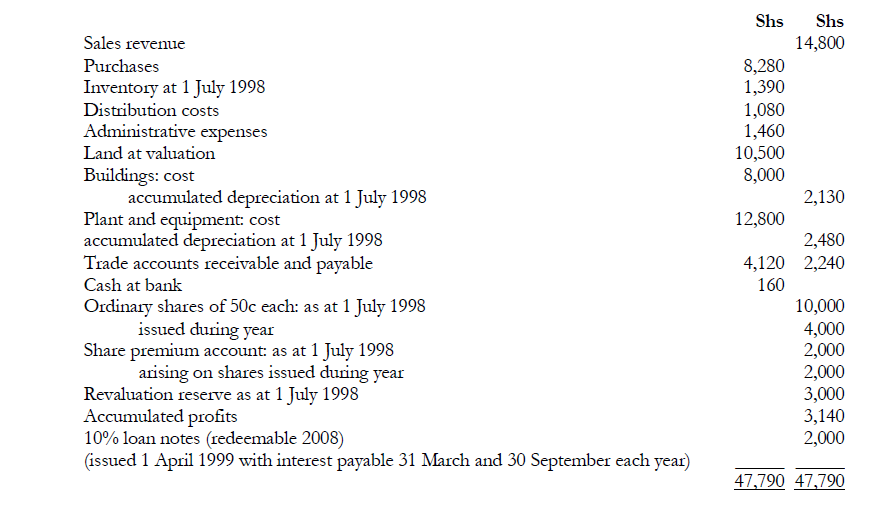 The following matters remain to be adjusted for in preparing the financial statements for
the year ended 30 June 1999:
(1) Inventory at 30 June 1999 amounted to Shs 1,560,000 at cost. A review of
inventory items revealed the need for some adjustments for two inventory lines:
(i) Items which had cost Shs 80,000 and which would normally sell for Shs 120,000
were found to have deteriorated. Remedial work costing Shs 20,000 would be needed
to enable the items to be sold for Shs 90,000.
(ii) Some items sent to customers on sale or return terms had been omitted from inventory
and included as sales in June 1999. The cost of these items was Shs 16,000 and they
were included in sales at Shs 24,000. In July 1999, the items were returned in good
condition by the customers.
(2) Depreciation is to be provided as follows:
Buildings: 2% per year on cost.
Plant and equipment: 20% per year on cost.
80% of the depreciation is to be charged in cost of sales, and
10% each in distribution costs and administrative expenses.
(3) The land is to be revalued to Shs 12,000,000. No change was required to the value
of the buildings.
(4) Accrued expenses and prepayments were:
The following matters remain to be adjusted for in preparing the financial statements for
the year ended 30 June 1999:
(1) Inventory at 30 June 1999 amounted to Shs 1,560,000 at cost. A review of
inventory items revealed the need for some adjustments for two inventory lines:
(i) Items which had cost Shs 80,000 and which would normally sell for Shs 120,000
were found to have deteriorated. Remedial work costing Shs 20,000 would be needed
to enable the items to be sold for Shs 90,000.
(ii) Some items sent to customers on sale or return terms had been omitted from inventory
and included as sales in June 1999. The cost of these items was Shs 16,000 and they
were included in sales at Shs 24,000. In July 1999, the items were returned in good
condition by the customers.
(2) Depreciation is to be provided as follows:
Buildings: 2% per year on cost.
Plant and equipment: 20% per year on cost.
80% of the depreciation is to be charged in cost of sales, and
10% each in distribution costs and administrative expenses.
(3) The land is to be revalued to Shs 12,000,000. No change was required to the value
of the buildings.
(4) Accrued expenses and prepayments were:
 (5) No dividends were paid during the year and no dividend is proposed for the year.
Required:
(a) Prepare the company's income statement for the year ended 30 June 1999 and balance
sheet as at that date for publication, complying as far as possible with the provisions of IAS1
Presentation of Financial Statements and other relevant International Accounting Standards.
(b) Prepare the statement of changes in equity as presented in IAS1. Notes to the financial
statements are not required.
(5) No dividends were paid during the year and no dividend is proposed for the year.
Required:
(a) Prepare the company's income statement for the year ended 30 June 1999 and balance
sheet as at that date for publication, complying as far as possible with the provisions of IAS1
Presentation of Financial Statements and other relevant International Accounting Standards.
(b) Prepare the statement of changes in equity as presented in IAS1. Notes to the financial
statements are not required.
Date posted:
November 20, 2018
-
Anne, Charlotte and Emily have been in partnership for some years, sharing profits in the ratio
50.30.20 and preparing their financial statements to 31 December each year.
On 30 June 1998 Anne retired and Charlotte and Emily decided to continue the partnership
sharing profits equally.
The partnership list of account balances at 31 December 1998, before making any adjustments
for Anne's retirement or for the asset revaluation was as follows.
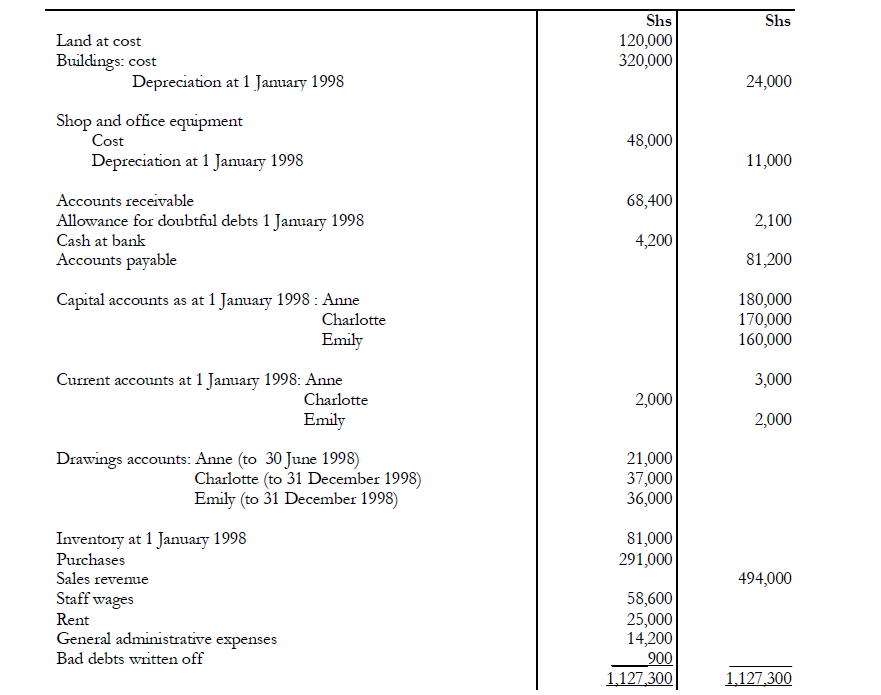 Notes
(1) Profits are to be assumed to accrue equally in the periods before and after
Anne's retirement
(2) The balance due to Anne is to remain in the partnership from 1 July 1998 as a loan
carrying no interest until 1 January
(3) The value of the partnership goodwill at 30 June 1998 was agreed by all three partners at
Shs 200,000. Goodwill is not to appear in the balance sheet after the adjustments
necessary at 30 June 1998.
(4) It was decided, as part of the process of valuing Anne's share of the
partnership, to revalue the land at 30 June from Shs 120,000 to Shs 160,000. The
increased value is to be included in the balance sheet.
(5) The inventory at 31 December 1998 was Shs 90,000
(6) Accruals and prepayments at 31 December 1998 were:
Rent paid in advance to 31 March 1999 Shs 5,000
General administrative expenses:
Prepayments Shs 1,800
Accruals Shs 6,200
(7) The allowance for doubtful debts is to be increased to Shs 2,400
(8) Depreciation is to be provided as follows:
Buildings 2 % per annum straight line
Shop and office equipment 15 % per annum straight line
Required:
(a) Prepare the income statement and a statement showing the division of the profit for the
year ended 31 December 1998 and balance sheet as at that date;
(b) Show the partners' capital and current accounts for the year Anne‟s loan account
Notes
(1) Profits are to be assumed to accrue equally in the periods before and after
Anne's retirement
(2) The balance due to Anne is to remain in the partnership from 1 July 1998 as a loan
carrying no interest until 1 January
(3) The value of the partnership goodwill at 30 June 1998 was agreed by all three partners at
Shs 200,000. Goodwill is not to appear in the balance sheet after the adjustments
necessary at 30 June 1998.
(4) It was decided, as part of the process of valuing Anne's share of the
partnership, to revalue the land at 30 June from Shs 120,000 to Shs 160,000. The
increased value is to be included in the balance sheet.
(5) The inventory at 31 December 1998 was Shs 90,000
(6) Accruals and prepayments at 31 December 1998 were:
Rent paid in advance to 31 March 1999 Shs 5,000
General administrative expenses:
Prepayments Shs 1,800
Accruals Shs 6,200
(7) The allowance for doubtful debts is to be increased to Shs 2,400
(8) Depreciation is to be provided as follows:
Buildings 2 % per annum straight line
Shop and office equipment 15 % per annum straight line
Required:
(a) Prepare the income statement and a statement showing the division of the profit for the
year ended 31 December 1998 and balance sheet as at that date;
(b) Show the partners' capital and current accounts for the year Anne‟s loan account
Date posted:
November 20, 2018
-
After preparation of the trial balance or Bakari Brothers Enterprises as at 31 September 2005, the firm's accountant has been provided with the following additional information for the purpose of preparation of the final accounts:
1 Due to an oversight, discount has been allowed to a credit customer on the gross `
invoiced amount of Sh.80,000 at the rate 10%. The firm should have used a rate if 6%.
2 Electricity accrued amounts to Sh.36,710 while insurance premiums of Sh. 22,450 have
been prepaid.
3 In October 2005, the employees of the firm received a general salary increase,
backdated to 1 July 2005. Amounts totaling Sh.126,550 in salary arrears are payable to
former employees who left shortly before the salary award was announced and who
have not yet been traced. It has been decided that the salary packets will be opened and
the cash banked until the ex-employees are traced.
4 Wages due to casuals amounting to Sh. 464,120 for services rendered in the last week of
December 2005 were paid in January 2006 together with the salaries for the month of
December 2005 which amounted to Sh.301,700.
5 During the year, the exterior of the warehouse was repaired and repainted at a cost of
Sh.500,000. This"
amount was erroneously debited to office premises account. It is policy of Bakari
Brothers Enterprises to provide for depreciation on the closing balances of non-current
assets and this has already been done. The annual rate of depreciation on office
premises is 2% calculated on the straight-line basis.
6 In December 2005 2005, Bakari Brothers Enterprises had bought goods on credit from
CB Ltd. for Sh. 452,100 and has also sold goods on credit to the same company for
Sh.163,040. These amounts were correctly posted to their respective accounts.
However, these accounts are to be offset as at 31 December 2005 and the remaining
balance settled by cheque in January 2006.
7 The provision for discounts allowed to debtors, which at present has a balance of
Sh.229,530 needs to be reduced to Sh. 157,400.
8 Debts totaling Sh.64,800 are irrecoverable and should be written off. However, amount
of Sh.21,440
written off as a bad debt in the previous year has now been recovered in full but the
cheque in settlement has not been banked or posted in the accounts.
Required:
Journal entries, including narrations, necessary to record the above transactions in the books of
Bakari Bothers Enterprises.
Date posted:
November 20, 2018
-
Outline the extent to which a trial balance is an indicator of correct book-keeping by an entity.
Date posted:
November 20, 2018
-
Grace and Beatrice were operating a retail business sharing profits and losses in the ratio of 2:1
respectively up to 31 March 2006 when they admitted Catherine to the partnership. The partners
allowed payment of interest on partners' fixed capital accounts but did not allow for interest on
partners' current accounts.
The following balances were extracted from the partnership's book of account as at 30 September 2006:
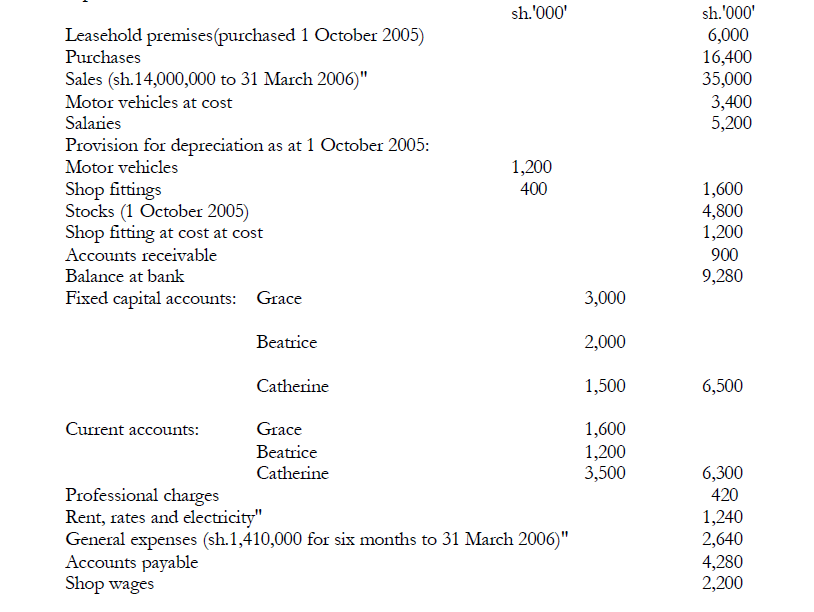 Additional information:
1. On 31 March 2006 when Catherine was admitted as a partner, the profit sharing ratio
changed to Grace 2/5, Beatrice 2/5 and Catherine 1/5. For the purpose of admission,
goodwill was valued at Sh. 12,000,000 and was written off the books immediately. On 1
April 2006, Catherine paid Sh.5,000,000 which comprised her fixed capital of
sh.1,500,000 and her current account contribution of sh.3,500,000."
2. The partners also agreed that any apportionment of gross profit was to be made on the
basis of sales. The apportionment of expenses, unless otherwise indicated, were to be
on time basis.
3. On 30 September 2006, stock was valued at Sh.5,100,000.
4. Provision was to be made for depreciation on motor vehicles and shop fittings at the
rate of 20% and 5% per annum respectively, based on cost.
5 Salaries included the following partners drawings during the year:
Grace - Sh.600,000
Beatrice - Sh.480,000
Catherine - "Sh.250,000"
6 At 30 September 2006, rates paid in advance amounted to sh.260,000 while electricity
accrued amounted to sh.60,000.
7 A difference in the books of sh.120,000 that had been written off to general expenses as
at 30 September 2006 was later found to have been due to the following errors:
- Sales returns of sh.180,000 had been debited to sales but was omitted from the
- customers account.
- The purchase journal had been undercast by sh.200,000.
8 Doubtful debts (for which full provision was required) as at 31 March 2006 amounted
to Sh.120,000 and sh.160,000 as at 30 September 2006.
9 Professional charges included sh.200,000 paid in respect to the acquisition of leasehold
premises. These fees are to be capitalized as part of the lease, the total cost of which was
to be depreciated in 25 equal annual installments. Other premises owned by Beatrice
were leased to the partnership at Sh. 600,000 per annum but no rent had been paid or
credited to her for the year to 30 September 2006.
Required:
(a) Income statement for the year ended 30 September
2006.
(b) Balance sheet as at 30 September 2006.
(c ) Partners' current accounts.
Additional information:
1. On 31 March 2006 when Catherine was admitted as a partner, the profit sharing ratio
changed to Grace 2/5, Beatrice 2/5 and Catherine 1/5. For the purpose of admission,
goodwill was valued at Sh. 12,000,000 and was written off the books immediately. On 1
April 2006, Catherine paid Sh.5,000,000 which comprised her fixed capital of
sh.1,500,000 and her current account contribution of sh.3,500,000."
2. The partners also agreed that any apportionment of gross profit was to be made on the
basis of sales. The apportionment of expenses, unless otherwise indicated, were to be
on time basis.
3. On 30 September 2006, stock was valued at Sh.5,100,000.
4. Provision was to be made for depreciation on motor vehicles and shop fittings at the
rate of 20% and 5% per annum respectively, based on cost.
5 Salaries included the following partners drawings during the year:
Grace - Sh.600,000
Beatrice - Sh.480,000
Catherine - "Sh.250,000"
6 At 30 September 2006, rates paid in advance amounted to sh.260,000 while electricity
accrued amounted to sh.60,000.
7 A difference in the books of sh.120,000 that had been written off to general expenses as
at 30 September 2006 was later found to have been due to the following errors:
- Sales returns of sh.180,000 had been debited to sales but was omitted from the
- customers account.
- The purchase journal had been undercast by sh.200,000.
8 Doubtful debts (for which full provision was required) as at 31 March 2006 amounted
to Sh.120,000 and sh.160,000 as at 30 September 2006.
9 Professional charges included sh.200,000 paid in respect to the acquisition of leasehold
premises. These fees are to be capitalized as part of the lease, the total cost of which was
to be depreciated in 25 equal annual installments. Other premises owned by Beatrice
were leased to the partnership at Sh. 600,000 per annum but no rent had been paid or
credited to her for the year to 30 September 2006.
Required:
(a) Income statement for the year ended 30 September
2006.
(b) Balance sheet as at 30 September 2006.
(c ) Partners' current accounts.
Date posted:
November 20, 2018
-
State any two circumstances that may hinder a firm from improving on the usefulness of its financial statements.
Date posted:
November 20, 2018
-
Akili, Busara and Chema are in partnership sharing profits sharing profits and losses equally after allowing for interest on capital at 5% per annum to the partners and a salary to Busara of Sh.20,000 per month.
The trial balance of the partnership as at 30 April 2006 was as follows:
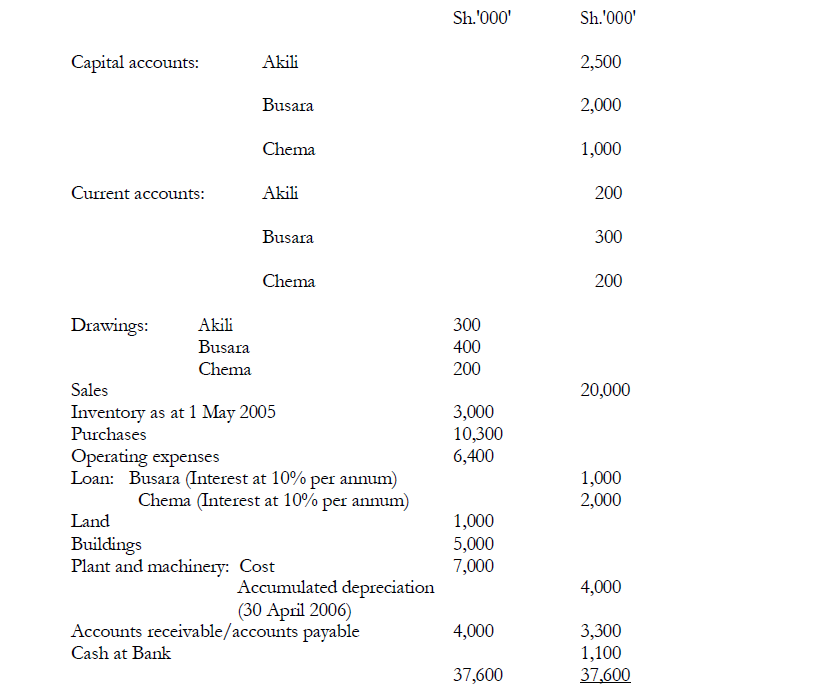 Additional Information
1. Closing inventory as at 30 April was valued at sh.2,400,000.
2. Interest on loans had not been paid.
3. Sales include credit sales of Sh.600,000 in respect of two items sold on the basis of
confirmation by the customers. The items had cost Sh.100,000 each. As at 30 April
2006, the customers had not confirmed whether they would buy the goods.
4. On 1 November 2005, the terms of th epartnership agreement were changed. The new
terms provided for:
- Profit sharing ratio of 5:3:2 for Askili, Busara and Chema respectively.
- Interest on capital at 5% per annum.
- Salaries of Sh.10,000 per month to Busara and Chema.
For the purpose of the change, goodwill was valued at Sh.1,200,000 and was to be written
off immediately while the land buildings were valued at Sh.2,000,000 and Sh.6,400,000
respectively.
Required:
a) Trading, Profit and loss and appropriation accounts for the year ended 30 April 2006
b) Partners' capital and current accounts
c) Balance sheet as at 30 April 2006
Additional Information
1. Closing inventory as at 30 April was valued at sh.2,400,000.
2. Interest on loans had not been paid.
3. Sales include credit sales of Sh.600,000 in respect of two items sold on the basis of
confirmation by the customers. The items had cost Sh.100,000 each. As at 30 April
2006, the customers had not confirmed whether they would buy the goods.
4. On 1 November 2005, the terms of th epartnership agreement were changed. The new
terms provided for:
- Profit sharing ratio of 5:3:2 for Askili, Busara and Chema respectively.
- Interest on capital at 5% per annum.
- Salaries of Sh.10,000 per month to Busara and Chema.
For the purpose of the change, goodwill was valued at Sh.1,200,000 and was to be written
off immediately while the land buildings were valued at Sh.2,000,000 and Sh.6,400,000
respectively.
Required:
a) Trading, Profit and loss and appropriation accounts for the year ended 30 April 2006
b) Partners' capital and current accounts
c) Balance sheet as at 30 April 2006
Date posted:
November 20, 2018
-
Briefly explain why goodwill should be paid under the following circumstances: (i) By a partner on admission to a partnership. (ii) To a partner on retirement from a partnership
Date posted:
November 20, 2018
-
Ben Mogaka prepared the following draft balance sheet for BM Enterprises as at 31 December 2005:
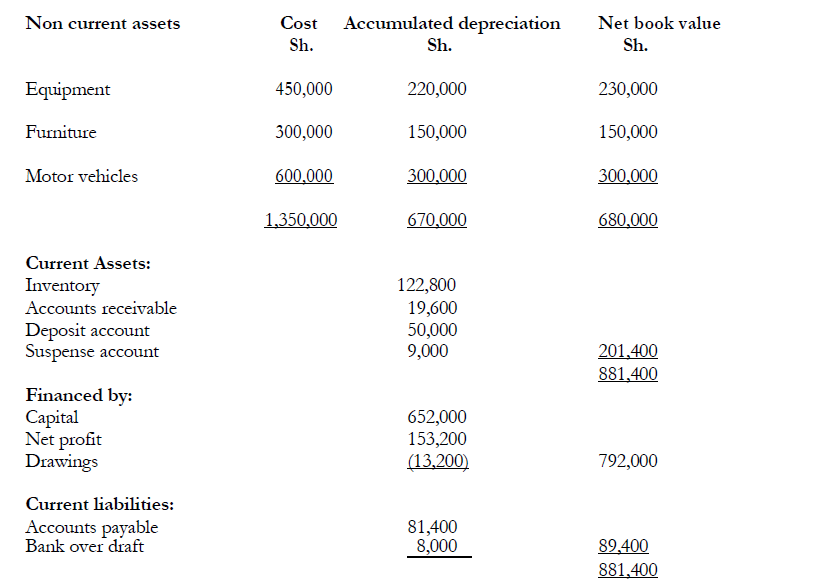 Additional information:
On further investigation, the suspense account was discovered to have resulted from the
following errors:
1. The sales of goods on credit to Alex Otis amounting to Sh.19,000 had been recorded in
the sales journal as sh.9,000.
2. A receipt of Sh.20,000 from sale of an item of equipment had been credited to sales
account. The equipment was shown in the books of account at costs of account of
Sh.90,000 and accumulated depreciation of Sh.72,000.
3. A credit note from a supplier, Simon Masound for Sh.15,000 had been omitted from the
books.
4. A bank overdraft for Sh.7,000 reflected in the cash book as at 31 December 2005 was
omitted In the trial balance.
5. A payment of Sh. 9,700 to Tom Wambugu, a creditor, was correctly entered in the cahs
book but posted to his personal account as Sh.7,900.
6. The debit side of rent expense account had been undercast by Sh.1,000.
7. A provision of Sh.2,000 for sundry expenses outstanding as at 31 December 2004 and
debited to sundry expenses at that dated had not been brought forward to the credit of
the account in the following period. No credit entry had been made in any other
account in respect to this account in respect to this item.
8. Discount received from the supplier of Sh.8,200 had been entered on the wrong side of
purchases ledger control account.
9. On 31 December, goods valued at Sh.9,600 (selling price) were returned by Jane Kerubo
(a debtor). No entry had been made in the books to reflect this transaction. These goods
were not included in the closing stock.
10. Discounts allowed were overcast by Sh.1,200.
Required:
(a) Journal entries to correct the above errors (Narration not required)
(b) Suspense account.
(c) Statement of corrected net profit for the year ended 31 December 2005
(d) Corrected balance sheet as 31 December 2005.
Additional information:
On further investigation, the suspense account was discovered to have resulted from the
following errors:
1. The sales of goods on credit to Alex Otis amounting to Sh.19,000 had been recorded in
the sales journal as sh.9,000.
2. A receipt of Sh.20,000 from sale of an item of equipment had been credited to sales
account. The equipment was shown in the books of account at costs of account of
Sh.90,000 and accumulated depreciation of Sh.72,000.
3. A credit note from a supplier, Simon Masound for Sh.15,000 had been omitted from the
books.
4. A bank overdraft for Sh.7,000 reflected in the cash book as at 31 December 2005 was
omitted In the trial balance.
5. A payment of Sh. 9,700 to Tom Wambugu, a creditor, was correctly entered in the cahs
book but posted to his personal account as Sh.7,900.
6. The debit side of rent expense account had been undercast by Sh.1,000.
7. A provision of Sh.2,000 for sundry expenses outstanding as at 31 December 2004 and
debited to sundry expenses at that dated had not been brought forward to the credit of
the account in the following period. No credit entry had been made in any other
account in respect to this account in respect to this item.
8. Discount received from the supplier of Sh.8,200 had been entered on the wrong side of
purchases ledger control account.
9. On 31 December, goods valued at Sh.9,600 (selling price) were returned by Jane Kerubo
(a debtor). No entry had been made in the books to reflect this transaction. These goods
were not included in the closing stock.
10. Discounts allowed were overcast by Sh.1,200.
Required:
(a) Journal entries to correct the above errors (Narration not required)
(b) Suspense account.
(c) Statement of corrected net profit for the year ended 31 December 2005
(d) Corrected balance sheet as 31 December 2005.
Date posted:
November 20, 2018
-
Umoja Women's Welfare Society sells water tanks at subsidised prices to its members and the
general public. The members' contributions are used to meet the cost of manufacturing the
water tanks.
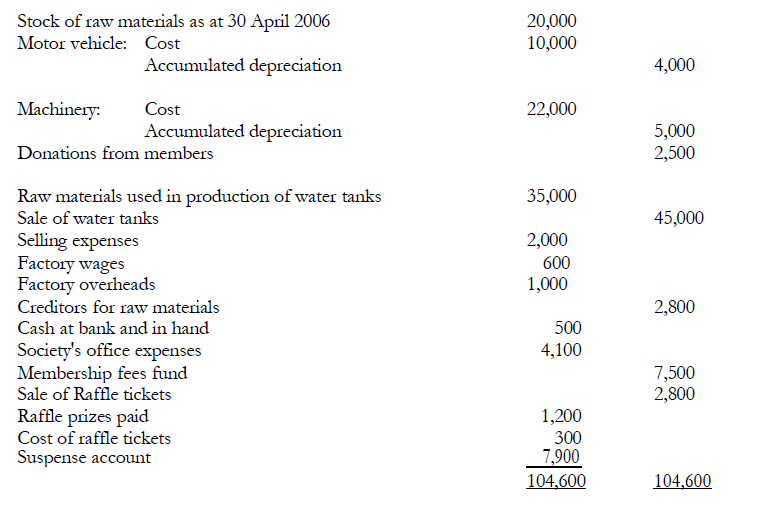
The trial balance extracted from the books of account of the society as at 30 April 2006 was as
follows:

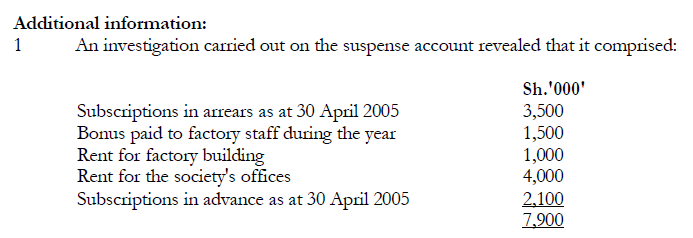 2 Annual subscriptions in arrears as at 30 April 2006 amounted to Sh.2,000,000 while
subscriptions received in advance as at 30 April 2006 amounted to sh.1,500,000.
3 The membership fee is levied every ten years. The membership fees attributable to the
year ended 30 April 2006 amounted to sh.800,000
4 Accrued society's office expenses as at 30 April 2006 amounted Sh.400,000.
5 The motor vehicle usage should be apportioned to the factory and society's offices at
80% and 20% respectively. Depreciation should be provided on cost at 5% per annum
on machinery and 10% per annum on motor vehicles.
Required:
(a) Water tanks trading and profit and loss account for the year ended 30 April 2006
(b) Income and expenditure account for the year ended 30 April 2006
(c) Balance sheet as at 30 April 2006.
2 Annual subscriptions in arrears as at 30 April 2006 amounted to Sh.2,000,000 while
subscriptions received in advance as at 30 April 2006 amounted to sh.1,500,000.
3 The membership fee is levied every ten years. The membership fees attributable to the
year ended 30 April 2006 amounted to sh.800,000
4 Accrued society's office expenses as at 30 April 2006 amounted Sh.400,000.
5 The motor vehicle usage should be apportioned to the factory and society's offices at
80% and 20% respectively. Depreciation should be provided on cost at 5% per annum
on machinery and 10% per annum on motor vehicles.
Required:
(a) Water tanks trading and profit and loss account for the year ended 30 April 2006
(b) Income and expenditure account for the year ended 30 April 2006
(c) Balance sheet as at 30 April 2006.
Date posted:
November 19, 2018
-
Give five purposes of control accounts.
Date posted:
November 19, 2018
-
While research and development costs of a project may meet the definition of an asset, the cost may not meet the criteria used in recognizing an asset.
Define the term “asset” and explain the criteria used in recognizing an asset.
Date posted:
November 19, 2018
-
"Qualitative characteristics are the attributes that make information provided in financial statements useful to users."
Briefly explain the four main qualitative characteristics of financial statements with
reference to shareholders of a company.
Date posted:
November 19, 2018
-
Using suitable examples, explain the meaning of the following terms:
(i) Accounting standards.
(ii) Accounting policies.
(iii) Accounting bases.
Date posted:
November 19, 2018
-
Photomap Ltd. is a leading manufacturer of digital video disks (DVDs). As part of its modernization programme, the company decided to replace its old machinery with a state of the art machine imported from Denmark. The following expenses were incurred for the purpose in the year ended 30 September 2005:
Shs. "000"
Catalogue price less cash discount at 10% of the list price 30,000
Freight and insurance 7,000
Customs and excise duty 7,300
Value added tax 7,100
Installation costs 2,000
Pre-production testing 700
Training costs (machine attendant) 50
Insurance (annual) 700
Salary paid to machine attendant (annual) 100
Additional information:
1. The old machinery disposed of in the year ended 30 September 2005 for Shs. 1,500,000
had cost the company Shs. 2,000,000 on 1 October 2002. An air conditioner equipment
purchased for Shs. 545,000 at the same time with the disposed of machinery was
scrapped during the year since it was no longer required.
2. The furniture used by the company was acquired on 1 October 2003 at a cost of
Shs. 800,000.
3. The value added tax incurred by the company in respect of the machinery
was recovered from the tax authority against output value added tax.
4. Depreciation per annum is provided at the following rates:
Machinery -25% on reducing balance basis
Equipment - 20% on cost
Furniture - 15% on cost
Full year‟s depreciation is provided in the year of acquisition and none in
the year of disposal.
Required:
(i) Ascertain the cost of the new machinery.
(ii) Disposal accounts.
(iii) Provision for depreciation accounts.
(iv) A property, plant and equipment movement schedule for the year ended 30
September 2005.
Date posted:
November 19, 2018
-
Briefly explain the concept "substance over form" with respect to: (i) Motor vehicles acquired on hire purchase. (ii) Leasehold land.
Date posted:
November 19, 2018