-
Figure 6 shows two inflated balloons hanging vertically on light threads.
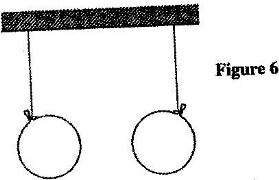 When a stream of air is blown in the space between the balloons, they are observed to move towards each other. Explain this observation
Date posted:
May 15, 2017
-
Figure 6 shows a sheet of paper rolled into a tube
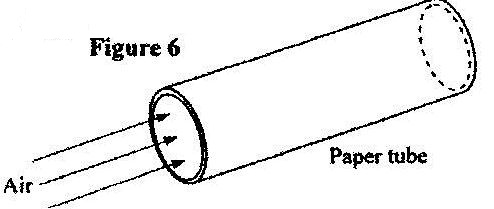 When a fast stream of air is blown into the tube as shown in the diagram the paper tube collapses. Explain the observation.
Date posted:
May 15, 2017
-
Figure 2 shows a tube of varying cross sectional area. V1, V2, V3 and V4 represent the speed of water as it flows steadily through the sections of the tube
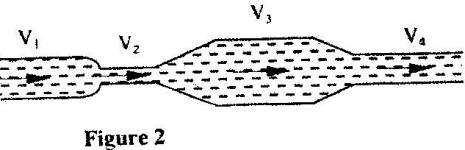 Arrange the speed V1, V2, V3 and V4 in decreasing order starting with the highest
Date posted:
April 19, 2017
-
Figure 19 shows a pith ball placed in a flask. When a jet of air is blown over the mouth of the flask as shown, the pith ball is observed to rise from bottom.
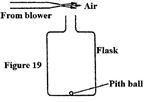 Explain this observation
Date posted:
April 19, 2017
-
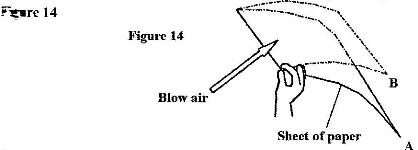
A student holds a sheet of paper at one end so that it hangs in the position A as shown in Figure 14
 If the cross-sectional area A1 at P is less than A2 at Q, state how the liquid velocity V2 at Q compares with velocity V1 at P.
Date posted:
April 19, 2017
-
Figure 1 shows a section of a pipe PQ. A constant pressure difference maintains a streamline flow of a liquid in the pipe.
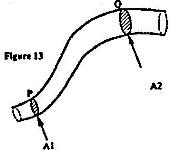 If the cross-section area A1 at P is less than A2 at Q, state how the liquid velocity V2 at Q compares with velocity V1 at P.
Date posted:
April 19, 2017
-
Fig. 9 shows a Bunsen burner.
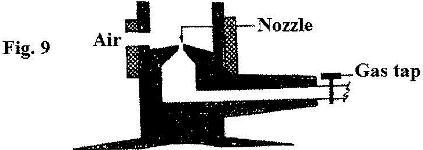 Use Bernoulli's principle to explain how air is drawn into the burner, when, the gas tap is opened.
Date posted:
April 19, 2017
-
Figure 12 shows a displacement - time graph for a progressive wave
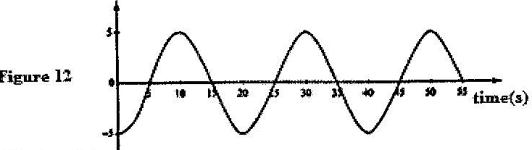 i) State the amplitude of the wave
ii) Determine the frequency of the wave.
i) State the amplitude of the wave
ii) Determine the frequency of the wave.
Date posted:
April 19, 2017
-
Figure 2 shows how the displacement varies with time for a certain wave
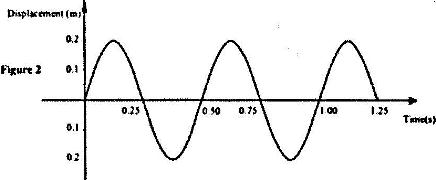 Determine the frequency of the wave.
Date posted:
April 19, 2017
-
Figure 4 shows the displacement - time graph for a certain wave
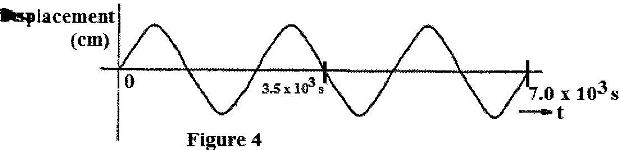 Determine the frequency of the wave
Date posted:
April 19, 2017
-
A long coil is attached to a vibrating blade as shown in Figure

Date posted:
April 19, 2017
-
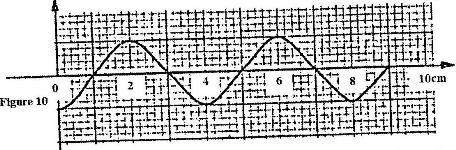
Figure 10 represents a transverse wave of frequency 5 Hz traveling in the X direction. Determine the speed of the wave.
Date posted:
April 19, 2017
-
Figure 5 shows the displacement time graph of a wave travelling at 200 cm/s.
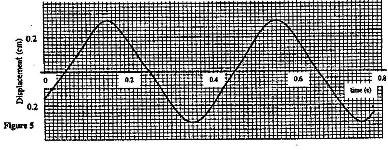 Determine for the wave, the
i) Amplitude
ii) Period
iii) frequency
iv) Wavelength
Determine for the wave, the
i) Amplitude
ii) Period
iii) frequency
iv) Wavelength
Date posted:
April 19, 2017
-
Figure 3 shows a transverse wave traveling along x-axis
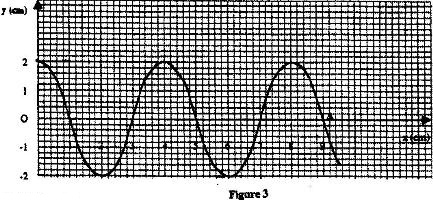 i) Determine the:
I. Wavelength of the wave
II. Amplitude of the wave
ii) If the time taken by the wave to move from O to A is 0.90 seconds, determine the:
I. frequency of the wave
II. Speed of the wave
i) Determine the:
I. Wavelength of the wave
II. Amplitude of the wave
ii) If the time taken by the wave to move from O to A is 0.90 seconds, determine the:
I. frequency of the wave
II. Speed of the wave
Date posted:
April 19, 2017
-
The three springs shown in figure 7 are identical and have negligible weight. The extension produced on the system of springs is 20 cm.
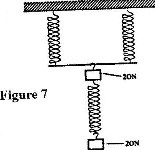 Determine the constant of each spring.
Date posted:
April 19, 2017
-
Table 1 shows the results of an experiment carried out to study the properties of a spring
 State with a reason whether the experiment was done within the elastic limit of the spring.
Date posted:
April 19, 2017
-
Figure 2 shows a spring balance. Its spring constant is 125Nm-1. The scale spreads over a distance of 20 cm.
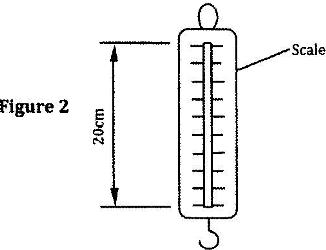 Determine the maximum weight that can be measured using the spring.
Date posted:
April 19, 2017
-
The three springs shown in Figure 5 are identical and have negligible weight. The extension produced on the system of springs is 20 cm.
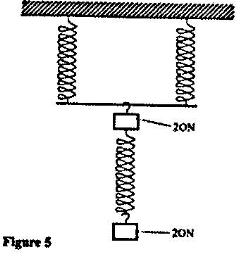 Determine the constant of each spring
Date posted:
April 19, 2017
-
The graph in Fig. 7 represent the relations between extension, e and mass, m added on two springs x and y.
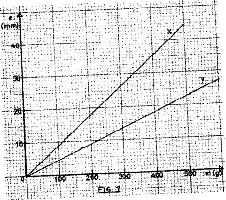 Given that the two springs are made of same materials, give a reason why the graphs are different
Date posted:
April 19, 2017
-
The spiral spring shown in Figure 4 are identical. Each spring has a spring constant k = 300 N/m
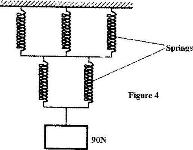 Determine the total extension caused by the 90 N weight. (Ignore the weight of the springs and connecting rods)
Date posted:
April 19, 2017
-
Two identical spring balances R and S each weighing 0.5 N are arranged as shown in Figure 2.
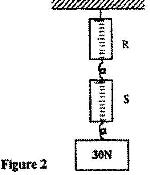 What is the reading on balance R?
Date posted:
April 19, 2017
-
Figure 7 shows a simple electric bell circuit
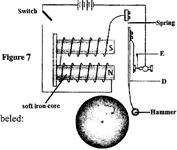 i) Name the parts labeled:
I) D
II) E
ii) When the switch is closed, the hammer hits the gong repeatedly. Explain why?
I) The hammer hits the gong.
II) The hammer hits the gong repeatedly
i) Name the parts labeled:
I) D
II) E
ii) When the switch is closed, the hammer hits the gong repeatedly. Explain why?
I) The hammer hits the gong.
II) The hammer hits the gong repeatedly
Date posted:
April 19, 2017
-
Figure 7 shows two similar coils P and Q around the end L and M of a piece of soft iron. A steady current passes through the coils
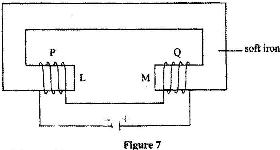 State the polarity of the resulting magnet at point L
Date posted:
April 19, 2017
-
Figure 5, shows a motor connected to a magnetic switch called a relay operated by an ordinary switch S1. Use the information in the figure to answer questions a) and b)
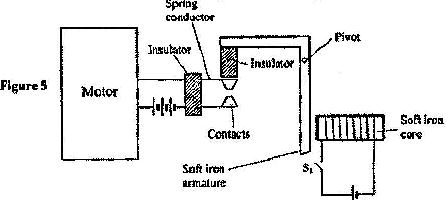 a) Explain how the relay switches on the motor when S1 is closed
b) State with a reason the effect on the motor, if the iron core is replaced with a steel core and switch S1 is put on and then off.
a) Explain how the relay switches on the motor when S1 is closed
b) State with a reason the effect on the motor, if the iron core is replaced with a steel core and switch S1 is put on and then off.
Date posted:
April 19, 2017
-
Figure 3 shows a flat spring made of iron clamped horizontally on the bench over a solenoid.
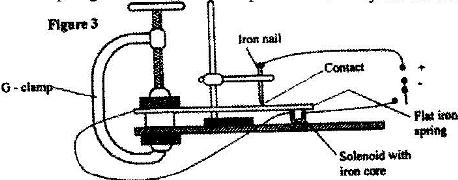 When the switch is closed, the spring vibrates. Explain this observation.
Date posted:
April 19, 2017
-
Figure 8 shows a current-carrying coil in a magnetic field
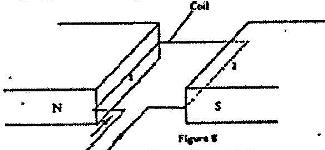 State two ways of increasing the force on the coil
Date posted:
April 19, 2017
-
Figure 8 shows two parallel thick copper conductors connected to a d.c. power supply. A rider made from a thin copper wire is placed on the conductors
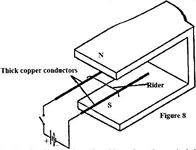 State and explain what is observed on the rider when the switch is closed.
Date posted:
April 19, 2017
-
Figure 2 shows the circuit of a simple telephone receiver. When the telephone is lifted a steady current flows through the solenoids. When a person speaks into the microphone on the other side, a varying current flows. These two currents are shown in Figure 2 (b)
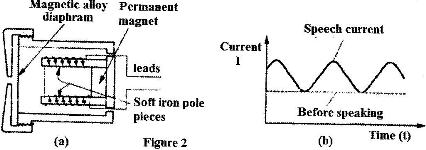 i) State the reason why the solenoids are wound in opposite directions around the soft-iron core pieces as shown.
ii) Explain how the speech current from the microphone is converted into sound in the direction receiver.
iii) State and explain the effect of replacing the soft iron core pieces with steel core pieces
i) State the reason why the solenoids are wound in opposite directions around the soft-iron core pieces as shown.
ii) Explain how the speech current from the microphone is converted into sound in the direction receiver.
iii) State and explain the effect of replacing the soft iron core pieces with steel core pieces
Date posted:
April 19, 2017
-
Figure 16 shows a wire XY at right angles to a magnetic field. XY is part of circuit containing a galvanometer.
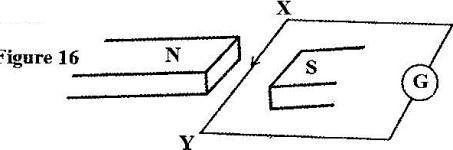 When XY is moved the current flows in the direction shown. State the direction in which XY is moved.
Date posted:
April 19, 2017
-
In the set up in Fig. 5, the suspended metre rule in equilibrium balanced by the magnet and the weight shown. The iron core is fixed to the bench.
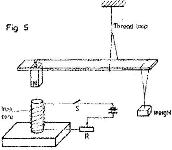 i) State and explain the effect on the metre rule when the switch S, is closed.
ii) What would be the effect of reversing the battery terminals?
iii) Suggest how the set up in figure 5 can be adapted to measure the current flowing in the current circuit.
i) State and explain the effect on the metre rule when the switch S, is closed.
ii) What would be the effect of reversing the battery terminals?
iii) Suggest how the set up in figure 5 can be adapted to measure the current flowing in the current circuit.
Date posted:
April 19, 2017