-
Give a sample cake recipe with Butter icing decoration.
Date posted:
May 16, 2019
-
Give the importance of cake decoration.
Date posted:
May 16, 2019
-
List the qualities of a well made cake.
Date posted:
May 16, 2019
-
a) Explain any four purposes of journal entries in the accounting process
b) Walter Muita, a sole trader, presented the following balance sheet of his business as at 30 June
2005. He asked you to investigate the causes of errors giving rise to the amount in the
suspense account:
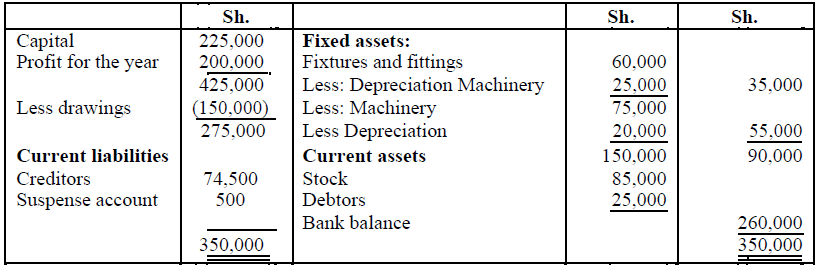 You subsequently discovered the following errors:
1. The purchases day book was undercast by Sh.4,000.
2. A telephone head costing Sh.3,000 was bought and the amount was debited to the repairs account.
3. The telephone head is to be depreciated at the rate of 15% per annum as pari of fixtures
and fittings.
4. An amount of Sh.2,000 was omitted from total debtors.
5. Returns outwards of Sh.500 were erroneously entered in the sales book.
6. A payment of Sh.1,250 to a creditor was correctly entered in the cash book but credited to his
account.
7. Goods valued at Sh.l 0,000 were taken by Walter Muita for his own use and no entry has
been made to this effect.
8. A bad debt of Sh 1,250 had been written off
9. A discount received of Sh4,500 had been correctly recorded in the cash book but had been posted
to the wrong side of the discount received account.
Required:
i) Show the necessary journal entries to correct the errors listed above.
ii) Prepare a statement of adjusted profit (or loss) for the year ended 30 June 2005.
iii) Prepare the corrected balance sheet as at 30 June 2005.
You subsequently discovered the following errors:
1. The purchases day book was undercast by Sh.4,000.
2. A telephone head costing Sh.3,000 was bought and the amount was debited to the repairs account.
3. The telephone head is to be depreciated at the rate of 15% per annum as pari of fixtures
and fittings.
4. An amount of Sh.2,000 was omitted from total debtors.
5. Returns outwards of Sh.500 were erroneously entered in the sales book.
6. A payment of Sh.1,250 to a creditor was correctly entered in the cash book but credited to his
account.
7. Goods valued at Sh.l 0,000 were taken by Walter Muita for his own use and no entry has
been made to this effect.
8. A bad debt of Sh 1,250 had been written off
9. A discount received of Sh4,500 had been correctly recorded in the cash book but had been posted
to the wrong side of the discount received account.
Required:
i) Show the necessary journal entries to correct the errors listed above.
ii) Prepare a statement of adjusted profit (or loss) for the year ended 30 June 2005.
iii) Prepare the corrected balance sheet as at 30 June 2005.
Date posted:
May 16, 2019
-
(a) Briefly explain the following types of errors:
i. Error of commission
ii. Error of principle
iii. Complete reversal of entries
iv. Compensating errors
(b) The trial balance of Amanda Ltd as at 30 April 2004 did not balance. On investigation, the
following errors were discovered:
1. A loan of Sh.2,000,000 from one of the directors has been correctly entered in the cashbook
but posted to the wrong side of the loan account.
2. The purchase of a motor vehicle on credit fro Sh.2,860,000 had been recorded by debiting the
supplier’s account and crediting the motor expenses account.
3. A cheque for Sh.80,000 from Ogola, a customer to whom goods are regularly supplied on
credit, was correctly entered in the cashbook but was posted to the credit of bad debts
recovered account in the mistaken belief that it was a receipt from Agola, a customer whose
debt had been written off three years earlier.
4. In reconciling the company’s cash book with the bank statement, it was found that bank
charges of Sh.38,000 had not been entered in the company’s records.
5. The totals of the cash discount columns in the cashbook for the month of April 2004 had not
been posted to the respective discount accounts.
The figures were:
Sh.
Discounts allowed 184,000
Discounts received 397,000
6. The company had purchased some plant on 1 March 2003 for Sh.1,600,000. The payment was
correctly entered in the cashbook but was debited to the plant repairs account. Depreciation on
such plant is provided for at the rate of 20% per annum on cost.
Required:
(i) Journal entries with narrations to correct the above errors.
(ii) Suspense accounts showing the original difference
Date posted:
May 16, 2019
-
Discuss the types of pastry and pastry products.
Date posted:
May 16, 2019
-
Ben Mogaka prepared the following draft balance sheet for BM Enterprises as at 31 December 2005:
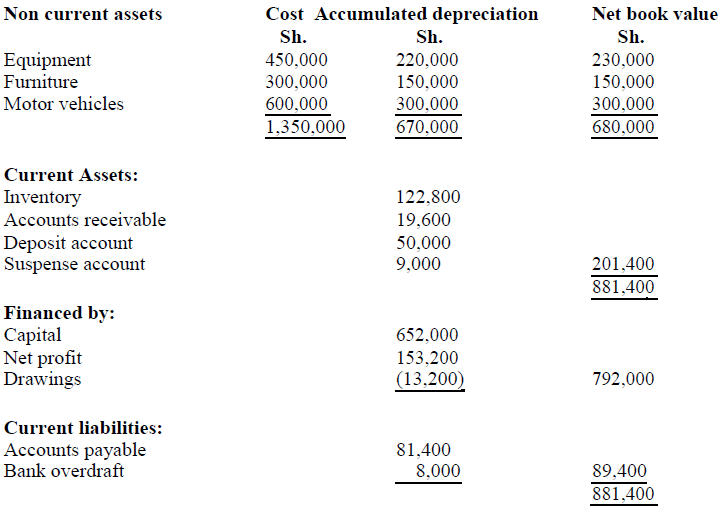 Additional information:
On further investigation, the suspense account was discovered to have resulted from the following
errors:
1. The sales of goods on credit to Alex Otis amounting to Sh.19,000had been recorded in the sales
journal as sh.9,000.
2. A receipt of Sh.20,000 from sale of an item of equipment had been credited to sales account. The
equipment was shown in the books of account at costs of account of Sh.90,000 and accumulated
depreciation of Sh.72,000.
3. A credit note from a supplier, Simon Masound for Sh.15,000 had been omitted from the books.
4. A bank overdraft for Sh.7,000 reflected in the cash book as at 31 December 2005 was omitted In
the trial balance.
5. A payment of Sh. 9,700 to Tom Wambugu, a creditor, was correctly entered in the cahs book but
posted to his personal account as Sh.7,900.
6. The debit side of rent expense account had been undercast by Sh.1,000.
7. A provision of Sh.2,000 for sundry expenses outstanding as at 31 December 2004 and debited to
sundry expenses at that dated had not been brought forward to the credit of the account in the
following period. No credit entry had been made in any other account in respect to this account in
respect to this item.
8. Discount received from the supplier of Sh.8,200 had been entered on the wrong side of purchases
ledger control account.
9. On 31 December, goods valued at Sh.9,600 (selling price) were returned by Jane Kerubo (a
debtor). No entry had been made in the books to reflect this transaction. These goods were not
included in the closing stock.
10. Discounts allowed were overcast by Sh.1,200.
Required:
(a) Journal entries to correct the above errors (Narration not required)
(b) Suspense account.
(c) Statement of corrected net profit for the year ended 31 December 2005
(d) Corrected balance sheet as 31 December 2005.
Additional information:
On further investigation, the suspense account was discovered to have resulted from the following
errors:
1. The sales of goods on credit to Alex Otis amounting to Sh.19,000had been recorded in the sales
journal as sh.9,000.
2. A receipt of Sh.20,000 from sale of an item of equipment had been credited to sales account. The
equipment was shown in the books of account at costs of account of Sh.90,000 and accumulated
depreciation of Sh.72,000.
3. A credit note from a supplier, Simon Masound for Sh.15,000 had been omitted from the books.
4. A bank overdraft for Sh.7,000 reflected in the cash book as at 31 December 2005 was omitted In
the trial balance.
5. A payment of Sh. 9,700 to Tom Wambugu, a creditor, was correctly entered in the cahs book but
posted to his personal account as Sh.7,900.
6. The debit side of rent expense account had been undercast by Sh.1,000.
7. A provision of Sh.2,000 for sundry expenses outstanding as at 31 December 2004 and debited to
sundry expenses at that dated had not been brought forward to the credit of the account in the
following period. No credit entry had been made in any other account in respect to this account in
respect to this item.
8. Discount received from the supplier of Sh.8,200 had been entered on the wrong side of purchases
ledger control account.
9. On 31 December, goods valued at Sh.9,600 (selling price) were returned by Jane Kerubo (a
debtor). No entry had been made in the books to reflect this transaction. These goods were not
included in the closing stock.
10. Discounts allowed were overcast by Sh.1,200.
Required:
(a) Journal entries to correct the above errors (Narration not required)
(b) Suspense account.
(c) Statement of corrected net profit for the year ended 31 December 2005
(d) Corrected balance sheet as 31 December 2005.
Date posted:
May 16, 2019
-
List the methods of presenting fruit dishes.
Date posted:
May 16, 2019
-
List the factors to consider in selecting fruits.
Date posted:
May 16, 2019
-
The trial balance extracted from the books of Benard Masita as at 30 September 2010 failed to
agree. The debit difference of Sh. 442,000 was posted to a suspense account. An income
statement was prepared which showed a gross profit and a net profit of Sh. 1,985,000 and
Sh.1,229,000 respectively. Upon investigations, the following errors were discovered:
1. A purchase of Sh 150,000 on credit was correctly posted to the suppliers account but was
completely omitted from the purchases day book.
2. Sales amounting to Sh. 250,000 to Samuel Njuguna were erroneously credited to his account.
The sales account had been correctly posted.
3. Salaries paid for the month of September 2010 amounting to Sh. 230,000 were recorded in
the salaries account as Sh 320,000.
4. Purchases of office stationery for Sh. 125,000 were erroneously debited to purchases account.
5. A payment of Sh.45,000 to Daniel Olunya, a creditor, was erroneously debited to the account of
Alois Olunya, another creditor.
6. An entry of Sh.21,000 for returns outwards was made in error in the sales day book instead of
in the purchases return day book.
7. A bad debt of Sh 22,500 is yet to be written off.
8. Goods valued at Sh220,000 were taken for personal use but no entry had been made in the
books.
9. A discount received of Sh.59,000 was correctly entered in the cashbook but posted to the
discounts allowed account.
Required:
i) A fully balanced suspense account.
ii) Statement of corrected gross profit.
iii) Statement of corrected net profit.
Date posted:
May 16, 2019
-
List the qualities of salads and salad dressing.
Date posted:
May 16, 2019
-
Pata Transport Limited (PTL) was incorporated on 1 June 2006 and on the same day bought its first
lorry; KB099S for Sh. 9,000,000.
On 1 April 2007, the company bought its second lorry KB 120T FOR Sh 12,000,000.
On 1 June 2008, the company bought a third lorry KB 340X for Sh. 6,000,000.
On 1 October 2008, lorry KB 099S was involved in an accident and was written off. The
insurance compensation paid to PTL by the insurers was Sh. 2,600,000.
On 31 December 2009,lorry KB 340X broke down and was traded in with a new lorry registration KB
419Y valued at Sh. 8,000,000.PTL; paid cash amounting to Sh. 5,400,000 for the lorry.
On 1 Apri12010, a van KB 890B was purchased for Sh 4,800,000.
Depreciation on motor vehicles is to be provided at the rate of 10% per annum on a straight line basis.
The policy of the company is to provide depreciation on a pro rata basis.
On 1 January 2009, the company decided to change its depreciation rate from 10% to 15% per annum.
The change was effected on motor vehicles that were in use retrospectively; that is from the year of
purchase. An adjusting entry was to be made in the accounts for the year ended 31 December 2009.
All lorries were comprehensively insured.
Assume the year end for PTL IS 31 December.
Required:
i) Motor vehicles account for the five years ended 31 December 2006,2007,2008,2009 and 2010.
ii) Provision for depreciation account for the same years stated in (b) (i) above
iii) Disposal of motor vehicles account
Date posted:
May 16, 2019
-
List the qualities of finished vegetable dishes.
Date posted:
May 16, 2019
-
You have just been employed by Best Way Ltd as a trainee accountant. Your first exercise is to
check the transactions in the company’s cash book, check entries in the bank statement, update
the cash book and make any amendments as necessary after which you will prepare a bank
reconciliation statement at the end of the month.
The company’s cash book and bank statement for the month of March 2013 are provided below;-
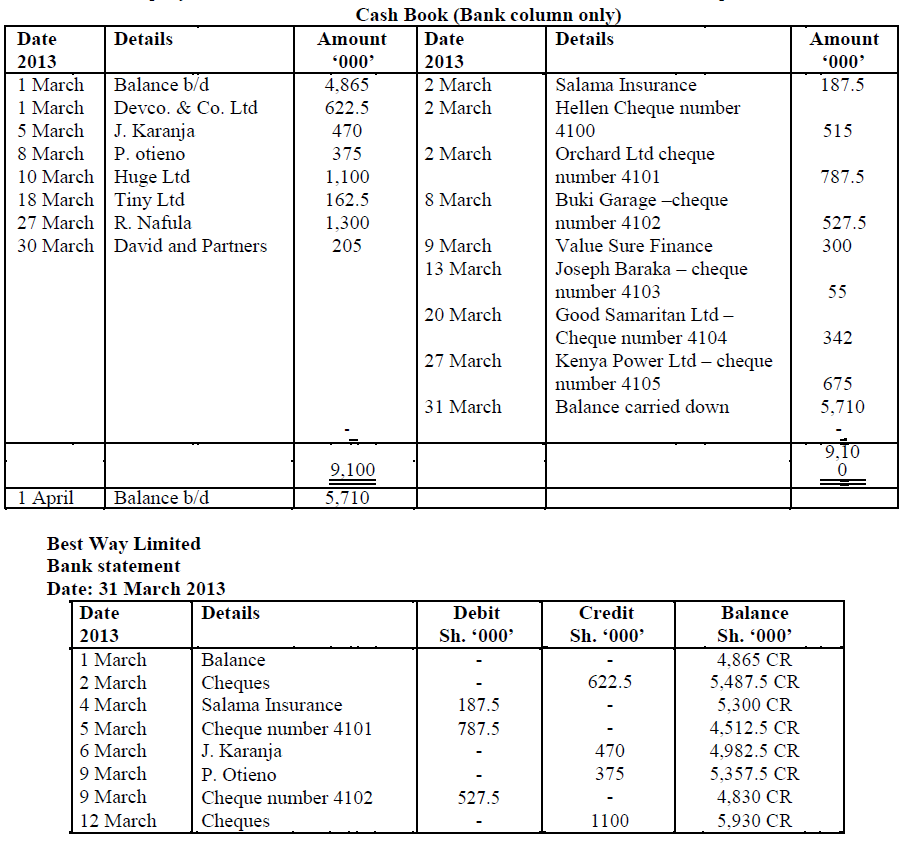
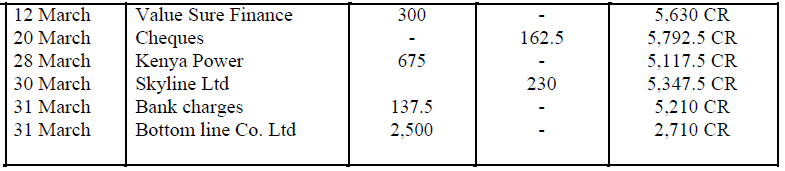 Required;
A bank reconciliation statement as at 31 March 2013
Required;
A bank reconciliation statement as at 31 March 2013
Date posted:
May 16, 2019
-
Factors to consider in selecting a starch food.
Date posted:
May 16, 2019
-
Distinguish between ‘purchased goodwill’ and ‘non-purchased goodwill’
Date posted:
May 16, 2019
-
List the factors to consider when selecting protein food.
Date posted:
May 16, 2019
-
The following balances were extracted from the books of Furahia Enterprises for the month of
September 2013:
Sh.
Debit balance (1 September 2013): Sales ledger 14,280,000
Purchases ledger 1,920,000
Credit balance (1 September 2013): Sales ledger 1,680,000
Purchases ledger 6,720,000
Credit notes received from suppliers 1,860,000
Debt collection expenses 480,000
Interest charged on customers' overdue accounts 384,000
Customers dishonoured cheques 1,260,000
Bad debts written off 720,000
Receipts from customers 1,280,000
Interest charged by creditors on overdue accounts^ 588,000
Payment to creditors 7,680,000
Contra settlements 390,000
Credit notes issued to customers 270,000
Credit sales 17,340,000
Cash sales 3,240,000
Cash purchases 2,160,000
Credit purchases 7,440,000
Discounts, allowed 1,080,000
Discounts received 690,000
Balances as at 30 September 2013:
Sales ledger (credit) 1,110,000
Purchases ledger (debit) 1,050,000
Required;
i) Sales ledger control account for the month ended 30 September 2013.
ii) Purchases ledger control account for the month ended 30 September
Date posted:
May 16, 2019
-
List the general rules when making cold dishes.
Date posted:
May 16, 2019
-
List the types of hors d’oeuvres and starter dishes.
Date posted:
May 16, 2019
-
List the qualities of well made stocks, soups and sauces.
Date posted:
May 16, 2019
-
Give the methods of producing and presenting stocks, soups and sauces.
Date posted:
May 16, 2019
-
The following is a summary of the cash book of Azimio Ltd. for the year ended 31 May 2014:
 Subsequent investigations reveal that:
1. A page of the receipt side of the cash book has been under cast by Sh.200, 000.
2. The following transactions appearing on the bank statement have not yet been entered in the cash
book:
- Dividend received on a trade investment Sh.1, 147,000.
- Hire purchase repayments for 12 months at Sh.55, 000 per month.
- Interest for the half year to 30 November 2014 on a loan of Sh.20, 000,000 at 11 percent per
annum.
3. Bank charges of Sh. 143,000 shown on the bank statement have not yet been entered in the cash
book.
4. A cheque received from a customer for Sh.180, 000 was returned by the bank unpaid and no entry
has been made in the cash book for this transaction.
5. The company owes Sh.430, 000 for electricity consumed in the month of May 2014.
6. A cheque for Sh.82, 000 has been debited to the company's account in error by the bank.
7. A cheque drawn for Sh.98, 000 has been entered in the cash book as Sh.89, 000 and another
one-drawn for Sh.230, 000 has been entered as a receipt.
8. A transposition error occurred in the opening balance of the cash book. The opening
balance should have been brought down as Sh.850, 000 instead of Sh.805, 000.
9. Cheques paid to suppliers totalling Sh.630, 000 have not yet been presented at the bank, while
deposits totaling Sh.580, 000 made on 31 May 2014 have not yet been credited to the company's
account.
10. The balance as per the bank statement is an overdraft of Sh.870, 000.
Required:
(i) Adjusted cash book balance.
(ii) Bank reconciliation statement as at 31 May 2014.
Subsequent investigations reveal that:
1. A page of the receipt side of the cash book has been under cast by Sh.200, 000.
2. The following transactions appearing on the bank statement have not yet been entered in the cash
book:
- Dividend received on a trade investment Sh.1, 147,000.
- Hire purchase repayments for 12 months at Sh.55, 000 per month.
- Interest for the half year to 30 November 2014 on a loan of Sh.20, 000,000 at 11 percent per
annum.
3. Bank charges of Sh. 143,000 shown on the bank statement have not yet been entered in the cash
book.
4. A cheque received from a customer for Sh.180, 000 was returned by the bank unpaid and no entry
has been made in the cash book for this transaction.
5. The company owes Sh.430, 000 for electricity consumed in the month of May 2014.
6. A cheque for Sh.82, 000 has been debited to the company's account in error by the bank.
7. A cheque drawn for Sh.98, 000 has been entered in the cash book as Sh.89, 000 and another
one-drawn for Sh.230, 000 has been entered as a receipt.
8. A transposition error occurred in the opening balance of the cash book. The opening
balance should have been brought down as Sh.850, 000 instead of Sh.805, 000.
9. Cheques paid to suppliers totalling Sh.630, 000 have not yet been presented at the bank, while
deposits totaling Sh.580, 000 made on 31 May 2014 have not yet been credited to the company's
account.
10. The balance as per the bank statement is an overdraft of Sh.870, 000.
Required:
(i) Adjusted cash book balance.
(ii) Bank reconciliation statement as at 31 May 2014.
Date posted:
May 16, 2019
-
List the factors to consider when holding and storing different dishes.
Date posted:
May 16, 2019
-
List the preparation methods for food commodities.
Date posted:
May 16, 2019
-
List the factors to consider when selecting cooking methods.
Date posted:
May 16, 2019
-
List the sources of fuel and energy used in catering establishments.
Date posted:
May 16, 2019
-
List the safety requirements in catering premises.
Date posted:
May 16, 2019
-
Outline examples of staff structures for different establishments.
Date posted:
May 16, 2019
-
Give five reasons why counselling and testing for HIV and AIDS is important.
Date posted:
May 16, 2019